Public Administration Optional for UPSC Civil Services Exam
Master the Public Administration Optional for the UPSC IAS Mains exam under the expert guidance of Abhishek Sir (M.A. Public Administration). This comprehensive online coaching program is strategically designed to help you secure a top score through high-yield video lectures, interactive answer writing, and personalized mentorship.
The details of the program are as follows;
- Mode of delivery: recorded lectures + live answer writing sessions
- Duration: 3 months approx.
- Fee: 50,000/
- Detailed syllabus: http://civilservicesonline.com/public-administration-optional-syllabus/
- For admissions call/WhatsApp: 9888016531
- Live online batch- lecture recordings are made available progressively.
- Press the curriculum button to watch free demo lectures.
Why Choose Public Administration as Your UPSC Optional?
Public Administration consistently ranks among the top 5 most popular optional subjects for the Civil Services Examination due to its concise syllabus, high-scoring potential, and massive structural overlap with the General Studies (GS) papers and the Essay paper.
The GS & Essay Overlap Advantage
By preparing for this 500-mark Optional subject, you simultaneously cover a major chunk of your General Studies syllabus, saving hundreds of hours of preparation time:
| Exam Paper | Core Overlap Topics | Estimated Marks Contribution |
| GS Paper II | Polity, Constitution, Governance, and Indian Administration | 120 – 150 Marks |
| GS Paper III | Social & Economic Development, Security Issues, and Disaster Management | 70 – 90 Marks |
| GS Paper IV | Core Administrative Ethics, Integrity, Aptitude, and Governance Case Studies | 150 – 180 Marks (Approx. 40%) |
| Essay Paper | At least one philosophical or administrative essay theme aligns with the syllabus | 125 Marks |
The High-Scoring Pub Ad Answer Template
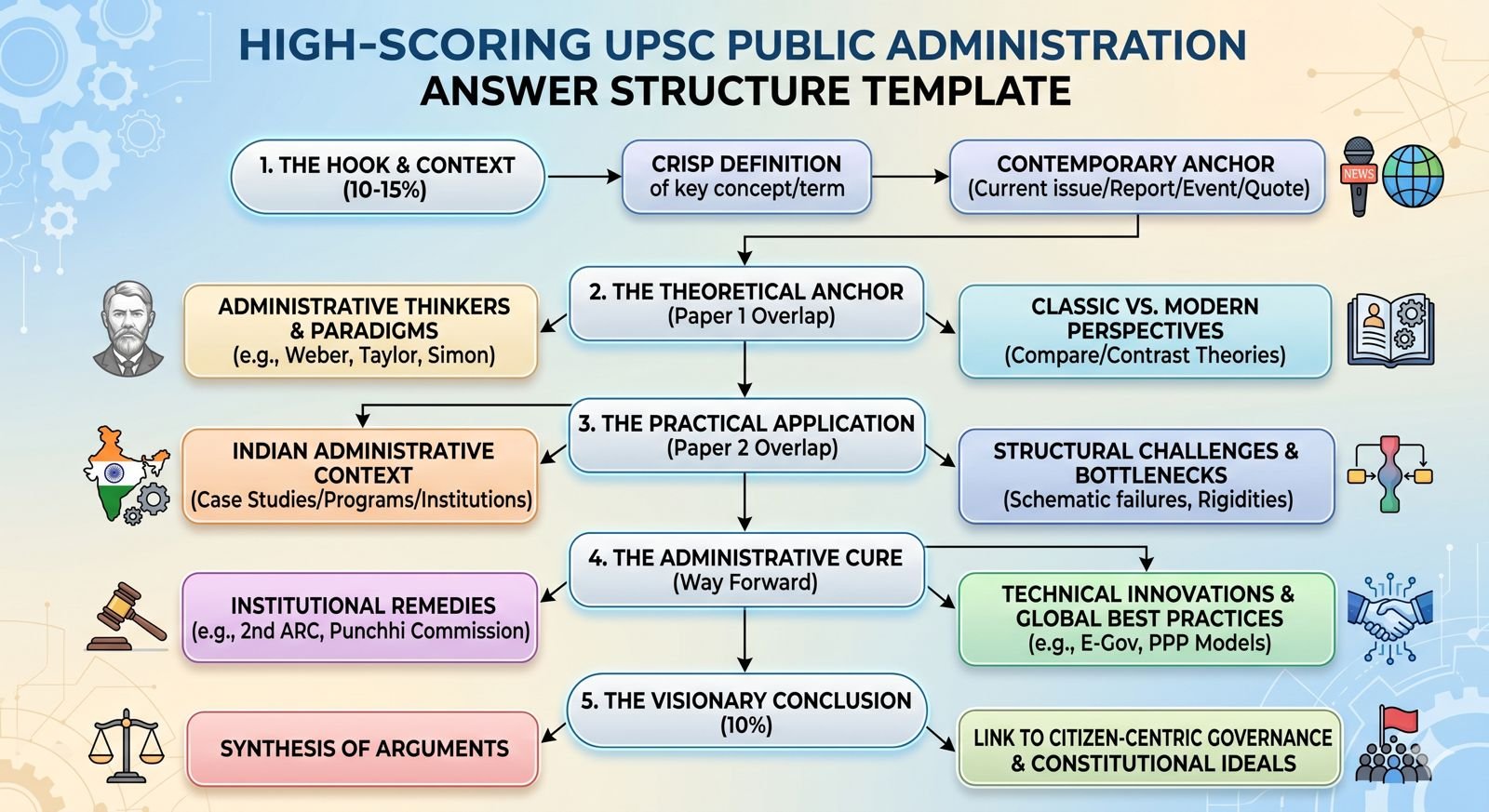
5-Step Breakdown of the Template
1. The Hook & Context (10–15% of space)
-
What to do: Start directly with a crisp definition of the core structural concept (e.g., Delegated Legislation, Performance Budgeting, or Lateral Entry).
-
The Topper’s Edge: Immediately anchor it to a current event. If the question is on Disaster Management, mention a recent climate event or the NDMA’s latest guidelines right in the introduction.
2. The Theoretical Anchor (Paper 1 Element)
-
What to do: Analyze the core issue using administrative theories and thinkers.
-
How to apply:
-
If discussing rigidity in bureaucracy, invoke Max Weber’s “ideal type” or Robert Merton’s “bureaucratic trained incapacity.”
-
If discussing organizational communication, bring in Chester Barnard’s zone of indifference or Chris Argyris’ double-loop learning.
-
3. The Practical Application (Paper 2 Overlap)
-
What to do: Pivot to the Indian landscape. Explain the challenges, bottlenecks, or structural issues plaguing the concept in real-world governance.
-
The Topper’s Edge: Use structural diagrams or flowcharts here to save time and words while mapping out institutional relationships (e.g., Center-State Financial Relations flow).
4. The Administrative Cure (Way Forward)
-
What to do: Never leave an answer at a critique. Provide an actionable, institutional remedy.
-
How to apply: Quote specific institutional bodies. Don’t say “the government should reduce corruption.” Say:
“As recommended by the 2nd Administrative Reforms Commission (ARC-2) in its 4th Report on ‘Ethics in Governance’…” or quote the NITI Aayog Three-Year Action Agenda.
5. The Visionary Conclusion (10% of space)
-
What to do: Conclude on a positive, forward-looking note that links the administrative mechanism back to its ultimate goal: Citizen-Centric Governance, Good Governance (Montek Singh Ahluwalia’s metrics), or Democratic Decentralization.
A Quick Example of the Template in Action
Question: “The traditional Weberian model of bureaucracy has outlived its utility in an era of New Public Management (NPM).” Critically evaluate.
-
Introduction: Define Weberian bureaucracy (heirarchy, rules) and note the shift toward NPM (efficiency, market orientation, citizen as consumer).
-
Theory (Paper 1): Contrast Max Weber with Woodrow Wilson or Warren Bennis’ “Death of Bureaucracy.” Bring in the Public Choice Approach (Niskanen’s budget-maximizing bureaucrat) to show why the traditional model is criticized.
-
Indian Reality (Paper 2): Connect this to Indian Civil Services. Cite issues like generalist vs. specialist conflict or rigid red tape slowing down digital public infrastructure rollouts.
-
Solution/Way Forward: Cite the Hota Committee or 2nd ARC recommendations on civil service reforms, advocating for a hybrid model—retaining Weberian structural integrity for stability, while injecting NPM’s performance metrics and agility.
-
Conclusion: Conclude with how a balanced administrative structure is essential for realizing an inclusive, welfare-driven state under the Indian Constitution.
Detailed syllabus for Public Administration optional for UPSC
PAPER-1
1. Introduction:
Meaning, scope, and significance of Public Administration; Wilson’s vision of Public Administration; Evolution of the discipline and its present status; New Public Administration; Public Choice approach; Challenges of liberalization, Privatisation, Globalisation; Good Governance: concept and application; New Public Management.
2. Administrative Thought:
Scientific Management and Scientific Management movement; Classical Theory; Weber’s bureaucratic model– its critique and post-Weberian Developments; Dynamic Administration (Mary Parker Follett); Human Relations School (Elton Mayo and others); Functions of the Executive (C.I. Barnard); Simon’s decision-making theory; Participative Management (R. Likert, C. Argyris, D. McGregor).
3. Administrative Behaviour:
Process and techniques of decision-making; Communication; Morale; Motivation Theories – content, process and contemporary; Theories of Leadership: Traditional and Modern.
4. Organisations:
Theories – systems, contingency; Structure and forms: Ministries and Departments, Corporations, Companies, Boards and Commissions; Ad hoc and advisory bodies; Headquarters and Field relationships; Regulatory Authorities; Public-Private Partnerships.
5. Accountability and control:
Concepts of accountability and control; Legislative, Executive, and Judicial control over administration; Citizen and Administration; Role of media, interest groups, voluntary organizations; Civil society; Citizen’s Charters; Right to Information; Social audit.
6. Administrative Law:
Meaning, scope, and significance; Dicey on Administrative law; Delegated legislation; Administrative Tribunals.
7. Comparative Public Administration:Historical and sociological factors affecting administrative systems; Administration and politics in different countries; Current status of Comparative Public Administration; Ecology and administration; Riggsian models and their critique.
8. Development Dynamics:
Concept of development; Changing profile of development administration; ‘Anti development thesis’; Bureaucracy and development; Strong state versus the market debate; Impact of liberalization on administration in developing countries; Women and development – the self-help group movement.
9. Personnel Administration:
Importance of human resource development; Recruitment, training, career advancement, position classification, discipline, performance appraisal, promotion, pay and service conditions; employer-employee relations, grievance redressal mechanism; Code of conduct; Administrative ethics.
10. Public Policy:
Models of policy-making and their critique; Processes of conceptualization, planning, implementation, monitoring, evaluation, and review, and their limitations; State theories and public policy formulation.
11. Techniques of Administrative Improvement:
Organization and methods, Work study and work management; e-governance and information technology; Management aid tools like network analysis, MIS, PERT, and CPM.
12. Financial Administration:
Monetary and fiscal policies; Public borrowings and public debt Budgets – types and forms; Budgetary process; Financial accountability; Accounts and audit.
PAPER-2
1. Evolution of Indian Administration:
Kautilya’s Arthashastra; Mughal administration; Legacy of British rule in politics and administration – Indianization of public services, revenue administration, district administration, local self-government.
2. Philosophical and Constitutional framework of government:
Salient features and value premises; Constitutionalism; Political culture; Bureaucracy and democracy; Bureaucracy and development.
3. Public Sector Undertakings:
The public sector in modern India; Forms of Public Sector Undertakings; Problems of autonomy, accountability and control; Impact of liberalization and privatization.
4. Union Government and Administration:
Executive, Parliament, Judiciary – structure, functions, work processes; Recent trends; Intra-governmental relations; Cabinet Secretariat; Prime Minister’s Office; Central Secretariat; Ministries and Departments; Boards; Commissions; Attached offices; Field organizations.
5. Plans and Priorities:
Machinery of planning; Role, composition, and functions of the Planning Commission and the National Development Council; ‘Indicative’ planning; Process of plan formulation at Union and State levels; Constitutional Amendments (1992) and decentralized planning for economic development and social justice
6. State Government and Administration:
Union-State administrative, legislative, and financial relations; Role of the Finance Commission; Governor; Chief Minister; Council of Ministers; Chief Secretary; State Secretariat; Directorates.
7. District Administration since Independence:
Changing role of the Collector; Union-state-local relations; Imperatives of development management and law and order administration; District administration and democratic decentralization.
8. Civil Services:
Constitutional position; Structure, recruitment, training, and capacity-building; Good governance initiatives; Code of conduct and discipline; Staff associations; Political rights; Grievance redressal mechanism; Civil service neutrality; Civil service activism.
9. Financial Management:
Budget as a political instrument; Parliamentary control of public expenditure; Role of finance ministry in the monetary and fiscal area; Accounting techniques; Audit; Role of Controller General of Accounts and Comptroller and Auditor General of India.
10. Administrative Reforms since Independence:
Major concerns; Important Committees and Commissions; Reforms in financial management and human resource development; Problems of implementation.
11. Rural Development:
Institutions and agencies since independence; Rural development programs: foci and strategies; Decentralization and Panchayati Raj; 73rd Constitutional amendment.
12. Urban Local Government:
Municipal governance: main features, structures, finance, and problem areas; 74th Constitutional Amendment; Global-local debate; New localism; Development dynamics, politics and administration with special reference to city management.
13. Law and Order Administration:
British legacy; National Police Commission; Investigative agencies; Role of central and state agencies including paramilitary forces in maintenance of law and order and countering insurgency and terrorism; Criminalisation of politics and administration; Police-public relations; Reforms in Police.
14. Significant issues in Indian Administration:
Values in public service; Regulatory Commissions; National Human Rights Commission; Problems of administration in coalition regimes; Citizen-administration interface; Corruption and administration; Disaster management.
Credits: upsc.gov.in
Curriculum
- 2 Sections
- 87 Lessons
- Lifetime
- Paper -1: Administrative Theory53 ItemsUPSC optional subject paper-1 for Public Administration
- 1.1Introduction to Public Administration- What and How to study?
- 1.2Unit 1- Administrative Thought: F.W. Taylor and Scientific Management Movement
- 1.3Classical Management- Henri Fayol, Luther Gulick and Lyndall Urwick
- 1.4Max Weber Bureaucracy part -1
- 1.5Max Weber Bureaucracy part-2
- 1.6Mary Parker Follett
- 1.7Elton Mayo- The Human Relations Approach
- 1.8Chester Barnard- Behavioral Approach
- 1.9Herbert Simon- Behavioral Approach
- 1.10Douglas McGregor & Rensis Likert- Participative Management Approach
- 1.11Chris Argyris
- 1.12Unit 2 Administrative Behavior- Motivation Theories
- 1.13Leadership Theories
- 1.14Decision Making Theories
- 1.15Unit 3 Organizational Theory- Systems + Middle range theories
- 1.16Organizational Structures and Organizational types
- 1.17Unit 4 Introduction to Public Administration- Definition, Scope and Nature
- 1.18Nature of Public Administration [part 2]+ Woodrow Wilson
- 1.19Politics- Administration Dichotomy debate+ Public Choice Approach
- 1.20New Public Management
- 1.21Good Governance + New Public Administration
- 1.22New Public Services Approach + Evolution of Public Administration
- 1.23Nicholas Henry Paradigms+ Post-Weberian developments
- 1.24Unit 5 Comparative Public Administration- Nature, Significance and Evolution
- 1.25Fred W Riggs- Theory of Prismatic Society
- 1.26Ecology and Administration
- 1.27Ecology and Administration [contd.] + Types of Politico-Administrative structures
- 1.28Impact of liberalization, privatization and globalization on administration
- 1.29Unit 6- Development Administration- Definition, scope and evolution
- 1.30Strong state vs market debate, Anti-development thesis
- 1.31Bureaucracy-Democracy Debate
- 1.32Women and Development
- 1.33Self Help Groups, Civil Society and Role of Media
- 1.34Unit-7 Personnel Administration
- 1.35Budget 2022-23 live session
- 1.36Unit-8 Public Policy- Definition, nature, types, scope and Public policy process
- 1.37Models of public policy 3rd and 4th Feb
- 1.38Economic Survey 2022 Chapter 1 and 2 [Useful for Public Policy and Financial administration]
- 1.39Economic Survey 2022 Chapters 3 and 4
- 1.40Economic Survey 2022 Chapters 5 and 6
- 1.41Economic Survey 2022 Chapter 7
- 1.42Unit 9- Accountability and Control- Definition, types, parliamentary & judicial control over administration
- 1.43Executive control over administration, Citizens Charter and Civil Society-administrative accountability
- 1.44Social Audit, Right to Information, Interest Group
- 1.45Unit 10- Administrative Law- introduction, rule of law
- 1.46Delegated legislation
- 1.47Administrative Adjudication
- 1.48Unit 11- Techniques of Administrative improvement- O&M, Work Measurement
- 1.49E-governance, CPM, and PERT
- 1.50Extra Inputs for Public Policy- Planning In India
- 1.51Unit 12- Financial Administration- MONETARY POLICY, FISCAL POLICY AND PUBLIC DEBT
- 1.52Budget , budgetary process and types of budget
- 1.53ZBB, audit and accounting
- Paper 2- Indian Administration34 Items
- 2.1Unit-1 : Evolution of Indian Administration part 1
- 2.2Mughal Administration+ British Administration
- 2.3Unit-2 : Philosophical and Constitutional framework of government part 1
- 2.4Philosophical and Constitutional framework of government part 2
- 2.5Philosophical and Constitutional framework of government part 3
- 2.6Unit-3 : Public Sector Undertakings part 1
- 2.7Public Sector Undertakings part 2
- 2.8Unit-4 : Union Government and Administration part 1
- 2.9Union Government and Administration part 2
- 2.10Union Government and Administration part 3
- 2.11Union Government and Administration part 4
- 2.12Union Government and Administration part 5
- 2.13Union Government and Administration part 6
- 2.14Unit 5 Plans and Priorities part 1
- 2.15Unit 5 Plan and Priorities part 2 + Unit 6 State Government and Administration
- 2.16State Government and Administration part 2
- 2.17State Government and Administration part 3
- 2.18Unit-6 District Administration since Independence
- 2.19District Administration since Independence part 2
- 2.20Unit-7 Administrative reforms since independence
- 2.21Administrative reforms since independence part 2
- 2.22Unit-8 Rural Development
- 2.23Rural Development part 2
- 2.24Rural Development part 3
- 2.25Unit-9 Urban Local Government
- 2.26Urban Local Government part 2
- 2.27Urban Local Government part 3
- 2.28Unit 10- Law and Order Administration
- 2.29Law and Order Administration part 2
- 2.30Law and Order Administration part 3
- 2.31Unit-11 Significant issues in Indian Administration
- 2.32Significant issues in Indian Administration part 2
- 2.33Significant issues in Indian Administration part 3
- 2.34Unit-12 Civil Services
