GEOMORPHOLOGY
CURRENT UPDATE
Recent scientific discoveries in late 2025 and early 2026 have fundamentally changed our understanding of what is happening deep beneath our feet. For decades, the Earth’s internal structure was viewed as a set of relatively stable layers, but new data reveals a highly dynamic, almost fluid-like solid core and a mantle that actively steers our magnetic field.
Here are the most significant recent breakthroughs regarding Earth’s internal structure:
1. The Inner Core is in a “Superionic” State
Historically, the inner core was understood to be a solid ball of iron and nickel, kept rigid by extreme pressure despite temperatures matching the surface of the Sun (over 5,000°C).
However, a major study recently published by researchers from Sichuan University revealed that the inner core actually exists in a superionic state. Using dynamic shock compression to recreate core-level pressures (up to 140 gigapascals), scientists discovered that light elements—specifically carbon atoms—flow freely through a stable, solid iron lattice, almost like a liquid.
- Why it matters: This highly mobile movement of carbon atoms makes the inner core much softer and less rigid than previously thought. It perfectly explains decades-old seismic anomalies where shear waves slowed down unexpectedly when passing through the core, and it introduces a brand new energy source that helps power Earth’s geodynamo.
2. Deep-Mantle “Blobs” Control the Magnetic Field
We have long known that the swirling liquid iron in the outer core generates Earth’s magnetic field. But new research published in Nature Geoscience in February 2026 by the Universities of Liverpool and Leeds proves that the mantle is actually pulling the strings.
Two massive, super-hot rock formations located at the core-mantle boundary—known as Large Low-Shear-Velocity Provinces (LLSVPs), sitting beneath Africa and the Pacific Ocean—are actively dictating how the magnetic field behaves.
- The Mechanism: These giant formations create sharp thermal contrasts. Beneath the hotter LLSVPs, the liquid iron in the outer core becomes sluggish and stagnates. Beneath cooler regions of the mantle, the iron flows vigorously.
- Why it matters: This uneven heat flow explains why our magnetic field fluctuates and occasionally reverses over hundreds of millions of years. It overturns the long-held assumption that the planet’s average magnetic field acts like a perfectly aligned bar magnet.
3. The Inner Core Boundary is Deforming
Building on studies from 2024 that showed the inner core’s rotation slowing or shifting relative to the mantle, follow-up research has indicated that the boundary between the solid inner core and the liquid outer core is actively deforming.
- Why it matters: Seismic data suggests that as iron freezes and melts at this extreme boundary, the near-surface of the inner core may be developing localized “bulges.” Rather than a frozen, static sphere, the inner core is an actively evolving structure.
EARTHQUAKES
Just as our understanding of the deep Earth has shifted, the last few months have brought massive breakthroughs in how we track and model the violent movement of its crust. Driven by advanced AI, satellite arrays, and unprecedented direct observations, seismology has made major leaps in early 2026.
Here are the most significant recent discoveries regarding earthquakes and fault mechanics:
1. First Real-Time Footage of a Fault Rupture
For decades, seismologists have relied on indirect seismic recordings to estimate how fast the ground moves during a strike-slip earthquake (where two plates slide past each other horizontally).
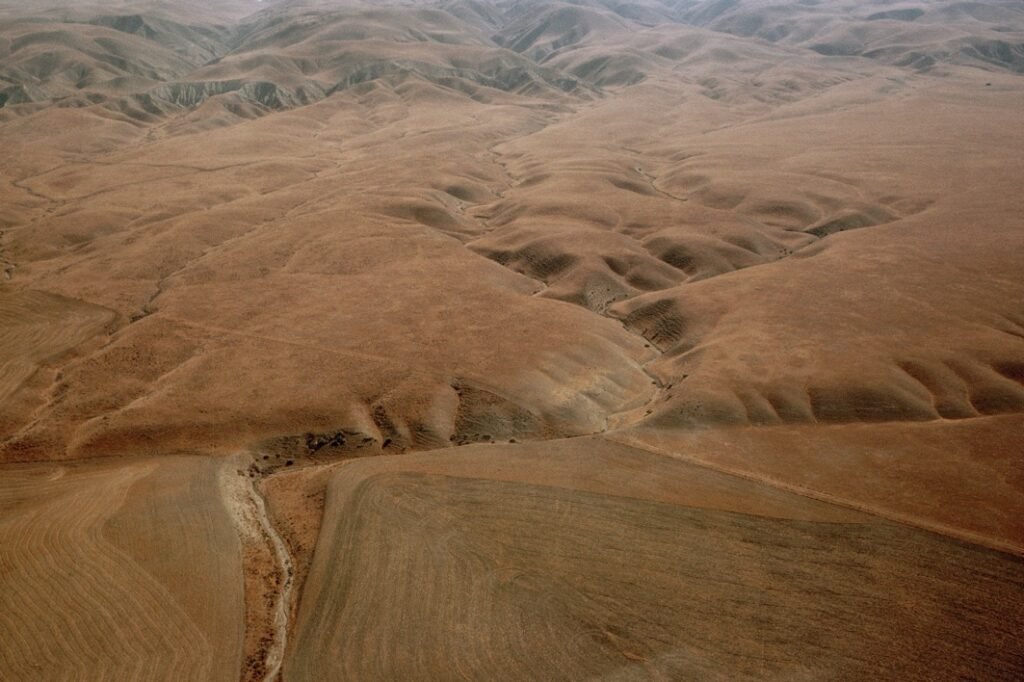
A study published in March 2026 by Kyoto University changed that. During a devastating Magnitude 7.7 earthquake on the Sagaing Fault in Myanmar, a nearby CCTV camera captured the actual fault line tearing open in real time.
- The Discovery: Frame-by-frame analysis revealed the ground shifted 2.5 meters in just 1.3 seconds (reaching a top speed of 3.2 m/s).
- Why it matters: It provides the first direct visual proof of a “pulse-like rupture”—a concentrated burst of movement that travels down a fault like a ripple flicked through a rug. It also revealed the fault slipped in a curved path, challenging the long-held assumption that these crustal fractures tear in perfectly straight lines.
2. 3D Electromagnetic Mapping of “Invisible” Faults
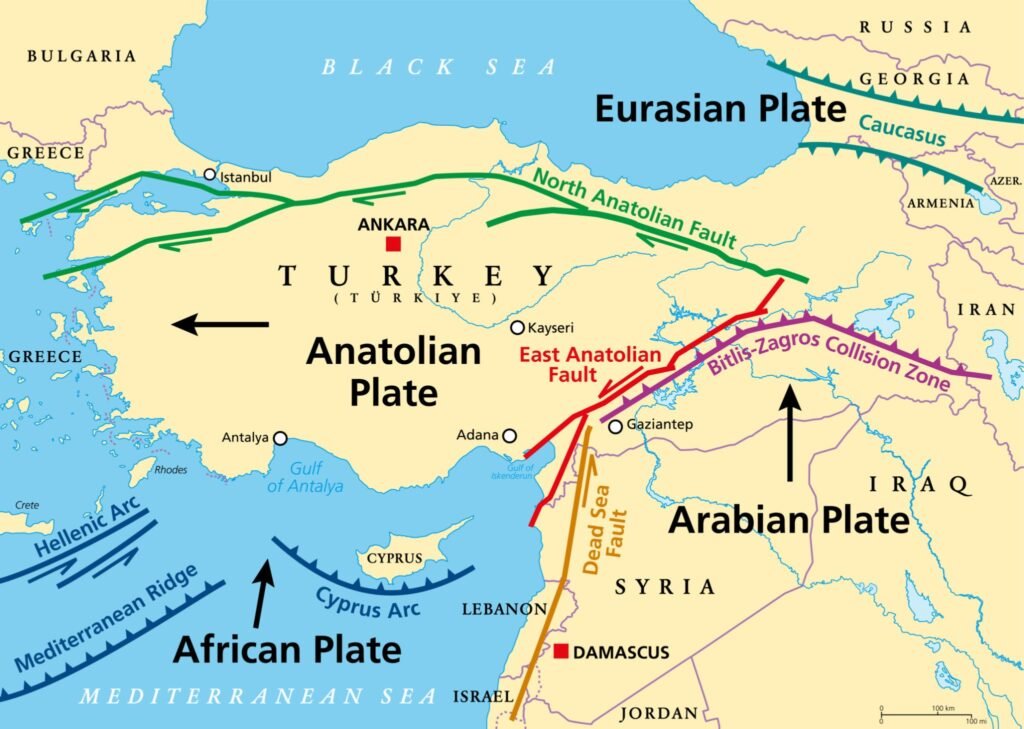
The North Anatolian Fault in Türkiye is one of the most dangerous seismic zones on the planet, with destructive quakes historically marching westward toward the heavily populated Istanbul region. However, the exact structure of the fault beneath the Marmara Sea has remained a mystery.
In February 2026, researchers successfully built the first full 3D model of this underwater fault system—but rather than using seismic waves, they used magnetotelluric measurements.
- The Discovery: By measuring subtle changes in the Earth’s electric and magnetic fields, scientists mapped the electrical resistivity of the crust tens of kilometers deep.
- Why it matters: Low-resistivity zones indicate fluid and mechanical weakness, while high-resistivity zones are strong and rigidly “locked.” By mapping exactly where the locked and weak zones meet beneath the sea, scientists can now pinpoint precisely where stress is accumulating and where the next major rupture is most likely to begin.
3. Detecting Tsunamis from the Ionosphere
When a massive earthquake displaces the ocean floor, it doesn’t just push water—it displaces a massive column of air that ripples all the way up to the edge of space.
NASA has recently deployed an AI-supported experimental hazard scout called GUARDIAN (GNSS Upper Atmospheric Real-time Disaster Information and Alert Network).
- The Discovery: GUARDIAN monitors continuous signals from global GPS satellites. When an earthquake triggers a tsunami, the atmospheric pressure wave creates slight distortions in the ionosphere that disrupt these GPS signals.
- Why it matters: Testing the system on the massive Magnitude 8.8 Kamchatka subduction earthquake, GUARDIAN’s AI detected the anomaly within eight minutes. It successfully flagged the incoming tsunami over a half-hour before traditional deep-ocean pressure sensors confirmed the wave, offering a massive leap forward in early warning capabilities.
RECENT EARTHQUAKE RELATED PROGRAMMES IN INDIA
The landscape of disaster management and seismic policy in India has seen significant turbulence and technological advancement between late 2025 and early 2026. For anyone analyzing policy shifts or studying infrastructure frameworks—especially for competitive exams—these recent developments are critical.
Here are the most notable recent earthquake-related programs and policy shifts in India:
1. The 2025 Seismic Code Revision (and 2026 Rollback)
In a major policy move, the Bureau of Indian Standards (BIS) released a radically updated seismic zonation map in November 2025 under the Revised Earthquake Design Code (IS 1893: 2025).
- The initial change: It introduced a new, highest-risk Zone VI, placing the entire Himalayan arc—from Jammu & Kashmir through Punjab’s northern foothills down to Arunachal Pradesh—under the strictest structural safety norms. It also mandated that towns on the boundary of two zones automatically default to the higher risk.
- The 2026 Rollback: In March 2026, the government formally withdrew this revised code after severe backlash from infrastructure agencies and metro rail corporations. The strict new parameters (which raised peak ground acceleration values) threatened to escalate construction costs by 10–15% for residential buildings and up to 50% for major infrastructure like dams.
- Current status: India has temporarily reverted to the older IS 1893: 2016 framework, which divides the country into four zones (II, III, IV, and V), keeping 59% of the landmass under moderate to high risk.
2. Massive Expansion of the National Seismological Network
To shift from reactive disaster response to proactive mitigation, the National Disaster Management Authority (NDMA) announced a major infrastructure upgrade in March 2026.
- The hardware: India is installing 1,200 new seismometers across the country, increasing the current density of monitoring stations five-fold.
- The objective: This dense network is designed to detect fast-moving, non-destructive Primary waves (P-waves) within seconds of a rupture. By processing these instantly, the system aims to issue automated alerts up to 45 seconds before the slower, highly destructive Secondary waves (S-waves) hit populated areas, approaching the gold-standard lead times seen in Japan.
3. The SACHET Portal and CAP Integration
Disseminating an early warning is just as difficult as detecting the quake. To solve this, the NDMA has fully rolled out the Common Alerting Protocol (CAP) through the SACHET (National Disaster Alert) platform.
- How it works: Instead of relying solely on SMS, SACHET uses geo-intelligence to blast localized, multilingual alerts across all media simultaneously—including mobile notifications, TV broadcasts, and radio. If an earthquake triggers in the Himalayas, the system automatically geofences the threatened radius and alerts only the districts directly in the path of the seismic waves, preventing nationwide panic while ensuring immediate local action.
4. Earthquake Disaster Risk Index (EDRI) Phase II
Under the umbrella PRITHVI scheme, the government is expanding its microzonation and risk-mapping efforts.
- Following the completion of Phase I, which mapped 50 high-risk cities, Phase II of the EDRI is currently targeting 16 additional urban centers. This project integrates geological hazard data with Population Exposure Mapping and Analysis (PEMA)—meaning it calculates risk not just by fault lines, but by population density, building types, and socioeconomic vulnerability.
Q. How do the recent rollbacks of the 2025 Seismic Code and the expansion of the SACHET system specifically impact infrastructure planning and civil administration in North Indian states like Punjab and Haryana?
The recent turbulence in seismic policy—specifically the withdrawal of the strict IS 1893:2025 code and the operationalization of the SACHET portal—creates a complex environment for infrastructure planning and civil administration in North-Western states like Punjab and Haryana.
Because these states straddle the boundary between the highly active Himalayan thrust faults and the relatively stable Peninsular shield, administrative strategies must carefully balance rapid economic expansion with disaster resilience. Here is a detailed breakdown of how these policy shifts impact state governance and development.
Impact of the IS 1893:2025 Rollback
The reversion to the 2016 seismic framework directly impacts urban development authorities, particularly in high-growth corridors like the Tricity region (Chandigarh, Mohali, Panchkula) and the National Capital Region (Gurugram, Faridabad).
- Cost Control vs. Structural Vulnerability: The 2025 code would have forced regions adjacent to the Himalayas (such as Pathankot, Gurdaspur, and Panchkula) to adopt much stricter structural norms, potentially escalating construction costs by 10–15%. The rollback provides immediate financial relief to state infrastructure boards (like GMADA and HSVP) and private developers, preventing a slowdown in the real estate sector. However, this leaves modern high-rise developments structurally vulnerable to long-term seismic threats.
- Regulatory Relief for Civil Planners: Under the 2025 revision, towns situated on the boundary of two seismic zones would automatically default to the higher-risk category. This would have caused severe bureaucratic bottlenecks in re-zoning and approving building plans in transitional districts. The rollback allows municipal corporations to maintain their current master plans without overhauling existing zoning bylaws.
- Strategic Infrastructure Timelines: Mega-projects such as the Haryana Orbital Rail Corridor and new industrial parks in Punjab can maintain their projected timelines and budgets based on the IS 1893:2016 baseline. State planners avoid the massive capital expenditure of immediately redesigning or retrofitting newly approved infrastructure.
Impact of the SACHET Expansion on Civil Administration
The integration of the Common Alerting Protocol (CAP) via the SACHET portal shifts the administrative approach from post-disaster response to real-time mitigation.
- Geo-Fenced Crisis Management: Earthquakes originating in the Himalayas have varying impacts across the plains. A tremor might trigger severe ground shaking in Ambala or Rupnagar while barely registering in Sirsa or Fazilka. District Disaster Management Authorities (DDMAs) can now utilize SACHET to geo-fence alerts, notifying only the districts in the direct path of the seismic waves.
- Prevention of Urban Panic: In dense urban centers like Gurugram, where high-rise corporate parks hold millions of workers, a statewide broadcast alert can trigger dangerous stampedes or unnecessary shutdowns of metro networks. Geo-targeted alerts ensure that civil administrators do not disrupt economic activity or cause panic in non-vulnerable zones.
- Multilingual and Multi-Channel Penetration: Effective administration requires reaching diverse demographic groups simultaneously. SACHET’s ability to instantly override broadcast media and push SMS alerts in Punjabi, Hindi, and English ensures that critical warnings reach both the agrarian communities in rural Punjab and the corporate workforce in Haryana’s urban hubs.
Ultimately, by reverting to older structural codes while simultaneously upgrading early warning software, civil administration in Punjab and Haryana is currently leaning heavily on technology-driven evacuation rather than mandated structural resilience to manage future seismic risks.
EARTH’S MAGNETIC FIELD
The dynamics of the Earth’s geomagnetic field intersect directly with both geomorphology and space technology, making recent breakthroughs highly relevant for advanced academic study and competitive syllabi. Between late 2025 and early 2026, several critical updates have fundamentally shifted our understanding of the planet’s magnetic shield.
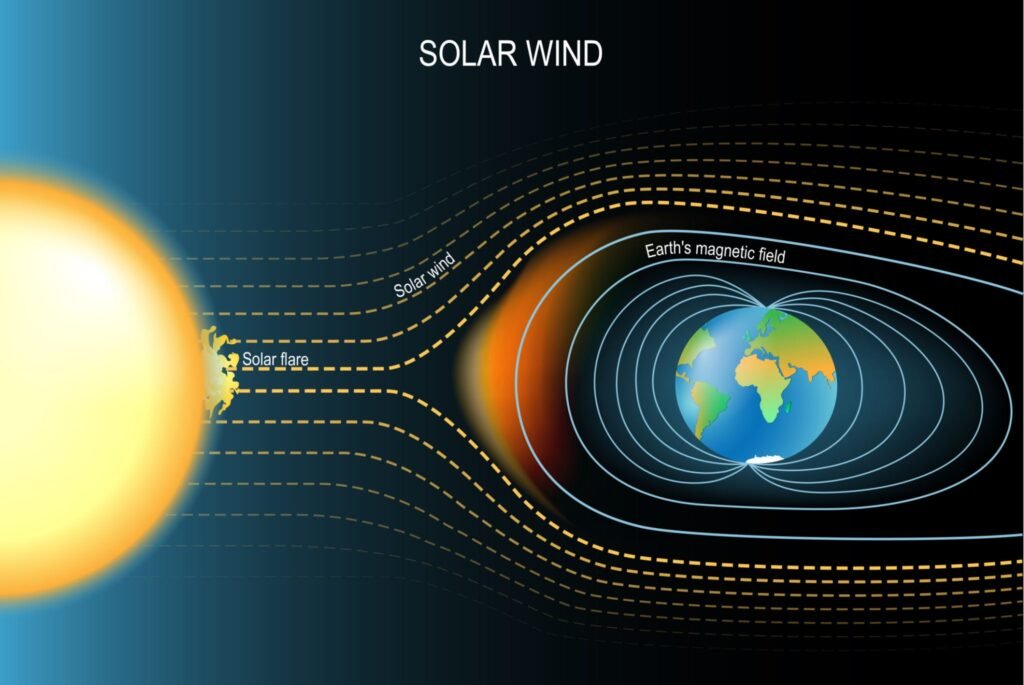
Here are the most significant recent discoveries:
1. The 2025 World Magnetic Model & SAA Expansion
Released in January 2026, the updated World Magnetic Model (WMM2025) confirmed that the magnetic North Pole continues its rapid sprint toward Siberia at roughly 36 kilometers per year, significantly outpacing the southern pole’s drift of 9 kilometers per year.
More alarmingly, continuous data from the European Space Agency’s Swarm satellites revealed a drastic change in the South Atlantic Anomaly (SAA)—a region over South America and the Atlantic Ocean where the magnetic field is unusually weak.
- The Discovery: The SAA has recently expanded by an area nearly half the size of continental Europe, and a secondary weak zone southwest of Africa is deteriorating even faster.
- The Impact: This expanding anomaly allows higher doses of solar radiation to penetrate closer to the Earth’s surface. It poses severe navigational and hardware risks to satellites passing through low Earth orbit, increasing the threat of technological blackouts.
- Here is a map showing the intensity of the Earth’s magnetic field, highlighting the South Atlantic Anomaly (SAA).
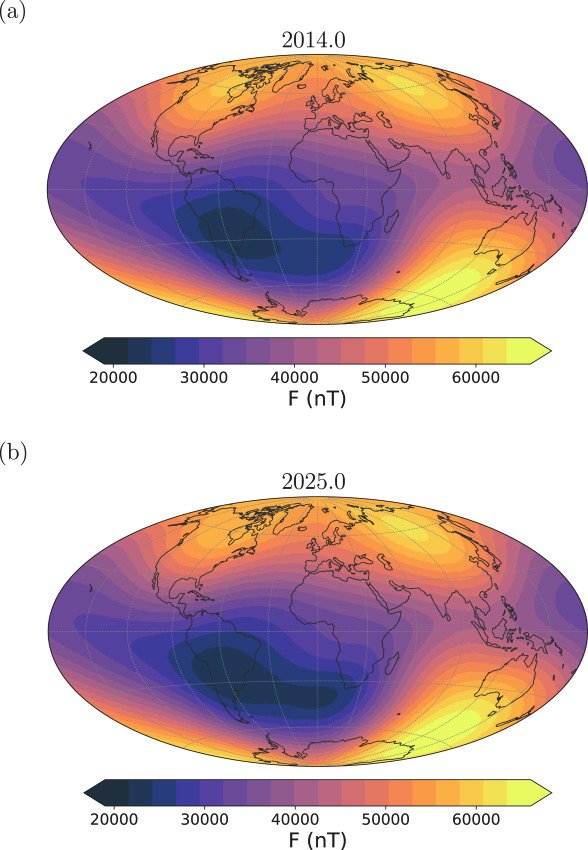
- The dark blue region stretching across South America and the southern Atlantic Ocean represents the area where the magnetic field is at its weakest. As noted in recent updates, this region is actively expanding and splitting, allowing more solar radiation to penetrate closer to the Earth’s surface and increasing the risk of interference for low-orbit satellites passing through this zone.
2. First Quantum Mapping of the Magnetic Field from Space
In May 2026, scientists published the results of the OSCAR-QUBE project, marking a massive leap forward in space-based monitoring technology. Instead of relying on bulky traditional satellites, researchers successfully mapped Earth’s magnetic field from the International Space Station using a quantum device the size of a grapefruit.
- How it works: The device utilizes a tiny piece of diamond with specific atomic lattice defects (where carbon is missing and replaced by nitrogen). These quantum defects respond predictably to magnetic fluctuations, allowing scientists to map the Earth’s field by measuring light emissions when the diamond is hit with microwaves and lasers.
- The Impact: This proves that highly sensitive, miniaturized quantum sensors can replace large legacy magnetometers, revolutionizing how we affordably monitor ocean tides, crustal rocks, and incoming space weather.
3. Decoding the “Magnetic Chaos” of the Ediacaran Period
For decades, the Ediacaran Period (630 to 540 million years ago) baffled geologists because paleomagnetic rock records showed wild, seemingly chaotic shifts in the Earth’s magnetic field. A landmark study from Yale University in April 2026 finally decoded this “chaos.”
- The Discovery: Using high-resolution rock sampling from Morocco, researchers discovered that these rapid polar shifts—which occurred over mere thousands of years rather than millions—were not random. Instead, the magnetic poles followed a highly structured, organized pattern of movement across the entire planet.
- The Impact: This effectively rules out the old theory of “true polar wander” (the idea that the entire planet’s mass tilted relative to its spin axis) and provides a brand-new statistical framework for accurately reconstructing the arrangement of ancient supercontinents.
MCQ TEST GEOMORPHOLOGY CURRENT UPDATES
Q1. Consider the following statements regarding the Earth’s inner core based on recent geophysical studies:
- The inner core is believed to exist in a ‘superionic’ state where light elements like carbon flow through a solid iron lattice.
- The boundary between the inner and outer core is a perfectly uniform, static sphere without localized deformation.
- The superionic state explains the unexpected acceleration of seismic shear waves passing through the core.
How many of the above statements are correct?
A) Only one
B) Only two
C) All three
D) None
Answer: A) Only one
Explanation: Only statement 1 is correct. Statement 2 is incorrect because recent studies indicate the boundary is actively deforming. Statement 3 is incorrect because the superionic state explains the slowing down (not acceleration) of shear waves.
Q2. With reference to Large Low-Shear-Velocity Provinces (LLSVPs), consider the following statements:
- They are massive, super-hot rock formations located at the boundary between the Earth’s crust and the upper mantle.
- Liquid iron in the outer core tends to become sluggish and stagnate beneath the hotter regions of these LLSVPs.
- Their uneven heat distribution helps explain the historical fluctuations and reversals of the Earth’s magnetic field.
How many of the above statements are correct?
A) Only one
B) Only two
C) All three
D) None
Answer: B) Only two
Explanation: Statements 2 and 3 are correct. Statement 1 is incorrect because LLSVPs are located much deeper, at the core-mantle boundary, not the crust-mantle boundary.
Q3. Regarding recent advancements in earthquake monitoring, which of the following is the most accurate description of a ‘pulse-like rupture’?
A) A continuous, steady sliding of tectonic plates over decades without the generation of surface seismic waves.
B) A concentrated burst of violent movement that travels rapidly down a fault line, as observed in recent strike-slip quakes.
C) An underwater rupture that strictly displaces water to generate tsunamis without any lateral crustal displacement.
D) A type of rupture that only occurs in deep-focus subduction zones and is never observed on shallow surface faults.
Answer: B) A concentrated burst of violent movement that travels rapidly down a fault line, as observed in recent strike-slip quakes.
Explanation: Recent real-time CCTV footage confirmed that faults can tear in rapid, concentrated pulses rather than uniform linear slips.
Q4. Consider the following statements about Magnetotelluric (MT) mapping in seismology:
- It utilizes subtle changes in the Earth’s natural electric and magnetic fields to map the structures of the crust.
- In MT mapping, high-resistivity zones indicate the presence of fluids and mechanical weakness along a fault.
- It was recently used to build a 3D structural model of the underwater segments of the North Anatolian Fault.
How many of the above statements are correct?
A) Only one
B) Only two
C) All three
D) None
Answer: B) Only two
Explanation: Statements 1 and 3 are correct. Statement 2 is incorrect because low-resistivity (not high-resistivity) indicates fluids and weakness, whereas high-resistivity indicates strong, locked rock.
Q5. The experimental GUARDIAN system recently developed for disaster management relies on which of the following mechanisms to detect incoming tsunamis?
A) Measuring changes in deep-ocean hydrostatic pressure using a grid of seabed sensors.
B) Tracking atmospheric pressure waves that disrupt global GPS satellite signals in the ionosphere.
C) Analyzing the rapid temperature variations in deep ocean currents following a subduction quake.
D) Monitoring the sudden release of radon gas along coastal fault lines prior to water displacement.
Answer: B) Tracking atmospheric pressure waves that disrupt global GPS satellite signals in the ionosphere.
Explanation: GUARDIAN uses GNSS/GPS signals to detect ionospheric distortions caused by the massive column of air pushed up by a tsunami wave.
Q6. Consider the following statements regarding the seismic policy and zonation in India:
- The IS 1893:2016 framework divides the Indian landmass into four active seismic zones (II, III, IV, and V).
- The revised and subsequently withdrawn IS 1893:2025 code proposed a new, extreme-risk Zone VI for the Himalayan arc.
- The withdrawal of the 2025 code immediately mandated the retrofitting of all existing urban infrastructure in North-Western states.
How many of the above statements are correct?
A) Only one
B) Only two
C) All three
D) None
Answer: B) Only two
Explanation: Statements 1 and 2 are correct. Statement 3 is incorrect; the withdrawal prevented mandatory upgrades and maintained the status quo, thereby avoiding massive retrofitting costs for existing infrastructure.
Q7. With reference to the SACHET portal used for disaster alerting, consider the following statements:
- It utilizes the Common Alerting Protocol (CAP) to simultaneously disseminate warnings across mobile, TV, and radio networks.
- It features geo-fencing capabilities to target alerts specifically to districts in the direct path of seismic waves.
- The system is designed to provide automated warnings up to 45 minutes before Primary (P-waves) reach an urban center.
How many of the above statements are correct?
A) Only one
B) Only two
C) All three
D) None
Answer: B) Only two
Explanation: Statements 1 and 2 are correct. Statement 3 is incorrect because seismic early warnings offer lead times measured in seconds (e.g., 45 seconds), not minutes, and they trigger after P-waves are detected to warn of slower S-waves.
Q8. Consider the following statements regarding the South Atlantic Anomaly (SAA):
- It represents a region over the Atlantic Ocean where the Earth’s magnetic field is unusually weak.
- Its continuous expansion allows higher doses of solar radiation to penetrate closer to the Earth’s surface.
- The expansion of the SAA poses a significant risk of technological interference for satellites in geostationary orbit (GEO) but not in low Earth orbit (LEO).
How many of the above statements are correct?
A) Only one
B) Only two
C) All three
D) None
Answer: B) Only two
Explanation: Statements 1 and 2 are correct. Statement 3 is incorrect because the SAA poses the greatest risk to Low Earth Orbit (LEO) satellites that pass directly through this localized weak point relatively close to the surface.
Q9. The recent ‘OSCAR-QUBE’ project represents a major technological leap in geophysics. What was its primary demonstrated capability?
A) Extracting and verifying the presence of superionic carbon directly from the Earth’s inner core.
B) Mapping the Earth’s magnetic field from the International Space Station using miniaturized quantum diamond sensors.
C) Providing the first real-time CCTV footage of a pulse-like rupture along the North Anatolian Fault.
D) Deploying a massive seabed array to track the shifting of the magnetic North Pole in real-time.
Answer: B) Mapping the Earth’s magnetic field from the International Space Station using miniaturized quantum diamond sensors.
Explanation: OSCAR-QUBE successfully demonstrated that tiny quantum devices can replace bulky traditional magnetometers for space-based monitoring of the magnetic field.
Q10. Consider the following statements regarding the paleomagnetic findings from the Ediacaran Period:
- High-resolution rock sampling revealed that magnetic polar shifts during this period were highly structured and organized rather than random.
- The findings suggest that magnetic poles shifted rapidly over mere thousands of years.
- The discovery validates the older theory of ‘true polar wander’, where the entire planet’s mass tilts relative to its spin axis.
How many of the above statements are correct?
A) Only one
B) Only two
C) All three
D) None
Answer: B) Only two
Explanation: Statements 1 and 2 are correct. Statement 3 is incorrect because these organized, rapid shifts in the magnetic field actually helped rule out the older theory of true polar wander, proving the magnetic field itself was highly dynamic.