Cockroach Janta Party (CJP) Protests
Today (June 6, 2026), the Cockroach Janta Party transitioned from a viral social media phenomenon into a physical political movement by staging its first major sit-in protest at Jantar Mantar in New Delhi.
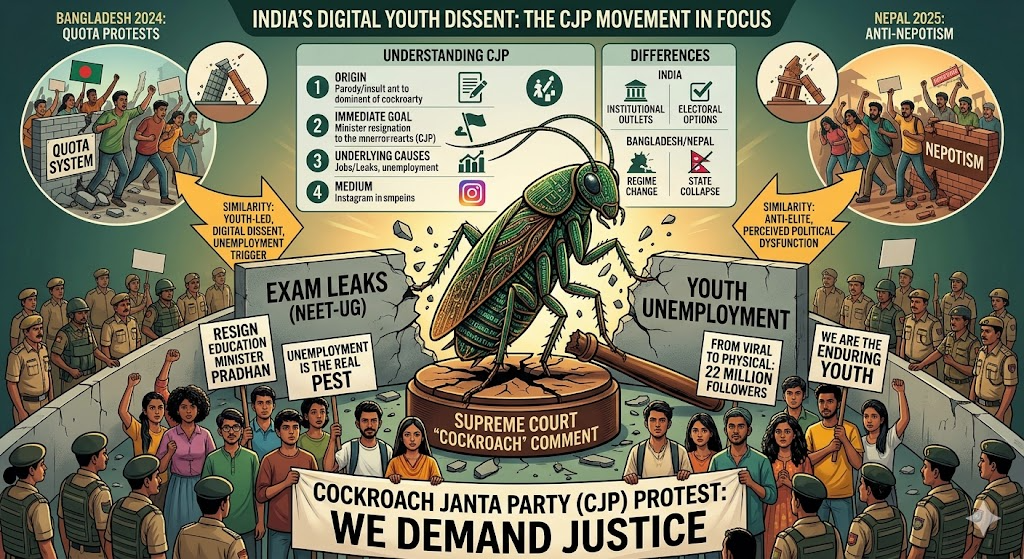
- Origin: The movement started as a parody in mid-May 2026 after Chief Justice of India Surya Kant reportedly likened critics and unemployed youth to “cockroaches” during a hearing. Founded by 30-year-old Abhijeet Dipke, the CJP adopted the insect as a wry badge of endurance and political articulation, rapidly amassing around 22 million Instagram followers.
- Core Demand: The immediate, single-point agenda of today’s protest is the resignation of Union Education Minister Dharmendra Pradhan. This stems from severe frustration over ongoing examination irregularities, notably the NEET-UG paper leak.
- Underlying Drivers: Beneath the satirical memes, the movement channels deep-seated anger regarding chronically high youth unemployment, perceived political dysfunction, and the shrinking of economic opportunities for young Indians.
- Current Status: The protest is being held under heavy police and paramilitary deployment. While largely peaceful, brief moments of chaos and minor detentions have been reported. Dipke has framed this as the beginning of a “long struggle.”
Comparative Analysis: India vs. Bangladesh & Nepal
The CJP’s rise mirrors recent massive youth uprisings in South Asia, specifically the quota protests in Bangladesh (August 2024) and the anti-nepotism protests in Nepal (September 2025).
Key Similarities
- Demographic & Medium: All three movements are driven primarily by “Gen Z” and young millennials. They bypassed traditional political structures, relying heavily on platforms like Instagram to mobilize, coordinate, and control their narrative.
- Core Grievances: The underlying catalysts are nearly identical: high youth unemployment, systemic corruption, and a profound sense of marginalization by entrenched political elites.
- Trigger Events in Education/Jobs: Just as the CJP mobilized around examination leaks (NEET-UG), the Bangladesh protests were ignited by a controversial civil service job quota system favoring political loyalists.
Critical Differences
While the optics look similar, the geopolitical and institutional realities of the CJP protest differ significantly from the movements that toppled Sheikh Hasina in Bangladesh and K.P. Sharma Oli in Nepal.
| Feature | Bangladesh (2024) & Nepal (2025) | India (CJP Movement – 2026) |
| Objective | Full regime change and institutional overhaul. | Currently focused on a specific ministerial resignation and examination reform. |
| State Stability | Protests occurred against a backdrop of partial state collapse and severe economic crises. | Operating within a functioning, though challenged, macroeconomic environment. |
| Institutional Outlets | Citizens felt they lacked meaningful democratic alternatives or avenues to punish the government. | India’s multi-tiered electoral system and active opposition parties provide established outlets for political frustration. |
| Demographic Cohesion | Youth populations united across the country against a singular elite target. | Highly fragmented youth demographic separated by regional, linguistic, and class divides; harder to sustain a unified national agenda. |
| Grassroots Structure | Movements quickly developed aggressive street power capable of shutting down capitals. | Still untested on the ground. Today marks the first test of converting online virality into sustained physical mobilization. |
UPSC Perspective: The CJP movement is a prime example of “digital dissent” attempting to mature into physical political action. The challenge for such movements in India is the transition from online grievance sharing to building the local cadres, booth-level structures, and sustained organization required to challenge established political machinery.
June 2026 RBI Monetary Policy Synopsis
The Reserve Bank of India’s (RBI) Monetary Policy Committee (MPC) met in June 2026 amid a challenging global macroeconomic environment. The policy marks a clear pivot from a growth-focused narrative toward inflation management and macroeconomic stability.
Key Policy Decisions
- Repo Rate: Kept unchanged at 5.25% by a unanimous decision.
- Policy Stance: Maintained at a neutral stance, adopting a cautious “wait-and-watch” approach.
Revised Macroeconomic Projections
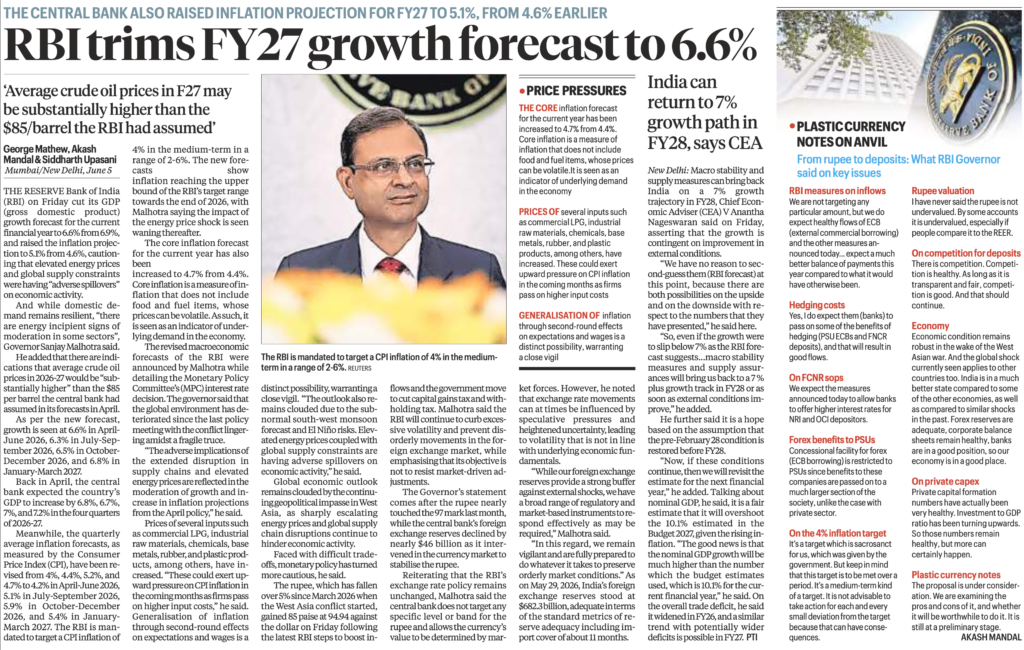
- GDP Growth: Forecast for FY27 revised downward to 6.6% (from an earlier 6.9%).
- Inflation (CPI): Projection raised significantly to 5.1%, with Q3 FY27 expected to peak around 5.9%, well above the RBI’s comfort zone.
Primary Drivers Behind the Decision
The MPC highlighted several headwinds driving stagflationary risks:
- Geopolitical Tensions: Escalating conflict in West Asia (involving the US, Israel, and Iran) causing financial market volatility.
- Energy Shocks: Elevated crude oil prices increasing imported inflation and widening the Current Account Deficit (CAD).
- Supply Chain Bottlenecks: Global trade disruptions and higher freight/insurance costs, particularly through critical chokepoints like the Strait of Hormuz.
- Currency Pressures: Capital outflows leading to rupee depreciation, further exacerbating the cost of imports.
Strategic Interventions & Capital Account Measures
To defend the rupee and attract foreign inflows without resorting to rate hikes, the RBI and the Government deployed coordinated tools:
- Foreign Portfolio Investment (FPI) Liberalization: Introduced tax exemptions on capital gains and interest income from Government Securities (G-secs) for Foreign Institutional Investors (FIIs).
- FAR Expansion: Expanded the Fully Accessible Route (FAR) to include new 15, 30, and 40-year G-secs, deepening the market for international long-duration funds.
- Forex Inflow Incentives: Provided full hedging support for mobilizing 3–5 year FCNR(B) deposits and offered concessional forex swap facilities for External Commercial Borrowings (ECBs) by Public Sector Undertakings (PSUs).
Economic Implications
- Borrowing Costs: Lending and deposit rates remain stable. EMIs for home, auto, and personal loans see no immediate relief but avoid upward shocks.
- Market Impact: The “stability over stimulus” approach favors banking and financial sectors while cautioning against sectors vulnerable to energy costs.
- Policy Trajectory: Future actions remain highly data-dependent, specifically contingent on whether the supply-side inflationary shocks prove temporary or persistent.