NEED FOR A NEW AGRICULTURAL PRICING POLICY
Recent Context
Following protests in Madhya Pradesh regarding the procurement limits on summer moong, the state government placated farmers by agreeing to procure 60% of the estimated harvest at the Minimum Support Price (MSP)—a significant increase from the initial 25% cap. This event has reignited nationwide discussions on the long-term viability of India’s current MSP framework and the urgent need for structural agricultural reforms.
Overview
The existing MSP system has been instrumental in safeguarding national food security and protecting farmers from distress sales during bumper harvests. However, it is increasingly burdened by massive fiscal costs, market distortions, environmental degradation, logistical inefficiencies, and constraints imposed by the WTO. Moving toward a sustainable agricultural model requires a strategic pivot from mere price support to comprehensive farmer welfare—utilizing tools like Minimum Income Support (MIP), the PM-AASHA scheme, crop diversification, Farmer Producer Organisations (FPOs), and enhanced agri-infrastructure.
Why is the MSP Regime Becoming Unsustainable?
- Massive Fiscal Strain: Extending guaranteed MSP procurement across all 23 mandated crops could cost the government between ₹10 lakh crore and ₹17 lakh crore. This immense burden would divert critical funding away from rural infrastructure, agricultural R&D, storage, and irrigation.
- Market Distortion & Monopsony: Establishing a legal price floor effectively outlaws transactions below the MSP. This inflates market prices, discourages private buyers, and forces the government into becoming the sole purchaser (a monopsony). Furthermore, the repeal of the 2020 farm laws hindered efforts to build direct farmer-to-buyer contract farming models, cementing reliance on the state.
- Skewed Cropping Patterns: Guaranteed purchases of wheat and rice incentivize farmers to practice monoculture. This discourages the planting of nutritionally vital crops like horticulture, oilseeds, and pulses, which threatens import security.
- Environmental Damage: The financial incentives for growing water-intensive crops (like paddy) in semi-arid regions such as Haryana and Punjab have led to severe ecological consequences, including soil degradation, rapid groundwater depletion, and toxic stubble burning.
- Inequitable Distribution of Benefits: According to the 2015 Shanta Kumar Committee, a mere 6% of Indian farmers actually benefit from MSP procurement. These gains are heavily skewed toward large, surplus-producing farmers in states like Punjab and Haryana, leaving small and marginal farmers marginalized.
- Storage and Logistics Crises: Large-scale state buying creates massive foodgrain surpluses. Agencies like the FCI are storing wheat and rice far in excess of what is needed for buffer stocks and the PDS, resulting in high storage costs and grain wastage.
- Outdated Costing Models: MSP calculations rely on delayed, historical cost data. Consequently, they often fail to account for sudden spikes in the costs of labor, diesel, and fertilizers, reducing the real-world income protection farmers receive.
- WTO Compliance Risks: Aggressively expanding state procurement threatens to violate the WTO’s Agreement on Agriculture (AoA). For developing nations, trade-distorting domestic support (the “Amber Box”) is capped at a 10% de minimis limit. Breaching this threshold could lead to international trade disputes.
Understanding the Minimum Support Price (MSP)
Definition & Purpose:
The MSP is a pre-announced, guaranteed price at which the government buys specified agricultural goods from farmers. It functions as a safety net to prevent market prices from crashing during abundant harvests, thereby securing both farmer livelihoods and national food reserves.
The Mechanism:
- Announcement: MSPs are declared before the sowing season based on recommendations from the Commission for Agricultural Costs and Prices (CACP), an advisory body under the Ministry of Agriculture & Farmers Welfare.
- Approval: The CACP analyzes market conditions and production economics. However, its recommendations are advisory; final approval rests with the Cabinet Committee on Economic Affairs (CCEA).
- Coverage: The government currently sets MSPs for 22 mandated crops, alongside a Fair and Remunerative Price (FRP) for sugarcane.
- Procurement Agencies: Physical procurement is handled by nodal agencies such as the FCI, NAFED, and the CCI.
How is MSP Calculated?
The CACP factors in paid-out expenses as well as the imputed value of family labor, acknowledging the effort of the entire farming household:
- A2 Cost: Covers all direct, out-of-pocket expenses paid by the farmer in cash or kind (e.g., seeds, fuel, hired labor, pesticides, fertilizers).
- A2 + FL (Current Method): Combines the A2 cost with the imputed value of unpaid family labor (FL). Since the 2018-19 season, the government has mandated that the MSP provide a minimum return of 50% over the A2+FL cost.
- C2 + 50% Formula (Proposed but Rejected): Recommended by the Dr. M.S. Swaminathan-led National Commission on Farmers (NCF), this comprehensive formula includes A2+FL plus the imputed rent on owned land and interest on fixed capital. Despite ongoing demands from farmer unions, the government has rejected this model due to the severe fiscal burden and potential for market distortion.
Digital and Strategic Initiatives:
- e-Samriddhi & e-Samyukti: Digital platforms developed by NAFED and NCCF for pulse and oilseed procurement. Farmers register using bank details, land records, and an [Aadhaar Redacted] to book delivery slots and receive direct digital payments.
- Kapas Kisan App: A multilingual application by the CCI allowing cotton farmers to self-register, track payments, book slots, and receive real-time updates on quality assessments.
- Long-Term Strategy: The MSP is shifting from a passive safety net to an active tool for agricultural self-reliance (Atmanirbharta). To eliminate pulse imports by 2027, the government has committed to purchasing 100% of the domestic production of Masoor, Urad, and Tur until 2028-29. Overall, 1.84 crore farmers benefited from foodgrain procurement in 2024-25.
Alternative Measures to Protect Farmers Beyond MSP
To sustainably protect farmer incomes without distorting markets, the following alternative strategies are recommended:
- Implement Minimum Income Support (MIP): Transition to per-acre, direct cash transfers to farmers. When paired with enhanced PM-KISAN benefits, this provides guaranteed income security without artificially inflating crop prices.
- Expand the Price Deficiency Payment System (PDPS): Under the PM-AASHA scheme, directly compensate farmers for the financial gap between the market price and the MSP. This eliminates the massive costs of physically procuring and storing crops.
- Invest in Market & Rural Infrastructure: Expand the Agriculture Infrastructure Fund (AIF) to build modern cold chains and warehouses, and bolster the e-NAM network to ensure transparent, competitive price discovery.
- Promote Farmer Producer Organisations (FPOs): Empower small and marginal farmers by organizing them into cooperatives and FPOs, which drastically improves their market bargaining power, lowers input costs, and boosts profits.
- Drive Crop Diversification: Encourage the cultivation of ecologically sustainable and import-reducing crops like oilseeds, pulses, and millets (Shree Anna) through targeted agro-climatic planning.
- Encourage Contract Farming: Establish frameworks for direct agreements between farmers and private buyers. With proper legal safeguards, this ensures technology transfer, stable prices, and guaranteed markets.
- Boost Agricultural R&D and Extension Services: Increase investments in precision agriculture, climate-resilient seeds, the Soil Health Card Scheme, and water efficiency initiatives like “Per Drop More Crop.”
- Adopt a Targeted MSP Strategy: Limit guaranteed state procurement only to strategically essential crops and regions. Allow state governments to design localized procurement models tailored to their specific agro-economic conditions.
- Transition to WTO-Compatible Support: Gradually shift agricultural funding away from trade-distorting price supports (Amber Box) and move toward infrastructure investments and direct income support (Green Box) to comply with international trade laws while supporting farmers.
Conclusion
Securing the future of India’s agricultural sector requires moving away from heavy reliance on physical price support. By transitioning toward direct income support systems like MIP, backed by robust crop insurance, market reforms, and modernized rural infrastructure, India can build a resilient, market-driven safety net that genuinely advances farmer welfare.
Prelims:
Q. Consider the following statements: (2020)
- In the case of all cereals, pulses and oil-seeds, the procurement at Minimum Support Price (MSP) is unlimited in any State/UT of India.
- In the case of cereals and pulses, the MSP is fixed in any State/UT at a level to which the market price will never rise.
Which of the statements given above is/are correct?
(a) 1 only
(b) 2 only
(c) Both 1 and 2
(d) Neither 1 nor 2
Ans: (d)
Mains:
Q. What are the reformative steps taken by the Government to make the food grain distribution system more effective? (2019)
Cauvery: The Reignited Cauvery Dispute

The Cauvery Water Management Authority (CWMA) recently upheld an order from the Cauvery Water Regulation Committee (CWRC), mandating Karnataka to release 3,500 cusecs (approx. 4.5 tmc ft) of water to Tamil Nadu. This directive comes despite a 60% shortfall in reservoir inflows.
- Karnataka’s Stance: Opposes the order, arguing that inadequate rainfall has prevented the commencement of local irrigation.
- Tamil Nadu’s Stance: Rejects the allocated amount as insufficient, demanding 9.8 tmc ft. Additionally, Tamil Nadu has appealed to the Prime Minister to block administrative and statutory approvals for Karnataka’s proposed Mekedatu Balancing Reservoir Project.
The Cauvery Water Management Authority (CWMA)
Established in 2018 under the Cauvery Water Management Scheme, the CWMA (alongside the CWRC) is a statutory, quasi-judicial body created under the Inter-State River Water Disputes Act, 1956.
- Mandate: To implement the modified Cauvery Water Disputes Tribunal (CWDT) Award as mandated by the 2018 Supreme Court judgment.
- Administration: Headquartered in New Delhi under the Ministry of Jal Shakti.
- Leadership & Composition:
- Chaired by a Secretary/Additional Secretary-rank IAS officer or a senior engineer (appointed by the Central Government for a 5-year term).
- 2 full-time members (representing Agriculture and Water Resources).
- 2 part-time members from the Central Government.
- 4 part-time members representing the basin states (Karnataka, Tamil Nadu, Kerala, Puducherry).
- 1 Secretary from the Central Water Engineering Services (CWES).
- Key Functions: It regulates inter-state reservoir releases, formulates distress-sharing formulas during low-rainfall years, monitors water flow/storage via the CWRC, and promotes efficient irrigation practices.
- Significance: It replaces recurring ad-hoc disputes with a permanent, rule-based, and technical institutional framework for water sharing.
Geographic & Hydrological Profile of the Cauvery River
Known as the “Ganga of the South,” the Cauvery is a major east-flowing peninsular river that sustains one of India’s longest-running inter-state water disputes.
- Origin & Course: Originates at Talakaveri in the Brahmagiri Hills (Kodagu, Karnataka). It flows through Karnataka and Tamil Nadu before draining into the Bay of Bengal near Poompuhar.
- Basin Size: 81,155 sq. km, spanning Karnataka, Tamil Nadu, Kerala, and Puducherry.
- Unique Hydrology: It is a perennial river because the upper basin is fed by the Southwest Monsoon, while the lower basin is fed by the Northeast Monsoon.
- Major Dams: Krishna Raja Sagara (Karnataka) and Mettur Dam (Tamil Nadu).
- Protected Habitats: Flows through Nagarhole National Park (Karnataka), Wayanad Wildlife Sanctuary (Kerala), and Sathyamangalam Tiger Reserve (Tamil Nadu).
Major Tributaries:
| Bank | Rivers |
| Left Bank | Harangi, Hemavati, Shimsha, Arkavati |
| Right Bank | Lakshmana Tirtha, Kabini, Suvarnavathi, Bhavani, Noyyal, Amaravati |
History of the River Water Dispute
The conflict dates back to the 1892 and 1924 agreements between the Princely State of Mysore and the Madras Presidency.
- The Core Conflict: During low-rainfall years, Karnataka (upper riparian) prioritizes Bengaluru’s drinking water and local irrigation. Tamil Nadu (lower riparian) demands guaranteed releases to save its Cauvery delta agriculture, specifically the Kuruvai crop.
- Legal Framework: Post-Independence, the dispute was managed under Article 262 of the Constitution and the Inter-State River Water Disputes Act, 1956, leading to the creation of the CWDT in 1990.
Evolution of Water Allocation (Total: 740 TMC):
| State / Entity | 2007 CWDT Award | 2018 Supreme Court Modification |
| Tamil Nadu | 419 TMC | 404.25 TMC (Reduced due to accounted groundwater availability) |
| Karnataka | 270 TMC | 284.75 TMC (Increased to secure Bengaluru’s drinking water needs) |
| Kerala | 30 TMC | 30 TMC (Unchanged) |
| Puducherry | 7 TMC | 7 TMC (Unchanged) |
| Environment | 14 TMC | 14 TMC (Unchanged) |
Key Legal Precedent (2018): The Supreme Court ruled that inter-state rivers are national assets, meaning no single state possesses exclusive ownership over the waters.
The Mekedatu Project Controversy
The Mekedatu Project is a proposed 48 TMC balancing reservoir located on the Cauvery River in Karnataka’s Ramanagara district, approximately 100 km south of Bengaluru.
Tamil Nadu’s Opposition: Tamil Nadu fears the upstream storage will allow Karnataka to artificially regulate river flow during distress years, starving the downstream delta of scheduled releases. They argue this violates the CWDT Award, which explicitly prohibits upstream projects that disrupt scheduled deliveries without mutual consent and regulatory consultation.
Karnataka’s Objectives: To supply drinking water to Bengaluru, generate hydropower, and recharge groundwater. Karnataka insists the project will not add new irrigation tracts or alter the CWDT/Supreme Court water allocations.
Prelims
Q. Which of the following Protected Areas are located in Cauvery basin? (2020)
- Nagarhole National Park
- Papikonda National Park
- Sathyamangalam Tiger Reserve
- Wayanad Wildlife Sanctuary
Select the correct answer using the code given below:
(a) 1 and 2 only
(b) 3 and 4 only
(c) 1, 3 and 4 only
(d) 1, 2, 3 and 4
Ans: (c)
Mains
Q. Constitutional mechanisms to resolve the inter-state water disputes have failed to address and solve the problems. Is the failure due to structural or process inadequacy or both? Discuss. (2013)
Tourism As The Economic Engine Of India
Tourism goes beyond travel; it fuels hospitality, transport, local handicrafts, and wellness industries. Recent data highlights its massive economic footprint:
| Metric | Figure | Timeframe / Details |
| Domestic Tourists | ~2.9 billion visits | 2024 (Surpassing pre-pandemic levels) |
| International Arrivals | ~2.02 crore | 2025 (Strong inbound recovery) |
| GDP Contribution | ₹15.73 lakh crore | 2023–24 (Accounts for ~5.22% of the economy) |
| Employment | 84.6 million jobs | 2023–24 (Direct and indirect) |
| Forex Earnings | USD 31.7 billion | 2025 (International tourism receipts) |
India’s Core Tourism Advantages
India’s appeal lies in its unparalleled diversity, combining ancient traditions with rich natural landscapes:
- Heritage: Home to 45 UNESCO World Heritage Sites reflecting vast cultural and civilizational wealth.
- Nature: Supported by 106 National Parks, 18 Biosphere Reserves, protected forests, islands, and beaches.
- Culture & Diversity: Offers a singular destination for living traditions, classical arts, festivals, diverse cuisines, Yoga, and Ayurveda.
Major Tourism Segments
- Spiritual Tourism: As the birthplace of Hinduism, Buddhism, Jainism, and Sikhism, India draws millions to pilgrimage hubs like Kashi, Ayodhya, Char Dham, Puri, Tirupati, and Amritsar.
- Buddhist Circuit: Sites like Bodhgaya, Sarnath, and Kushinagara strengthen civilizational ties and cultural exchange with other Asian nations.
- Heritage & Culture: Immersive experiences through forts, temples, museums, and historical cities.
- Wellness & Medical: A global leader in affordable, world-class medical treatments combined with Yoga, naturopathy, and Ayurveda.
- Eco & Wildlife: Safaris, trekking, and birdwatching across tiger reserves and Himalayan landscapes.
- Rural & Community: Homestays, village walks, and local crafts that provide direct income to rural households.
- MICE Tourism: Growing as a hub for Meetings, Incentives, Conferences, and Exhibitions due to modernized convention infrastructure.
- Coastal & Adventure: Leveraging a 7,500+ km coastline, rivers, deserts, and mountains for cruise tourism, water sports, mountaineering, and desert safaris.
Infrastructure & Destination Development Schemes
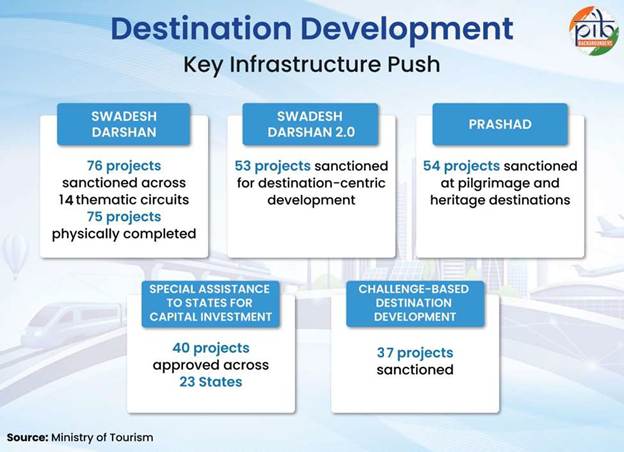
The government is transforming destinations through heavy capital investment and strategic initiatives:
- Swadesh Darshan: Sanctioned 76 projects (₹5,295.24 crore) across 14 thematic circuits (e.g., Ramayana, Buddhist, Coastal). Currently, 75 projects are physically complete.
- Swadesh Darshan 2.0: A sustainable, destination-centric upgrade with 53 projects sanctioned (₹2,207.08 crore).
- PRASHAD Scheme: 54 projects (₹1,726.24 crore) approved to upgrade facilities at major heritage and pilgrimage sites.
- Special Assistance to States (Capital Investment): 40 projects approved across 23 States (₹3,295.76 crore) to develop iconic tourist centers to global standards.
- Challenge-Based Destination Development: 37 projects (₹687.99 crore) sanctioned for high-potential spiritual and eco-tourism sites.
- Viksit UDAN: An outlay exceeding ₹28,840 crore to build 100+ new aerodromes and 200 helipads, drastically improving Tier-2, Tier-3, and remote connectivity. This is supplemented by expanded highways and Vande Bharat trains.
Ease of Travel & Digital Integration
India is leveraging technology to remove friction for both travelers and service providers:
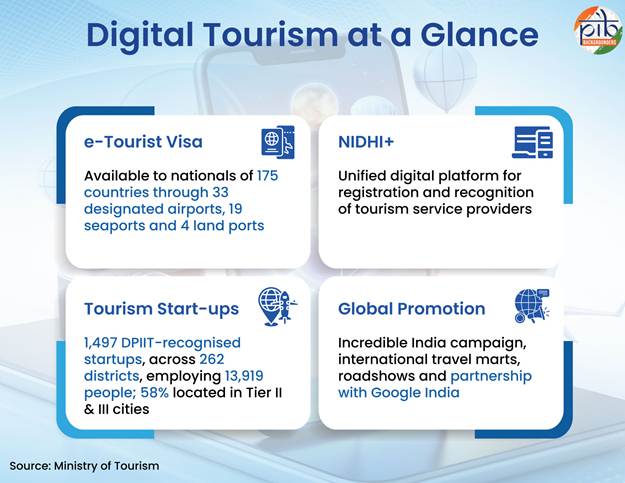
- Expanded e-Visa: The e-Tourist Visa is now available to citizens of 175 countries, allowing entry via 33 airports, 19 seaports, and 4 land ports.
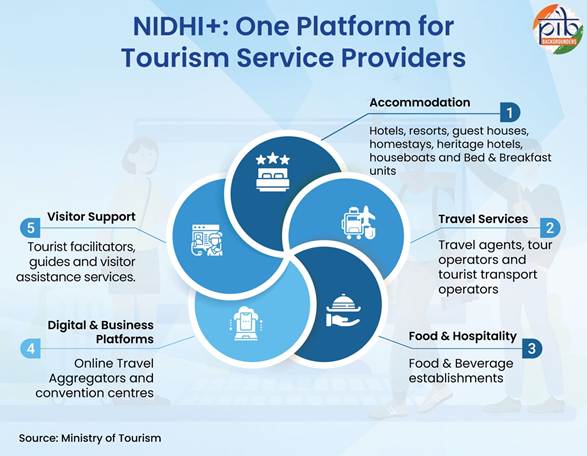
- NIDHI+ Platform: The National Integrated Database of Hospitality Industry serves as a unified portal for online applications, seamless payments, and transparent approvals for tourism service providers.
- Tourism Startups: As of April 2023, India had 1,497 DPIIT-recognized startups across 262 districts, generating nearly 13,919 jobs.
- Regional Spread: 58% of these startups operate in Tier-II and Tier-III cities.
- Notable Innovators: Highway Delite (digitally connected highway amenities), VilloTale (rural homestays), and udChalo (tech-enabled travel for defense personnel and veterans).
Sustainable and Inclusive Tourism
To ensure long-term viability, the next phase of growth balances high visitor numbers with environmental and cultural protection:
- Travel for LiFE: A national initiative encouraging tourists and businesses to make environmentally conscious, resource-conserving choices.
- Decentralizing Footfall: Promoting niche nature trails (like turtle tracking or birdwatching) to relieve pressure on overcrowded traditional destinations.
- SDG Alignment: India’s sustainable tourism approach directly advances the UN Sustainable Development Goals:
- SDG 8.9: Promoting jobs and local culture.
- SDG 12.B: Monitoring the impacts of sustainable tourism.
- SDG 14.7: Ensuring the sustainable use of marine and coastal resources.
Conclusion: Backed by rich civilizational depth, natural assets, and aggressive infrastructure scaling, India is transitioning into a globally competitive visitor economy. The ultimate goal is a balanced model where increased tourism directly fuels community prosperity, heritage preservation, and ecological responsibility.
Overview of Pradhan Mantri Surya Sarovar Yojana (PM-SSY)
Recently approved by the Union Cabinet, the PM-SSY is a Central Sector Scheme designed to bolster India’s energy security by scaling up Floating Solar Photovoltaic (FSPV) projects. By utilizing inland water bodies and reservoirs, the scheme aims to rapidly expand renewable energy capacity without exacerbating land acquisition conflicts.
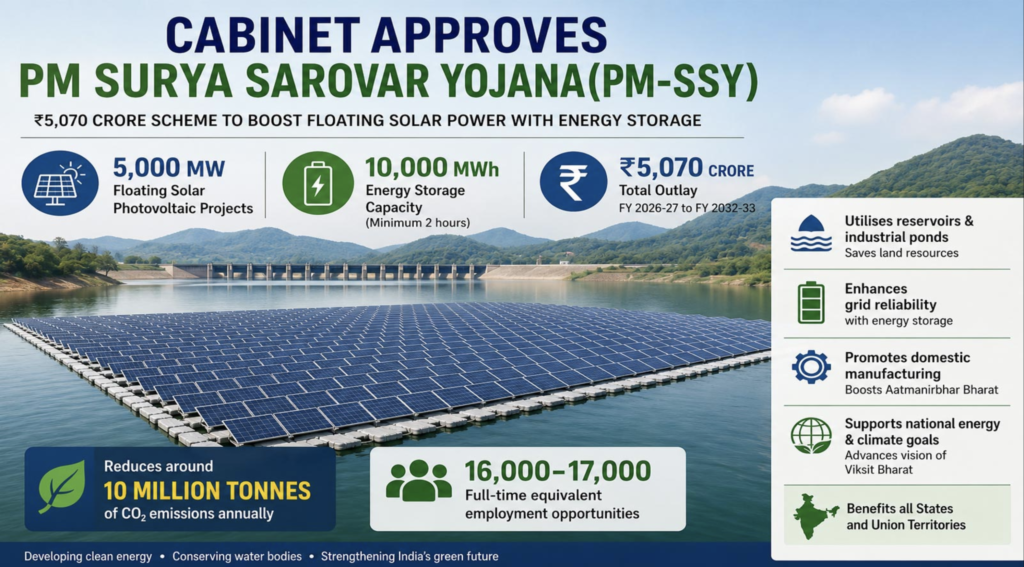
Key Scheme Parameters:
| Metric | Details |
| Total Outlay | ₹5,070 crore |
| Capacity Target | 5,000 MW of FSPV capacity |
| Implementation Timeline | FY 2026-27 to FY 2030-31 |
| Energy Storage Mandate | Projects must include co-located Energy Storage Systems (ESS) providing a minimum of 2 hours of storage (Targeting 10,000 MWh total across the scheme) to ensure grid stability. |
| Underlying Potential | The National Institute of Solar Energy (NISE) estimates India’s floating solar potential at 102.18 GWp (Giga Watt peak). |
Financial Support & Incentives
To make these projects viable, the government is providing dual-layered financial backing:
- Central Financial Assistance (CFA): Developers will receive ₹1 crore per MW upon the successful commissioning of eligible floating solar projects.
- Project De-risking Support: An additional CFA of up to ₹50 lakh per project is available to cover crucial pre-development feasibility studies, including bathymetry, hydrography, and environmental impact assessments.
Understanding Floating Solar (FSPV)
Floating solar involves mounting PV panels on buoyant platforms over lakes, dams, and industrial ponds.
- The Land Advantage: It is a “land-neutral” technology, eliminating competition for agricultural land and human habitation. It also reduces water evaporation and improves panel efficiency due to the cooling effect of the water.
- Cost Dynamics: Due to the need for specialized floating platforms, anchoring systems, and waterproof electrical infrastructure, FSPV projects typically cost 25% more than traditional ground-mounted plants.
- Flagship Indian Project: The Omkareshwar Floating Solar Park on the Narmada River (Madhya Pradesh) is currently India’s largest operational FSPV project at 278 MW, with plans to expand to 600 MW.
- Global Context: As of 2024, global floating solar capacity reached 9.6 GW, with Asia dominating nearly 90% of all installations.
Strategic Significance of PM-SSY
The scheme is expected to deliver massive dividends across environmental, economic, and industrial sectors:
- Massive Capacity Leap: It will propel India’s current FSPV capacity from a mere 700 MW to 5,700 MW.
- Climate Impact: The generated clean energy will prevent the emission of approximately 10 million tonnes of CO₂ annually.
- Job Creation: The initiative is projected to generate 16,000 to 17,000 full-time equivalent (FTE) jobs across the project lifecycle.
- Grid Reliability: Integrating 2-hour Battery Energy Storage Systems (BESS) manages the intermittency of solar power, helping operators meet peak electricity demand.
- Aatmanirbhar Bharat: The scheme mandates and promotes domestic manufacturing across the entire value chain—from PV cells and modules to floatation devices and energy storage systems.
The Broader Landscape of Solar Energy in India
PM-SSY is part of a much larger national push toward a target of 500 GW of non-fossil fuel capacity by 2030.
- Rapid Expansion: India’s overall solar capacity has surged from just 3 GW in 2014 to ~129 GW in 2025. Leading states include Rajasthan, Gujarat, Maharashtra, and Tamil Nadu, aided by high solar irradiation and favorable policies.
- Rooftop & Agriculture: Under the PM Surya Ghar Yojana, roughly 24 lakh rooftop installations were completed by December 2025. Concurrently, the PM-KUSUM scheme is driving the adoption of grid-connected solar water pumps for farmers.
- Energy Storage (BESS): To support continuous power, a Viability Gap Funding (VGF) scheme of ₹5,400 crore has been launched to develop 30 GWh of Battery Energy Storage Systems.
- Domestic Manufacturing: Supported by the Approved List of Models and Manufacturers (ALMM), India has built a robust 100 GW Solar PV module manufacturing capacity.
- Infrastructure & Diplomacy: Domestic transmission is being fortified by the Green Energy Corridor. Globally, India leads the International Solar Alliance (ISA) (headquartered in Gurugram) to mobilize investments and aggregate technology demand across sun-rich nations.
Prelims
Q. Consider the following statements about ‘PM Surya Ghar Muft Bijli Yojana’: (2025)
- It targets installation of one crore solar rooftop panels in the residential sector.
- The Ministry of New and Renewable Energy aims to impart training on installation, operation, maintenance and repairs of solar rooftop systems at grassroot levels.
- It aims to create more than three lakhs skilled manpower through fresh skilling, and upskilling, under scheme component of capacity building.
Which of the statements given above are correct?
(a) I and II only
(b) I and III only
(c) II and III only
(d) I, II and III
Ans: D
Q. Consider the following statements: (2016)
1. The International Solar Alliance was launched at the United Nations Climate Change Conference in 2015.
2. The Alliance includes all the member countries of the United Nations.
Which of the statements given above is/are correct?
(a) 1 only
(b) 2 only
(c) Both 1 and 2
(d) Neither 1 nor 2
Ans: (a)
Mains
Q. India has immense potential for solar energy, though there are regional variations in its development. Elaborate.(2020)
Qeshm Island
The United States executed targeted strikes on Islamic Revolutionary Guard Corps (IRGC) military infrastructure situated on Iran’s Qeshm Island. The operation aimed to counter perceived threats directed at American forces and regional maritime security.
Geographical & Ecological Profile
- Location: The largest island in the Persian Gulf, located at the mouth of the strategic Strait of Hormuz in Iran’s Hormozgan Province (near Bandar Abbas). It is separated from the Iranian mainland by the Khuran (Clarence) Strait.
- Key Ecological Attractions:
- Qeshm Geopark: The Middle East’s first UNESCO-recognized Geopark. Features unique geological formations such as the Valley of Stars, Chahkuh Gorge, and the Namakdan Salt Cave.
- Namakdan Salt Cave: One of the world’s longest salt caves, spanning over 6 kilometers.
- Hara Mangrove Forest: Serves as a vital breeding habitat for migratory birds.
Strategic Importance
- Strait of Hormuz Control: The island occupies a crucial position overlooking the Strait of Hormuz—a vital maritime chokepoint connecting the Persian Gulf to the Gulf of Oman, through which ~20% of global oil and LNG trade flows.
- IRGC Operational Hub: Qeshm Island serves as a primary military base for Iran’s IRGC, housing radar installations, missile batteries, drone facilities, and naval assets used for coastal surveillance, shipping monitoring, and regional power projection.
Environmental Performance Index (EPI) 2026
Recent Context & Overall Ranking
In the Yale Environmental Performance Index (EPI) 2026, India ranked 176th out of 177 countries with a score of 22.46.
- Global Standing: Second-lowest globally (ranking directly above Laos).
- Regional Standing: Ranked 7th out of 8 South Asian nations.
- Top Performer: Estonia secured the 1st position with a score of 74.79.
About the Environmental Performance Index
- Publishers: Jointly produced biennially by the Yale Center for Environmental Law & Policy (YCELP) and the Center for International Earth Science Information Network (CIESIN) at Columbia University. Established in 2000.
- Framework: Evaluates 177 nations across 47 indicators across 12 issue categories, organized under 3 main policy objectives:
- Environmental Health
- Ecosystem Vitality
- Climate Change
- Benchmark Role: Monitors international progress toward the UN Sustainable Development Goals (SDGs), the Paris Agreement, and the Kunming-Montreal Global Biodiversity Framework.
India’s Performance Trend & Performance Breakup
- Historical Ranking Trajectory: 141st (2016) → 177th (2018) → 168th (2020) → 180th (2022) → 176th (2024 & 2026). India has consistently remained among the five worst-performing nations since 2022.
- Major Concerns: Ranked near the absolute bottom in air quality, environmental health, and biodiversity, alongside historical declines in tree cover, fisheries, and pesticide pollution.
- Relative Strengths: Made comparative progress in climate change mitigation, sanitation, and waste management.
Debate Over Methodology
| Perspective | Arguments / Defense |
| MoEFCC & Indian Experts | Questioned the EPI’s methodology, citing that it overlooks India’s developmental stage, large population, historical emissions, and the principle of Common but Differentiated Responsibilities (CBDR) while relying heavily on simplified cross-country extrapolations. |
| Yale Center (YCELP) | Maintained that the EPI evaluates current real-time environmental conditions rather than future pledges, seeking to guide immediate policy decisions rather than allocate historical blame. |
Structural and Pro-Competitive Reforms in India
A report titled “India’s Next Growth Frontier: Reducing Anti-Competitive Market Distortions to Build on India’s 2010–2023 Reform Progress” was released by the Competere Foundation.
- Key Finding: India advanced 25 places on the Market Distortions Performance Index, climbing from 82nd (2010) to 57th position (2023).
Assessment Framework & Key Pillars
The index tracks progress in mitigating market distortions and improving market competitiveness by evaluating performance across three main pillars:
- Property-rights protection
- Domestic competition
- International competition
The study covers key operational domains including competition policy, overall investment conditions, digital markets, and external regulatory barriers affecting India’s integration into global trade.
Primary Drivers of Reform
- Goods and Services Tax (GST): Unified the country’s indirect tax system and dismantled inter-state trade barriers.
- Insolvency and Bankruptcy Code (IBC): Created a time-bound mechanism for resolving insolvency, enhancing credit discipline and capital efficiency.
Key Recommendations & Impact
- Policy Suggestions: Advises adopting an evidence-based competition policy, reviewing sector-specific investment limits, and bolstering cooperation with like-minded trading partners.
- Significance: Emphasizes that sustained structural reforms are essential to driving national productivity, boosting the investment climate, and deepening India’s integration into the global economy.