Railway line through Tiger Reserve
Satpura Tiger Reserve, Melghat Tiger Reserve, and the recent contentious railway line project passing through their critical wildlife corridor.
1. Satpura Tiger Reserve (STR)
* Location & Geography: Situated in the Narmadapuram (formerly Hoshangabad) district of Madhya Pradesh. It lies south of the Narmada River in the central Indian highlands (Satpura Range).
* Composition: It comprises three protected areas:
* Satpura National Park
* Bori Wildlife Sanctuary (India’s oldest forest reserve)
* Pachmarhi Wildlife Sanctuary *
Status: Declared a Tiger Reserve in 2000. It is also Madhya Pradesh’s first Biosphere Reserve (designated in 1999).
* Topography & Flora: Rugged terrain consisting of sandstone peaks, narrow gorges, and ravines. The highest peak is Dhoopgarh (1,350 m). Vegetation is predominantly moist deciduous (Teak, Sal, Bamboo).
* Key Fauna: Famous for a viable population of tigers, leopards, sloth bears, dholes, Indian giant squirrels, and flying squirrels. Notably, Barasingha (swamp deer) were successfully reintroduced here from Kanha Tiger Reserve.
* Important Water Body: The Denwa River is the main water source, feeding into the Tawa Reservoir.
* Ecological Significance: Often referred to in biogeography as a zone holding elements of both Himalayan (northern extremity of Western Ghats linkage) and Nilgiri flora/fauna.
2. Melghat Tiger Reserve (MTR)
* Location & Geography: Located in the Amravati district of Maharashtra, along the southern foothills of the Satpura Range (often called the Gawilgarh Hills).
* Status: Declared a tiger reserve in 1973–1974 as one of the first initial 9 tiger reserves under Project Tiger.
* Rivers: The reserve acts as an important catchment area for several rivers, including the Tapi, Sipna, Khapra, Dolar, and Wanda, which flow into the Tawa/Tapi river systems.
* Key Fauna: Tigers, leopards, sloth bears, Indian gaur (bison), sambar, and barking deer.
3. The Satpura-Melghat Tiger Corridor & Proposed Railway Line
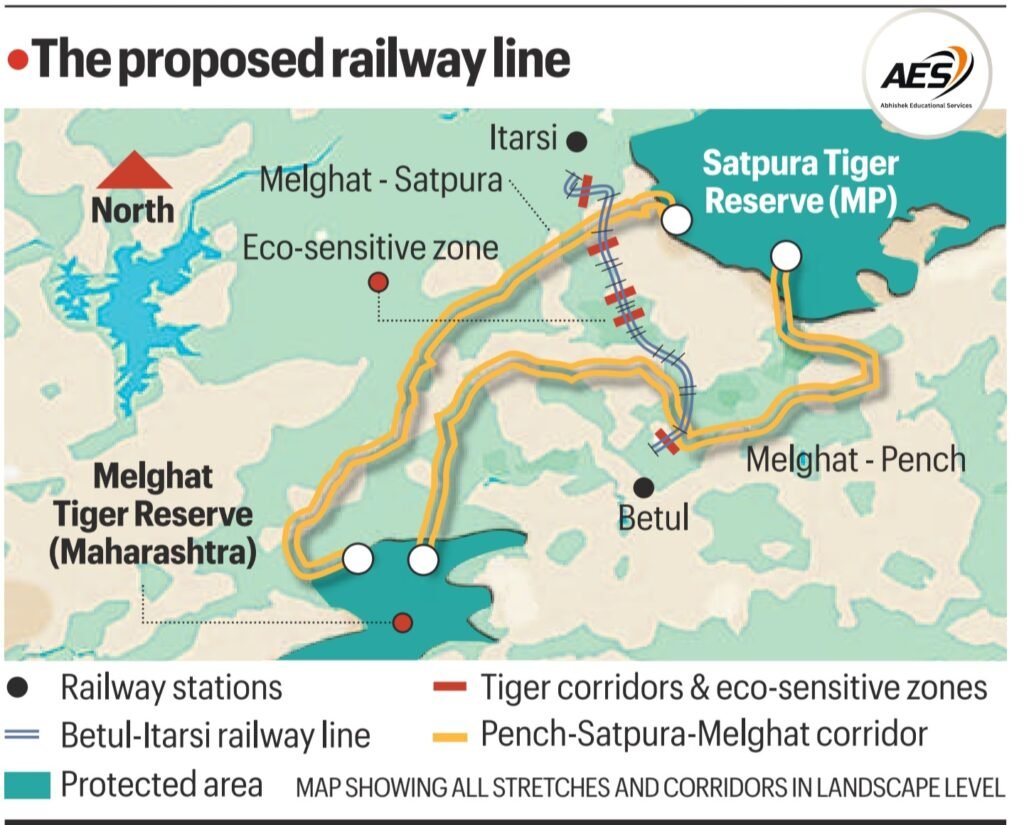
The Conflict & Project Details
* The Project: The Central Railway proposed laying a third and fourth railway line (part of the heavily congested Itarsi-Nagpur route on the Delhi-Chennai/Bengaluru high-density corridor).
* The Route Impact: The Jujharpur-Chichonda / Jujharpur-Dhodramohar section cuts directly through the Satpura-Melghat tiger corridor—a vital ecological link connecting Madhya Pradesh and Maharashtra.
* Ecological Importance of the Corridor: Tiger corridors allow genetic dispersal, preventing inbreeding depression and ensuring long-term metapopulation persistence for tigers, leopards, sloth bears, and various herbivores.Recent Regulatory Approvals & Conditions
* Forest & Wildlife Clearances:
* The Union Ministry’s Forest Advisory Committee (FAC) granted in-principle (Stage-I) forest clearance for the diversion of forest land.
* The Standing Committee of the National Board for Wildlife (SC-NBWL) recommended in-principle wildlife clearance, stipulating strict riders.
* Mitigation Measures: Due to high wildlife mortality risks on linear infrastructure (rail/roads), bodies like the National Tiger Conservation Authority (NTCA) and the Wildlife Institute of India (WII) mandated strict mitigation structures, such as ecologically designed wildlife overpasses/underpasses, noise barriers, and fencing along the rail alignment
.Key Terms & Concepts for Prelims Revision
* Forest Clearance Stages: Divided into Stage-I (In-principle) and Stage-II (Final) under the Forest (Conservation) framework, processed via the FAC.
* NBWL: Headed ex-officio by the Prime Minister; its Standing Committee clears projects falling within or adjacent to Protected Areas/Eco-Sensitive Zones.
* NTCA: A statutory body under the Ministry of Environment, Forest and Climate Change (MoEFCC) established via the 2006 amendment of the Wildlife (Protection) Act, 1972 for managing Project Tiger.