1. Ethanol Blending in India
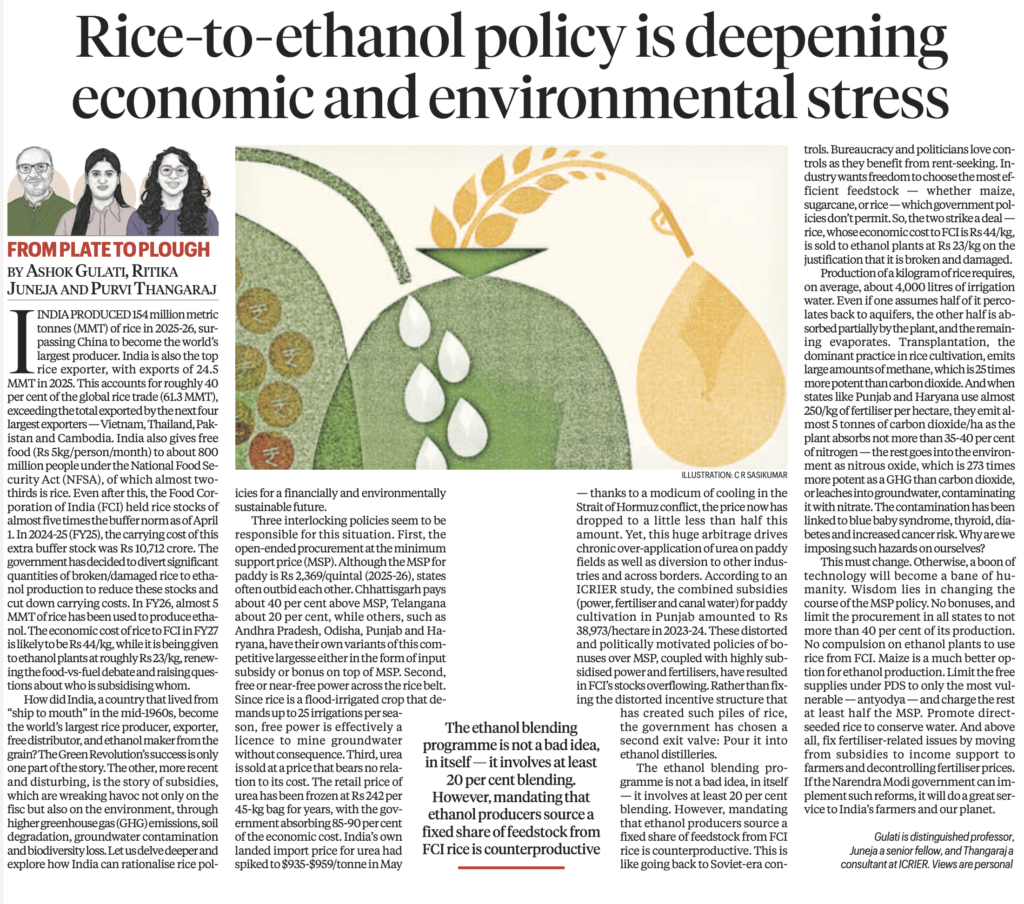
India’s Ethanol Blended Petrol (EBP) Programme is a cornerstone of the nation’s energy transition, aiming to curb carbon emissions, reduce reliance on imported crude oil, and boost the agricultural economy.
Key Highlights of the EBP Programme
- Target Achievement: India successfully met its 20% ethanol blending target (E20) in 2025, five years ahead of the 2030 deadline.
- Production Capacity: National ethanol production capacity has expanded from 2 billion liters in 2014 to nearly 20 billion liters.
- Economic Impact: The transition has saved India over Rs. 1.4 lakh crore in foreign exchange and generated substantial income for farmers and distilleries.
- Environmental Impact: E20 blending has reduced CO2 emissions by approximately 832 lakh metric tonnes, supporting India’s Net-Zero by 2070 goal.
Generations of Ethanol Production
| Generation | Feedstock Source | Characteristics |
| First (1G) | Edible biomass (Sugarcane, Corn, Wheat) | Competes with food security; technologically mature. |
| Second (2G) | Non-edible biomass (Agri-residue, Paddy Stubble) | Addresses crop burning; complex conversion process. |
| Third (3G) | Algae-based | High yield; no arable land needed; in R&D stage. |
| Fourth (4G) | Genetically modified organisms | Designed for high carbon capture; largely theoretical. |
Current Challenges and Roadblocks
- Vehicle Compatibility: While newer vehicles are E20 compatible, older engines may suffer material degradation due to ethanol’s moisture-absorbing nature.
- Fuel Efficiency: Ethanol possesses lower energy density than pure petrol, leading to slight mileage reductions for consumers.
- Consumer Choice: Indian fuel stations lack differential pricing and multi-blend options (E10, E20, pure petrol) compared to global leaders like Brazil.
- Sustainability: Heavy reliance on water-intensive crops (like sugarcane) raises ecological concerns, emphasizing the need for a faster shift to 2G ethanol.
Associated UPSC PYQs
- Prelims (2020): According to India’s National Policy on Biofuels, which of the following can be used as raw materials for the production of biofuels? (1) Cassava (2) Damaged wheat grains (3) Groundnut seeds (4) Horse gram (5) Rotten potatoes (6) Sugar beet.
- Answer: (a) 1, 2, 5 and 6 only
- Mains (2018): Access to affordable, reliable, sustainable and modern energy is the sine qua non to achieve Sustainable Development Goals. Comment on the progress made in India in this regard.
2. India’s Marine Fisheries Sector
While government data (CMFRI) suggests 91.1% of India’s assessed marine fish stocks are sustainable, observations from the Food and Agriculture Organization (FAO) highlight ecological and governance stress.
Sector Overview
- Economic Value: Fisheries contribute 7.43% to the Agricultural Gross Value Added (GVA).
- Exports: Seafood exports are valued at over Rs 62,400 crore, dominated by frozen shrimp.
- Technological Shift: The sector is rapidly adopting high-density farming techniques like Recirculatory Aquaculture Systems (RAS) and Bio-floc technology.
Core Challenges
- Assessment Discrepancies: India relies heavily on “landing data” (catch size) rather than direct scientific stock assessments at sea.
- Mechanised Trawling: Unregulated expansion of mechanized trawlers damages inshore benthic ecosystems and creates resource conflicts with traditional, small-scale fishers.
- Inshore Degradation: Critical near-shore habitats are threatened by mangrove destruction, river nutrient depletion, and pollution.
Way Forward
- Implement strict zoning rules and seasonal bans to regulate destructive bottom trawling.
- Shift focus from deep-sea fishing expansion back to restoring and managing highly productive inshore waters.
- Expand the use of Aquaponics and improve cold-chain infrastructure to reduce post-harvest losses.
Associated UPSC PYQs
- Mains (2018): Defining the Blue Revolution, explain the problems and strategies for pisciculture development in India.
- Mains (2019): Coastal sand mining, whether legal or illegal, poses one of the biggest threats to our environment. Analyse the impact of sand mining along the Indian coasts, citing specific examples.
3. UN Scientific Panel on AI Report
A preliminary report by the UN warns that the exponential growth of Artificial Intelligence (AI) is outpacing global regulatory frameworks, leading to severe multidimensional risks.
Key Findings
- The Compute Divide: The US and China control roughly 90% of global AI computing power, leaving the Global South heavily dependent.
- Agentic AI Risks: Autonomous AI systems (Agentic AI) are accelerating software development but introduce severe multi-agent miscoordination and cybersecurity vulnerabilities.
- Linguistic Inequality: Most AI models are optimized for a fraction of global languages, leading to dangerous translation errors in critical fields like healthcare for low-resource languages.
- Corporate Concentration: Over 90% of notable AI models originate from the private sector, concentrating governance decisions within corporations.
Implications for India
- Accelerates the need to expand sovereign GPU capacity under the IndiaAI Mission to ensure digital sovereignty.
- Highlights the importance of local initiatives like BHASHINI and BharatGen to build inclusive, multilingual foundation models.
- Underscores the urgency of enforcing the Digital Personal Data Protection (DPDP) Act, 2023 to safeguard against agentic AI cyber threats.
Associated UPSC PYQs
- Prelims (2020): With the present state of development, Artificial Intelligence can effectively do which of the following? (1) Bring down electricity consumption in industrial units (2) Create meaningful short stories and songs (3) Disease diagnosis (4) Text-to-Speech Conversion (5) Wireless transmission of electrical energy.
- Answer: (b) 1, 3 and 4 only
- Mains (2020): Discuss different types of cyber crimes and measures required to be taken to fight the menace.
4. NCLAT Ruling on IBC-PMLA Conflict
The National Company Law Appellate Tribunal (NCLAT) has clarified the jurisdictional boundaries between insolvency laws and anti-money laundering laws.
Key Ruling
- The moratorium established under Section 14 of the Insolvency and Bankruptcy Code (IBC) cannot shield assets classified as “proceeds of crime” from attachment under the Prevention of Money Laundering Act (PMLA).
- The IBC is designed for corporate rescue and debt recovery (civil law), whereas the PMLA targets ill-gotten wealth (criminal law).
- Insolvency tribunals do not have the jurisdiction to review or halt Enforcement Directorate (ED) attachment orders.
Comparison Matrix
| Feature | IBC, 2016 | PMLA, 2002 |
| Primary Objective | Corporate rescue and debt recovery. | Tracing and confiscating proceeds of crime. |
| Asset Treatment | Protects legitimate assets to maximize creditor value. | Attaches tainted wealth regardless of corporate status. |
| Jurisdiction | NCLT and NCLAT. | PMLA Adjudicating Authorities. |
Associated UPSC PYQs
- Prelims (2017): Which of the following statements best describes the term ‘Scheme for Sustainable Structuring of Stressed Assets (S4A)’, recently seen in the news?
- Answer: (b) It is a scheme of RBI for reworking the financial structure of big corporate entities facing genuine difficulties.
- Mains (2021): Discuss how emerging technologies and globalisation contribute to money laundering. Elaborate measures to tackle the problem of money laundering both at national and international levels.
5. Telangana Declares Cancer a Notifiable Disease
Telangana has mandated that all public and private healthcare facilities report every diagnosed cancer case to a centralized state portal within one month.
- Objective: To accurately map the state’s cancer burden, track geographical distribution, and improve targeted public health interventions.
- National Context: Cancer is not currently a notifiable disease at the national level in India. The central government relies on Population and Hospital-Based Registries, which cover less than 16% of the population.
- Significance: Making it a notifiable disease standardizes data collection, addressing the massive data deficit from the private healthcare sector and aiding in the formulation of better insurance and infrastructure policies.
6. Exercise RIMPAC 2026
The Indian Navy’s P-8I maritime patrol aircraft is participating in the 30th edition of the Rim of the Pacific Exercise (RIMPAC) in Hawaii.
- About RIMPAC: Hosted by the U.S. Pacific Fleet, it is the world’s largest international naval exercise involving over 30 nations.
- 2026 Theme: “Partners: Integrated and Prepared.”
- P-8I Aircraft: A multi-role, long-range maritime reconnaissance aircraft that enhances India’s anti-submarine warfare and surveillance capabilities in the Indo-Pacific.
7. eSARAS Initiative
eSARAS is an official online marketplace developed by the Ministry of Rural Development under the Deendayal Antyodaya Yojana – National Rural Livelihood Mission (DAY-NRLM).
- Purpose: To empower rural women by providing Self-Help Groups (SHGs) direct access to national buyers.
- Support Provided: Offers end-to-end institutional support including marketing, branding, logistics, and packaging.
- Impact: Drives digital inclusion, preserves cultural heritage (e.g., Chanderi sarees, marble crafts), and builds a self-reliant rural economy.
8. Bonn Climate Conference 2026
At the mid-year UNFCCC climate negotiations in Bonn, India raised significant concerns regarding the scientific terminology and financial equity in global climate talks.
- Climate Tipping Points: India warned against using this term in negotiations without a universally accepted scientific definition, noting that ambiguous terms could unfairly shift mitigation burdens onto developing nations.
- The 1.5°C Clarification: The Indian delegation emphasized that the 1.5°C and 2°C limits of the Paris Agreement are political targets, not scientifically proven “tipping points.”
- Trade and Finance: India strongly opposed unilateral trade measures like the EU’s Carbon Border Adjustment Mechanism (CBAM) and highlighted the continuous decline in committed climate finance from developed countries.