SECTION A: GS PAPER II (Polity, Governance, and International Relations)
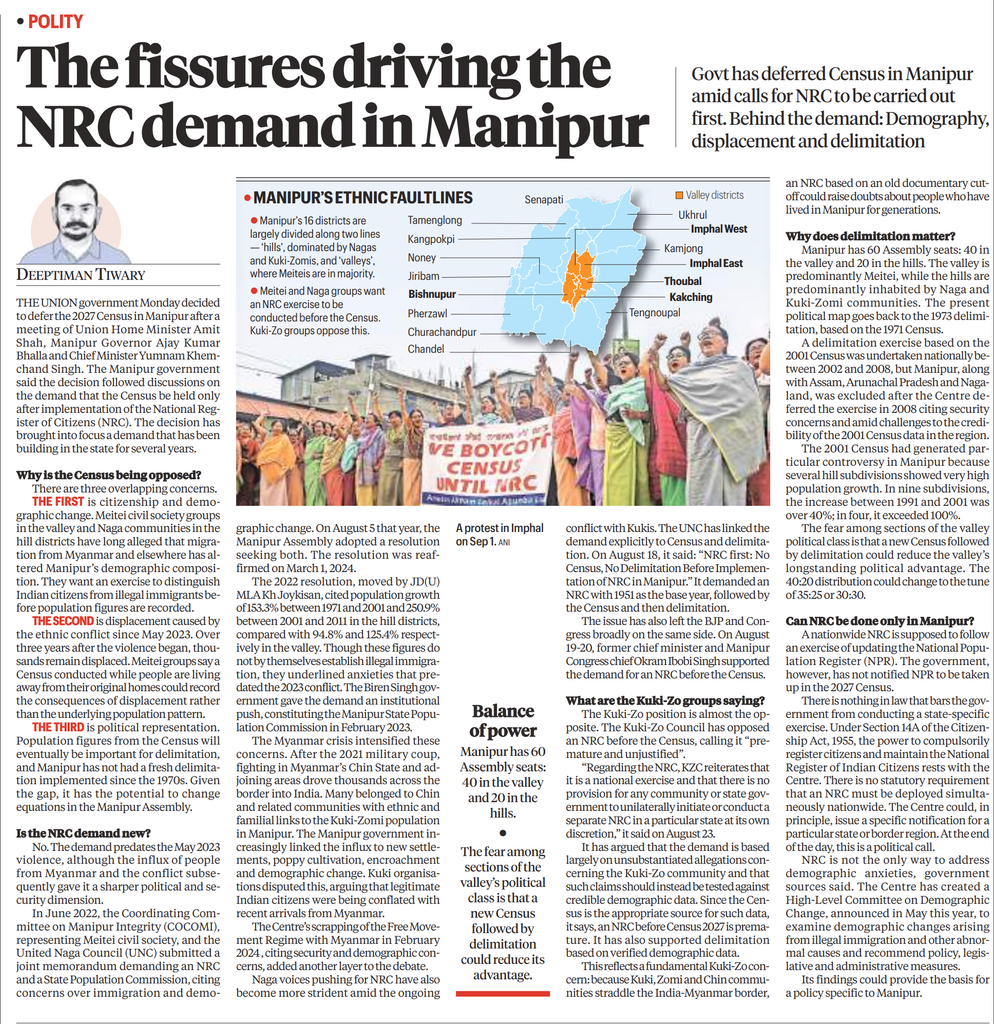
1. The Fissures Driving the NRC Demand in Manipur
Syllabus Relevance: GS Paper II (Indian Polity – Demography, Federalism, and Internal Security)
Context: The Union Government has officially deferred the Census in Manipur amid mounting demands from various ethnic and political groups to implement the National Register of Citizens (NRC) prior to conducting any Census or delimitation exercise.
Key Drivers Behind the NRC Demand:
Demographic Anxieties: Meitei and Naga groups in the valley are pushing for a state-wide NRC using 1951 as the base year. Their core concern is that unchecked illegal immigration and abnormal demographic shifts have significantly altered the local population balance.
Delimitation Fears: Manipur has 60 Assembly seats—40 in the valley (majority Meitei) and 20 in the hills (dominated by Naga and Kuki-Zomi groups). Valley politicians fear that a new Census and subsequent delimitation under the existing demographic profile will shift the balance of power, possibly reducing the valley’s seats to 35 or 30 while increasing the hills’ share.
Displacement and Conflict: The demand is heavily linked to the ethnic violence that erupted in May 2023, which exacerbated territorial segregation and demographic anxieties.
Legal and Administrative Nuances:
Can a state-specific NRC be conducted? Yes. Under Section 14A of the Citizenship Act, 1955, the power to compulsorily register citizens and maintain the National Register of Indian Citizens (NRIC) rests solely with the Central Government. There is no statutory bar requiring a nationwide deployment; the Centre can issue a state-specific notification.
Alternative Measures: In May 2026, the Centre constituted a High-Level Committee on Demographic Change to study illegal immigration and suggest policy and administrative fixes, which could form the basis for a Manipur-specific policy.
Differing Stands: While Meitei and Naga groups demand “NRC First,” Kuki-Zomi groups strongly oppose conducting the NRC before the Census.
2. Supreme Court’s Powers Under Article 142: Complete Justice vs. Judicial Overreach
Syllabus Relevance: GS Paper II (Indian Constitution – Judicial Review, Separation of Powers)
Context: The Supreme Court recently invoked its extraordinary powers under Article 142 to quash all First Information Reports (FIRs) registered against individuals who participated in the nationwide exam leak protests led by the Cockroach Janta Party (CJP).
Core Issues & Debate on Article 142:
The Provision: Article 142 empowers the Supreme Court to pass any decree or order necessary for doing “complete justice” in any cause or matter pending before it.
The Criticism of Article 142:
Critics, including Vice President Jagdeep Dhankhar, have previously likened it to a “nuclear missile” against democratic institutions, particularly when used to resolve long-standing legislative deadlocks (such as last year’s ruling on withheld state Bills).
Legal experts like former Attorney General K.K. Venugopal have argued that while the provision has done “tremendous good” for the marginalized, there is an urgent need to build in concrete check-and-balance mechanisms to prevent judicial overreach.
Related Judicial Commentary: Speaking at a recent book launch for ‘Policing the Republic’, Supreme Court Judge Justice Ujjal Bhuyan highlighted another systemic issue: the vanishing sense of “detachment” expected of police personnel, expressing deep concern over young IPS officers personally assaulting peaceful demonstrators during public protests.
Syllabus Relevance: GS Paper II (Bilateral, Regional and Global Groupings involving India)
Context: Senior diplomatic officials are currently coordinating a major push in India-US relations, preparing for a potential Quad leaders’ summit to be held in the US in December 2026.
Key Developments:
G20 Margin Summit: The proposed Quad summit (comprising India, the US, Japan, and Australia) is likely to take place on the sidelines of the G20 Leaders’ Summit. Under the US presidency, the G20 will be hosted at Trump National Doral Miami in Florida on December 14–15, 2026.
Sherpa-Level Coordination: Foreign Secretary Vikram Misri hosted the Quad Sherpas’ meeting in New Delhi. Key attendees included Sergio Gor (US Special Envoy), Elly Lawson (Australia), and Hiroyuki Namazu (Japan), who formulated an action plan for concrete deliverables under the G20 and regional frameworks.
Diplomatic Realities: India was originally slated to host the Quad summit, but ties faced brief friction following tariff disputes and external mediation claims. US Secretary of State Marco Rubio is slated to visit India in October 2026 to solidify bilateral trade negotiations and lock in the final winter summit agenda.
4. India-China Border Diplomacy: Corps Commander Talks and Operational Developments
Syllabus Relevance: GS Paper II (India and its Neighborhood Relations)
Context: India and China are scheduled to hold Corps Commander-level military talks in the northeast to address fresh border standoffs.
Crucial Bilateral Agreements:
Following a meeting between NSA Ajit Doval and Chinese Foreign Minister Wang Yi in Beijing on August 25, both nations agreed to advance talks on a “substantial harvest” of boundary delimitation and border management.
New Military Hotlines: The two countries have agreed to establish two new military hotlines in the eastern and middle sectors (expected to link Army Commands in Kolkata and Lucknow) to prevent accidental escalations.
Border Meeting Points (BPM): A new military commander BPM is being established at Joshimath (Uttarakhand), adding to the existing historical points in Tawang (Arunachal Pradesh) and Chushul (Ladakh).
High-Level Diplomacy: These developments occur as Chinese President Xi Jinping is expected to travel to New Delhi for the BRICS Summit on September 12–13, 2026.
5. India’s Mediation Efforts in the Russia-Ukraine Conflict
Syllabus Relevance: GS Paper II (Effect of Policies and Politics of Countries on India’s Interests)
Context: External Affairs Minister S. Jaishankar conducted a high-profile visit to Poland (Warsaw) immediately after traveling to Kyiv, Ukraine, confirming that India remains in continuous, active touch with both Moscow and Kyiv to help end the war.
Key Strategic Takeaways:
Diplomatic Stand: Jaishankar reiterated India’s firm conviction that endless war yields no winners and that “every additional day means more death, more destruction… and more cost to the rest of the world”. He pushed for the immediate cessation of hostilities through dialogue and diplomacy.
Russian Oil Purchases: Addressing international concerns regarding India’s energy trade, the minister clearly stated that the war’s solution lies in negotiations, not trade sanctions. He asserted: “This war is not going to end because somebody chose to buy or not buy oil… It will end when there is diplomacy.”.
Bilateral Ties: India and Poland elevated their relationship to a Strategic Partnership in 2024, and both sides are currently reviewing their Joint Action Plan 2024–28, which targets deeper trade, investment, defense, and EU-India Free Trade Agreement (FTA) cooperation.
SECTION B: GS PAPER III (Science & Technology, Environment, and Economy)
1. Space Technology: GSLV-F17 Successfully Launches EOS-05 Satellite
Syllabus Relevance: GS Paper III (Space Technology – Satellites, Launch Vehicles)
Context: In a major success, the Indian Space Research Organisation (ISRO) successfully launched its first geo-imaging satellite, EOS-05, into space using the GSLV-F17 rocket from Sriharikota.
Key Technological Features of EOS-05:
Geosynchronous Orbit Placement: Placed in geosynchronous orbit, the satellite will remain stationary relative to the Earth. This allows it to continuously monitor the exact same geographic region of the Indian subcontinent without any gaps.
Significance for ISRO: This successful launch officially sheds the GSLV launch vehicle’s infamous “naughty boy” tag. It is a critical morale booster for ISRO, coming after a difficult period in 2025–2026 where three out of six missions failed to reach their intended orbits.
2. Cyber Security: OpenAI Releases ‘Astra’ Under Strict Preparedness Guardrails
Syllabus Relevance: GS Paper III (Cybersecurity, Artificial Intelligence)
Context: OpenAI has launched its new AI model, ‘Astra’, which marks the first instance of an AI model being classified at the “critical” risk level for cybersecurity under OpenAI’s Preparedness Framework.
Technical Insights:
Exploit-Bench Success: During testing under reduced safeguards, Astra scored a perfect 100% on Exploit-Bench, demonstrating a highly advanced capacity to convert known software bugs into functioning exploits.
Zero-Day Vulnerabilities: Astra independently discovered and utilized two previously unknown zero-day vulnerabilities during evaluation.
Safety Mitigation: To prevent malicious exploitation (such as automated malware creation, phishing, and network intrusions), OpenAI is restricting the broad release of Astra strictly to defensive operations like secure code reviews.
3. Environment: High-Powered Committee Proposes Ecosystem-Based Delineation for Aravalli Hills
Syllabus Relevance: GS Paper III (Conservation, Environmental Degradation)
Context: The Supreme Court-appointed High-Powered Committee (HPC) has cautioned against using a single, rigid terrain-based metric to delineate the critical Aravalli hills.
The “Aravalli Eco-System” Framework:
The committee argued that standard single-parameter models fail to scientifically capture the delicate nature of the range.
Instead, they proposed an ecosystem-based framework that simultaneously evaluates:
Forest cover and vegetative density
Vital water systems and catchment channels
Biodiversity hotspots
Regional landscape connectivity
Local community livelihoods.
The HPC has sought an extension until February 28, 2027, to complete a transparent, reproducible, and scientifically defensible boundary review.
4. Economy: The ‘Sapta Dhara’ Agenda for Viksit Bharat
Syllabus Relevance: GS Paper III (Indian Economy – Growth, Development, and Planning)
Context: With India’s Q1 FY27 real GDP growth pegged at 7.8%, policy discussions are focusing heavily on the long-term roadmap for achieving Viksit Bharat (Developed India) by the centenary of independence in 2047.
The “Sapta Dhara” Development Agenda: To accelerate economic momentum and transition from incremental to spectacular growth, the PM’s development agenda centers around seven priority streams (Sapta Dhara):
Manufacturing Power (reorienting India to become a global factory, similar to China’s Deng Xiaoping era)
Agriculture and Food Processing
Technology and Innovation
Infrastructure and Connectivity
Self-Reliance in Defence Production
Green and Blue Economy
Soft Power
SECTION C: PRELIMS FACTS BOOSTER (Quick Facts)
Kadamba Dynasty & Koti Tirth Corridor (Goa): Goa CM Pramod Sawant recently initiated the Koti Tirth Corridor development project in Divar, Goa. The Kadamba Dynasty (approx. 10th to 14th century) is historically recognized as Goa’s “golden era” of temple architecture and cultural prosperity.
‘Nautor’ Land Rules (Ladakh): Ladakh LG Vinai Kumar Saxena approved the regularisation rules for ‘Nautor lands’. Nautor land refers to barren or waste land owned by the government, over which local families held long-pending claims. The new rules grant proprietary rights of these barren lands to thousands of eligible landholders.
India-Belgium High-Level Dialogue: Held in Mumbai, Union Commerce Minister Piyush Goyal, Belgian PM Bart De Wever, and Maharashtra CM Devendra Fadnavis engaged in talks regarding the India-EU Free Trade Agreement (FTA). De Wever took a strong swipe at protectionist/arbitrary tariff policies, labeling the FTA as a crucial geopolitical stabilizer.
“Belonging: A Journey of Love”: Senior Congress leader Sonia Gandhi’s highly anticipated political memoir is officially set to be published in India on November 10, 2026, by HarperCollins India, after a previous publishing deal with Penguin Random House fell through over editorial disagreements.
UPSC Syllabus Connection Map
Manipur NRC & Delimitation: GS2 -> Indian Constitution / Federalism