India’s Recalibrated Trade and Investment Policy: Balancing Openness & Strategic Autonomy
Context
India is transitioning toward a calibrated trade and investment strategy by selectively relaxing Foreign Direct Investment (FDI) norms, anti-dumping measures, and e-commerce regulations. This pivot aims to strengthen domestic manufacturing, integrate India into Global Value Chains (GVCs), and attract foreign capital while preserving Strategic Autonomy amidst US-China geopolitical competition.
Why is India Recalibrating its Policy?
- The “China Plus One” Capital Constraint: While Press Note 3 (2020) successfully restricted adversarial Chinese equity, it failed to bridge the trade deficit, which crossed USD 112 billion in FY25-26. India realized that replacing Chinese supply chains requires foreign capital and affordable intermediate goods.
- The PLI Competitiveness Paradox: The success of the Production-Linked Incentive (PLI) scheme depends on low-cost inputs. However, rigid anti-dumping duties on Chinese Active Pharmaceutical Ingredients (APIs), electronics, and specialty chemicals inflated raw material costs, rendering Indian finished goods uncompetitive globally.
- Bureaucratic Friction in Capital Formation: The mandatory inter-ministerial screening under Press Note 3 created institutional bottlenecks. It deterred legitimate global venture capital funds that had minor, passive Chinese Limited Partners (LPs).
- Mitigating US Trade Coercion: Easing inventory-based e-commerce FDI (strictly for exports) and banning forced-labor imports are tactical moves. They are designed to secure US market access and deter potential secondary US tariffs on India’s booming export sector.
How is India Balancing Liberalization with Strategic Interests?
- The “Small Yard, High Fence” Doctrine: In early 2026, India relaxed FDI norms to allow companies with up to 10% beneficial ownership from land-bordering countries to invest via the automatic route. This secures manufacturing capital while maintaining rigorous scrutiny over critical infrastructure and controlling stakes.
- Prioritizing Domestic Value Addition (DVA): Echoing the Economic Survey 2023-24, the government recognized that incentivizing Chinese firms to manufacture locally for Western exports generates higher DVA than merely importing intermediate goods.
- Selective Trade Defense: The Ministry of Finance has increasingly rejected Directorate General of Trade Remedies (DGTR) recommendations for anti-dumping duties (with ~72% of China-related rejections between 2000 and late 2025). This protects downstream, export-oriented MSMEs by keeping raw materials (capital goods) affordable, even if it pressures upstream producers.
- Multi-alignment in Digital Trade: By allowing e-commerce FDI solely for exports, India satisfies the lobbying of US Big Tech (like Amazon) without exposing its massive domestic retail market to predatory pricing.
Key Concerns: The “Trojan Horse” Dilemma
- Assembly vs. True Manufacturing: Heavily relying on cheap intermediate imports risks trapping India in the “screwdriver technology” phase—becoming a low-margin assembly hub rather than an indigenous manufacturing powerhouse.
- Erosion of Institutional Credibility: The Finance Ministry’s unreasoned executive rejections of data-backed DGTR investigations create regulatory opacity. This exposes primary domestic producers (like steel and chemicals) to state-subsidized foreign dumping.
- Weaponisation of Bilateral Dependencies: Relying on China for intermediate goods and the US for export markets places India in a geoeconomic crossfire. Sudden US-China tariff escalations could severely threaten India’s macroeconomic stability.
- Ideological Friction: Overriding WTO-compliant anti-dumping mechanisms is viewed by domestic lobbies as a compromise on the Atmanirbhar Bharat ethos, potentially leading to capacity underutilization and job losses in local industries.
Way Forward
- Enact a Statutory “Public Interest Test”: Amend the Customs Tariff Act, 1975, to require the Ministry of Finance to publish reasoned, transparent economic justifications when rejecting DGTR recommendations. This will balance downstream export benefits against upstream MSME survival.
- Shift to Value-Addition Linked Incentives (VALI): Restructure the PLI scheme to subsidize verified percentage growth in Domestic Value Addition (DVA) rather than gross output volume. Mandatory tech-transfer clauses should govern joint ventures with land-bordering nations.
- Strengthen Customs Rules of Origin: Deploy blockchain-enabled origin-auditing under CAROTAR, 2020 to prevent adversarial firms from circumventing tariffs via third-country transit hubs (e.g., ASEAN FTAs) without genuine domestic value addition.
- Deepen Middle-Power Tech Partnerships: Expand the US–India TRUST Initiative (successor to iCET) and forge semiconductor/deep-tech alliances with trusted middle powers like Japan and South Korea to transcend the US-China binary.
Relevant UPSC Previous Year Questions (PYQs)
Prelims
Q. Consider the following: (UPSC CSE Prelims 2021)
- Foreign currency convertible bonds
- Foreign institutional investment with certain conditions
- Global depository receipts
- Non-resident external depositsWhich of the above can be included in Foreign Direct Investments?(a) 1, 2 and 3(b) 3 only(c) 1 and 3(d) 2 and 4Answer: (a)
Q. With reference to foreign direct investment in India, which one of the following is considered its major characteristic? (UPSC CSE Prelims 2020)
(a) It is the investment through capital instruments essentially in a listed company.
(b) It is a largely non-debt creating capital flow.
(c) It is the investment which involves debt-servicing.
(d) It is the investment made by foreign institutional investors in the Government securities.
Answer: (b)
Mains
Q1. (GS Paper 3, 2024) Discuss the rationale of the Production Linked Incentive (PLI) scheme. What are its achievements? In what way can the functioning and outcomes of the scheme be improved? (250 words, 15 Marks)
Q2. (GS Paper 3, 2020) Explain the rationale behind the Goods and Services Tax (Compensation to States) Act of 2017. How has COVID-19 impacted the GST compensation fund and created new federal tensions? (Linked to broader trade/tax shifts and state-level manufacturing friction)
Q3. (GS Paper 3, 2017) “Account for the failure of the manufacturing sector in achieving the goal of labour-intensive exports rather than capital-intensive exports. Suggest measures for more labour-intensive rather than capital-intensive exports.” (Highly relevant to the ‘Screwdriver Technology/Assembly’ dilemma)
India’s Triumph Over Left-Wing Extremism: The Journey to a Naxal-Free Nation
Context
On March 31, 2026, India marked a historic milestone in internal security by becoming effectively free from Left-Wing Extremism (LWE) after nearly six decades. This achievement is the result of a paradigm shift from ad hoc, reactive containment to an integrated, whole-of-government strategy grounded in three pillars: Vishwaas (Trust), Nirman (Infrastructure), and Jan Kalyan (Welfare).
Background: The Rise and Peak of LWE
- Origins: The Naxalite movement originated in 1967 in Naxalbari, West Bengal, drawing ideological inspiration from Maoism and armed agrarian revolution.
- Consolidation: In 2004, various extremist factions merged to form the CPI (Maoist), expanding violence across the “Red Corridor” spanning Central and Eastern India.
- Peak Violence: In 2009, the government acknowledged Naxalism as India’s gravest internal security challenge. Violence peaked in 2010, recording 1,936 incidents and over 1,005 civilian and security personnel fatalities.
- Historical Policy Gaps: Prior to 2015, responses were fragmented. States operated in silos with limited central coordination, and security operations were severely hindered by dense forests, intelligence gaps, and a lack of basic infrastructure.
The National Policy and Action Plan (2015)
In 2015, India adopted a comprehensive, three-pronged strategy—Security, Development, and Coordination. The Ministry of Home Affairs (MHA) spearheaded this integrated approach, replacing the security vacuum with a robust state presence.
The Three Pillars of Transformation
1. Vishwaas (Security & Trust)
Vishwaas aimed to rebuild trust by establishing a sustained state presence, dismantling the Naxal ecosystem, and bridging the gap between security agencies and tribal communities.
- Expanded Security Grid: 597 fortified police stations and 408 new Central Armed Police Force (CAPF) camps were established in former strongholds.
- Elite Force Interoperability: A layered security architecture was created, integrating the CRPF’s CoBRA commandos with state-specific elite units like the District Reserve Guard (DRG) in Chhattisgarh, Jharkhand Jaguar, and Andhra Pradesh’s Greyhounds.
- Trace, Target, Neutralise Doctrine: Intelligence-driven campaigns like Operation Black Forest, Operation Octopus, and Operation Double Bull systematically dismantled Maoist leadership structures.
- Choking Terror Finance: The National Investigation Agency (NIA) and the Enforcement Directorate (ED) collaborated in a “Whole-of-Agency” approach, seizing assets worth over ₹92 crore combined and filing over 100 charge sheets by mid-2026.
- Surrender & Rehabilitation Policy: By offering immediate grants (₹2.5 to ₹5 lakh), a monthly stipend (₹10,000 for 36 months), and vocational training, the state facilitated 3,927 surrenders between 2024 and 2026.
2. Nirman (Infrastructure & Connectivity)
Nirman focused on breaking geographical isolation, ensuring that security gains were immediately followed by physical and digital integration.
- Roads & Mobility: Over 12,249 km of roads were constructed to connect inaccessible villages to district headquarters. Night-landing helipads enabled rapid casualty evacuation and troop movement.
- Digital Inclusion: Bridging the digital divide, 9,600 mobile towers were installed, covering 96% of villages in the most affected regions, paving the way for e-governance and online education.
- Financial & Educational Outreach: The state deployed over 74,000 banking correspondents and established 1,804 bank branches. Simultaneously, 179 Eklavya Model Residential Schools were operationalized for tribal youth.
3. Jan Kalyan (Welfare, Dignity & Mainstreaming)
Jan Kalyan focused on last-mile welfare delivery and empowering indigenous communities through targeted governance.
- Targeted Schemes: Interventions under the Aspirational Districts Programme, PM-JANMAN (for Particularly Vulnerable Tribal Groups), and the Dharti Aaba Janjatiya Gram Utkarsh Abhiyan aggressively bridged human development gaps.
- The Chhattisgarh/Bastar Model: Once the epicenter of LWE, the Bastar region’s turnaround was driven by local inclusion. The Bastariya Battalion (formed 2017) recruited local youth, while initiatives like the Bastar Olympics promoted cultural identity. Former CAPF camps were converted into Seva Deras (service centers) providing banking, medical, and agricultural support.
Key Takeaways & Conclusion
The systematic reduction of LWE—from 126 affected districts in 2014 to just two isolated pockets in 2026—proves that kinetic military action alone cannot defeat insurgencies rooted in socio-economic deprivation. The success of India’s strategy lies in the inseparable chain of progress: robust security creates the space for infrastructure development, which in turn strengthens public trust and accelerates inclusive welfare.
Relevant UPSC Previous Year Questions (PYQs)
Mains
Q. The Government of India recently stated that Left Wing Extremism (LWE) will be eliminated by 2026. What do you understand by LWE and how are the people affected by it? What measures have been taken by the government to eliminate LWE? (2025)
Q. Naxalism is a social, economic and developmental issue manifesting as a violent internal security threat. In this context, discuss the emerging issues gest a multilayered strategy to tackle the menace of Naxalism. (2022)
Q. What are the determinants of left-wing extremism in the Eastern part of India? What Strategy should the Government of India, civil administration and security forces adopt to counter the threat in the affected areas? (2020)
Q. The persisting drives of the government for development of large industries in backward areas have resulted in isolating the tribal population and the farmers who face multiple displacements. With Malkangiri and Naxalbari foci, discuss the corrective strategies needed to win the Left Wing Extremism (LWE) doctrine that affected citizens back into the mainstream of social and economic growth. (2015)
Prelims
Q. Consider the following pairs regarding state-specific specialized anti-Naxal forces: (UPSC Pattern Mock)
- Greyhounds : Andhra Pradesh and Telangana
- District Reserve Guard (DRG) : Chhattisgarh
- Special Operation Group (SOG) : Odisha
- Jharkhand Jaguar : Jharkhand
How many of the above pairs are correctly matched?
(a) Only one pair
(b) Only two pairs
(c) Only three pairs
(d) All four pairs
Answer: (d)
Pradhan Mantri Viksit Bharat Rojgar Yojana (PM-VBRY): Accelerating Workforce Formalisation
Context
On August 1, 2026, the Pradhan Mantri Viksit Bharat Rojgar Yojana (PM-VBRY) completed its first year of implementation. By incentivizing both job creation and social security enrollment, the scheme marks a critical milestone in India’s ongoing efforts to transition its workforce from the informal economy to the organized sector.
Key Features of the PM-VBRY
- Implementation & Outlay: Administered by the Employees’ Provident Fund Organisation (EPFO), the scheme runs from August 1, 2025, to July 31, 2027, with a massive financial outlay of ₹99,446 crore.
- Employment Target: It aims to generate formal employment for over 3.5 crore people, specifically targeting 1.92 crore first-time employees.
- Synergy with National Manufacturing: The scheme explicitly supports the National Manufacturing Mission by providing extended incentives to labor-intensive manufacturing sectors, aiding the creation of a robust industrial workforce.
Supporting labor-intensive manufacturing employment. Source: Bloomberg / Bloomberg via Getty Images
The Two-Part Incentive Framework
The core innovation of PM-VBRY is its dual-incentive model, subsidizing both the supply (employees) and demand (employers) sides of formal labor:
- For First-Time Employees:
- Applicable to those earning up to ₹1 lakh per month.
- Provides a one-time incentive equal to one month’s EPF wage (capped at ₹15,000).
- Behavioral Nudge: Disbursed in two tranches (at 6 months and 12 months). The second tranche requires the completion of a financial literacy program, and a portion is mandated for long-term savings.
- For Employers:
- Employers receive a wage subsidy of up to ₹3,000 per month for two years for each eligible new hire retained for at least six months.
- For the manufacturing sector, this subsidy is extended into the third and fourth years to offset the long-term costs of capacity expansion.
Impact and First-Year Achievements (2025–2026)
- Workforce Expansion: Over 72 lakh first-time employees entered the formal workforce, and more than 15 lakh beneficiaries have already received direct employment-linked financial incentives.
- Gender Inclusion: Notably, 30% of the beneficiaries are women, indicating a positive shift toward female labor force participation in the organized sector.
- Leakage-Free Digital Delivery: The scheme operates on a 100% digital architecture using Aadhaar authentication, Universal Account Numbers (UANs), and Electronic Challan-cum-Return (ECR) filings. Subsidies are routed exclusively via Direct Benefit Transfer (DBT) to Aadhaar-linked bank accounts.
- Institutional Convergence: Implementation is monitored via a real-time portal, driven by cross-functional teams from the EPFO, Employees’ State Insurance Corporation (ESIC), and the Chief Labour Commissioner (CLC).
Conclusion
The PM-VBRY represents a shift from passive welfare to active labor market intervention. By lowering the cost of formal hiring for firms and guaranteeing social security for vulnerable workers, the scheme is instrumental in translating India’s demographic dividend into sustainable, formalized economic growth in the run-up to Viksit Bharat 2047.
Relevant UPSC Previous Year Questions (PYQs)
Prelims
Q. With reference to the ‘Employees’ Provident Fund Organisation (EPFO)’, consider the following statements: (UPSC Mock/Trend)
- It is a statutory body under the Ministry of Labour and Employment.
- It administers the Employees’ Pension Scheme (EPS) alongside the Provident Fund.
- Universal Account Number (UAN) allows portability of PF accounts across different employers.Which of the statements given above are correct?(a) 1 and 2 only(b) 2 and 3 only(c) 1 and 3 only(d) 1, 2 and 3Answer: (d)
Q. Disguised unemployment generally means (UPSC CSE Prelims 2013)
(a) large number of people remain unemployed
(b) alternative employment is not available
(c) marginal productivity of labour is zero
(d) productivity of workers is low
Answer: (c) (Note: Schemes like PM-VBRY aim to pull surplus labor from disguised informal roles into formal, productive manufacturing sectors).
Mains
Q1. (GS Paper 3, 2023) “Most of the unemployment in India is structural in nature.” Examine the methodology adopted to compute unemployment in the country and suggest improvements. (15 Marks, 250 Words)
Q2. (GS Paper 3, 2019) “Economic growth in the recent past has been led by an increase in labour productivity.” Explain this statement. Suggest the growth pattern that will lead to creation of more jobs without compromising labour productivity. (15 Marks, 250 Words)
India at the 2026 Commonwealth Games: Performance, Milestones, and Challenges
Context
India finished 4th at the 2026 Commonwealth Games (CWG) in Glasgow, securing 39 medals despite a reduced contingent and the exclusion of traditionally strong sports. During the closing ceremony, Olympic champion Neeraj Chopra received the Commonwealth Flag, marking India’s official takeover as the host nation for the centenary 2030 Commonwealth Games in Ahmedabad. Jaismine Lamboria (Boxing Gold medalist) led the Indian contingent as the flag bearer.
India’s Performance at Glasgow 2026
- Final Medal Tally: India secured the 4th position globally with 39 medals (13 Gold, 17 Silver, and 9 Bronze), finishing behind Australia, England, and Canada.
- The Contingent Challenge: This feat was achieved despite competing with a reduced contingent of just 122 athletes. The reduction was due to doping-related eligibility restrictions and the exclusion of medal-rich sports like shooting, wrestling, badminton, hockey, and table tennis (which accounted for 25 of India’s 61 medals at Birmingham 2022).
- Improved Conversion Rate: While the absolute medal count was lower than in 2022, the smaller contingent delivered an improved medal success rate of 31% (up from 29% in 2022).
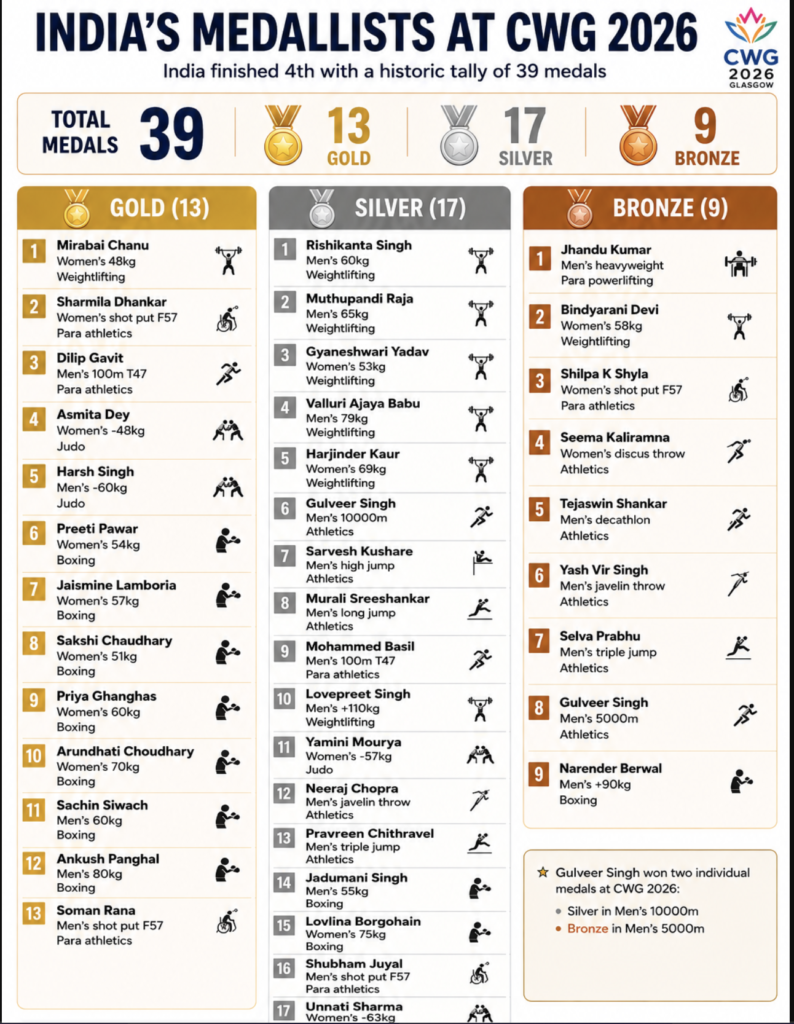
Historic Firsts & Major Achievements
| Discipline/Athlete | Key Achievement at Glasgow 2026 |
| Boxing | Most successful discipline with 10 medals (7 Gold, 3 Silver). Recorded the highest boxing gold tally by any nation at a single CWG. Women boxers led with 5 golds. |
| Para Sports | Best-ever CWG para campaign with 7 medals, equalling the combined tally from all previous editions. |
| Mirabai Chanu (Weightlifting) | Scripted history as the first Indian weightlifter to win three consecutive CWG gold medals (2018, 2022, 2026). |
| Asmita Dey & Harsh Singh (Judo) | Became India’s first-ever Commonwealth Games gold medalists in Judo. |
| Tejaswin Shankar (Decathlon) | Became the first Indian to win a CWG medal in the decathlon (Bronze). |
| Gulveer Singh (Track & Field) | Emerged as India’s sole double medalist in Glasgow (Silver in men’s 10,000m, Bronze in 5,000m). |
| Neeraj Chopra (Javelin) | Returned to the CWG to secure a silver medal after missing the 2022 edition. |
Background: The Commonwealth Games (CWG)
- Origin: The CWG is the world’s second-largest multi-sport event (after the Olympics). It originated from the 1911 Inter-Empire Championships and was first officially held in 1930 in Hamilton, Canada, as the British Empire Games.
- Governing Body: The Commonwealth Games Federation (CGF) directs and controls the Games, which feature athletes from 71 nations and territories (mostly former British colonies).
- India’s CWG History: India debuted at the 1934 London Games. Rashid Anwar won India’s first medal (Bronze, Wrestling), and Milkha Singh won the first individual gold (1958 Cardiff).
- Hosting Rights: India recorded its best-ever performance as the host of the 2010 New Delhi Games (101 medals, 2nd overall). Ahmedabad will host the 2030 edition.
Mains Perspective: India’s Doping Challenge
- Global Anti-Doping Concern: According to the World Anti-Doping Agency (WADA) 2024 Testing Figures Report, India recorded a 3.6% positivity rate. This is the highest among countries conducting over 5,000 tests for the third consecutive year.
- Impact on CWG 2026: Multiple Anti-Doping Rule Violations (ADRVs) led to the loss of a weightlifting quota, penalizing clean, qualified athletes and reducing India’s overall contingent.
- Threat to Global Ambitions: Persistent doping cases undermine India’s sporting credibility precisely as the country prepares to host the 2030 CWG and bids for the 2036 Olympic Games.
- Need for Institutional Reforms: There is an urgent need to strengthen the National Anti-Doping Agency (NADA) through intelligence-led enforcement, robust athlete education on supplements, and strict penal action against the broader ecosystem, including coaches, doctors, and traffickers.
UPSC Previous Year Questions (PYQs)
Prelims
Q1. Consider the following statements in respect of the 44th Chess Olympiad, 2022: (UPSC CSE 2023)
- It was the first time that the Chess Olympiad was held in India.
- The official mascot was named ‘Thambi’.
- The trophy for the winning team in the open section is the Vera Menchik Cup.
- The trophy for the winning team in the women’s section is the Hamilton-Russell Cup.How many of the statements given above are correct?A. Only oneB. Only twoC. Only threeD. All fourAnswer: B (Statements 1 and 2 are correct. The Vera Menchik Cup is for the women’s section, and the Hamilton-Russell Cup is for the open section).
Q2. Consider the following statements in respect of the 32nd Summer Olympics: (UPSC CSE 2021)
- The official motto for this Olympics is ‘A New World’.
- Sport Climbing, Surfing, Skateboarding, Karate and Baseball are included in this Olympics.Which of the above statements is/are correct?(a) 1 only(b) 2 only(c) Both 1 and 2(d) Neither 1 nor 2Answer: (b)
Q3. Consider the following statements: (UPSC CSE 2010)
- The Commonwealth has no charter, treaty or constitution.
- All the territories/countries once under the British empire (jurisdiction/rule/mandate) automatically joined the Commonwealth as its members.Which of the statements given above is/are correct?(a) 1 only(b) 2 only(c) Both 1 and 2(d) Neither 1 nor 2Answer: (a)
Mains Practice Question
Q. (GS Paper 2 – Governance / GS Paper 3 – Internal Security & Ethics)
Despite significant improvements in India’s global sporting performances, the rising instances of doping present a severe challenge to sports governance and ethics. Analyze the institutional loopholes in India’s anti-doping framework and suggest measures to ensure a clean sporting ecosystem ahead of India’s bid for the 2036 Olympics. (250 words, 15 marks)