I. Polity & Governance
Internet Shutdowns in India
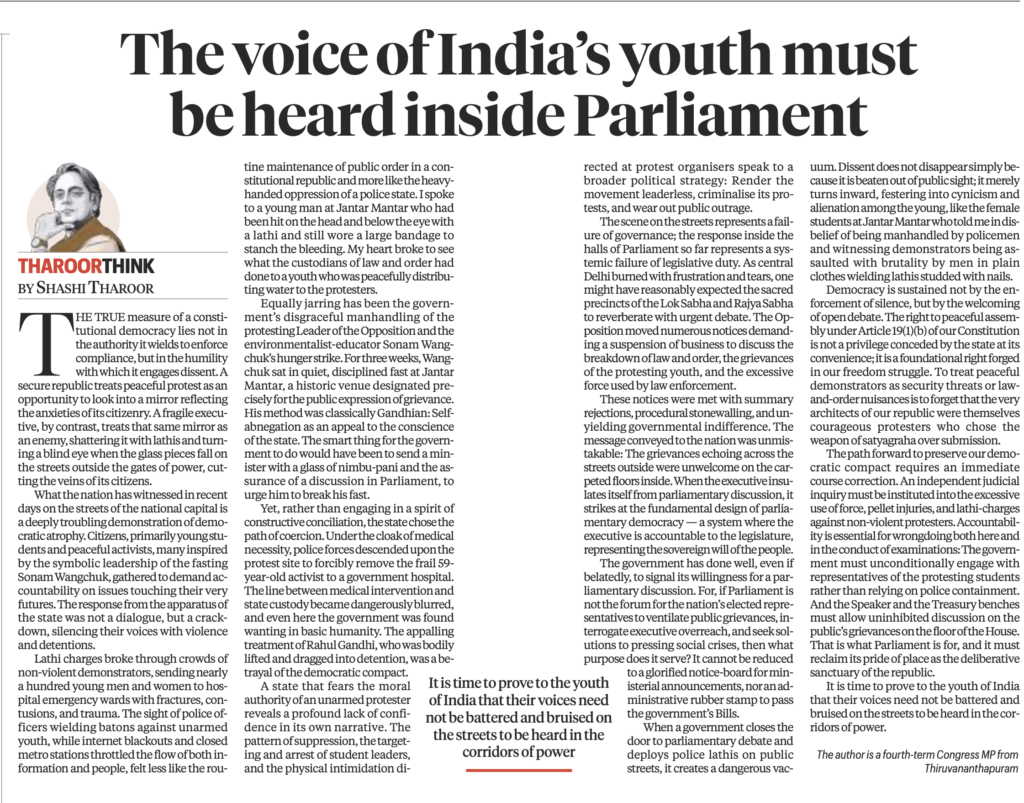
Recent suspensions of mobile internet during the July 2026 protests in Central Delhi have reignited debates over the legality, proportionality, and transparency of internet shutdowns.
- Legal Framework: Governed by the Telecommunications Act, 2023 and the Telecommunications (Temporary Suspension of Services) Rules, 2024.
- The Grounds: Telecom services can only be suspended in cases of public emergency or public safety. A protest by itself is not a lawful ground. Under the 2024 rules, suspensions cannot remain in force for more than 15 days.
- Judicial Stance (Anuradha Bhasin Case, 2020): The Supreme Court ruled that internet access is closely tied to fundamental rights under Article 19(1)(a) (freedom of speech) and 19(1)(g) (freedom of trade). Shutdowns must pursue a legitimate objective, be limited in scope, published, and proportionate.
- Current Concerns: Despite the 2024 Rules, many states continue to bypass procedural safeguards (sometimes invoking older, repealed acts). The lack of published orders and unchecked economic disruption (costing India an estimated USD 255.2 million in 2023) remain major issues.
SC Sets Aside Death Sentence, Upholds Fair Trial
In Abdul Hameed v. State of Rajasthan, the Supreme Court set aside a death sentence in the 1996 Samleti Bus Bomb Blast case, ordering a fresh trial due to the denial of effective legal representation.
- Core Ruling: The constitutional guarantee of a fair trial is “absolutely non-negotiable.” Due process cannot be sacrificed for retribution.
- Constitutional Safeguards:
- Article 21: Expanded by courts to include the right to a fair trial and free legal aid.
- Article 22(1): Guarantees the right to consult and be defended by a legal practitioner.
- Article 39A: Directs the State to provide free legal aid.
- Statutory Backing: Section 341 of the BNSS, 2023 (formerly Sec 304 CrPC) mandates court-assigned, state-funded advocates for indigent accused.
II. Economy & Monetary Policy
Revival of Polymer Currency Notes
The RBI is reviving a decade-old plan to introduce polymer (plastic) currency notes, starting with lower denominations like ₹10 and ₹20.
| Feature | Details |
| What are they? | Banknotes made from Biaxially Oriented Polypropylene (BOPP) rather than the traditional 100% cotton-pulp paper. |
| Benefits | Highly durable, water/tear-resistant, and last 2.5 to 4 times longer. They feature embedded transparent windows making them much harder to counterfeit. |
| Why now? | Under the RBI’s Clean Note Policy, 20-24 billion soiled notes are destroyed annually. India spends ~₹5,000 crore yearly replacing them. |
| Challenges | Polymer notes cost 30–60% more to produce initially and require importing polypropylene. ATMS and sorting machines will also require expensive recalibration. |
The “Currency Demand Paradox”: Despite the massive boom in UPI (handling ~85% of retail digital payments), physical currency in circulation has actually increased to over ₹41 lakh crore (2025–26). Cash remains indispensable for the informal economy and rural areas.
III. Science, Technology & Environment (Rapid Fire)
1. New Exoplanet Discovered (Beta Pictoris d)
Atmospheric composition of Beta Pictoris d. Source: NASA Science
Astronomers using NASA’s James Webb Space Telescope (JWST) have discovered Beta Pictoris d, a hidden gas giant in the Beta Pictoris star system (~63 light-years away).
- Characteristics: It is a gas giant with at least twice the mass of Jupiter, orbiting far from its star in a bright debris disk.
- Significance: It is the first directly imaged exoplanet discovered primarily through moderate-resolution spectroscopy, identifying it via atmospheric chemical fingerprints (like carbon monoxide, water vapor, and methane) rather than traditional direct imaging.
2. White-bellied Heron Conservation
White-bellied Heron in its riverine habitat. Source: Jason Edwards / Getty Images
A proposed 1,200 MW hydropower project on Arunachal Pradesh’s Lohit River is threatening the White-bellied Heron, one of the world’s most critically endangered birds.
- Status: Critically Endangered (IUCN Red List); Schedule-I (Wildlife Protection Act, 1972).
- Population: Fewer than 60 individuals globally. India has only 6–9 individuals remaining across the Noa-Dehing, Lahm, and Lohit rivers.
- Habitat Sensitivity: They are extremely sensitive to altered river flows and water turbidity caused by hydropower dams.
3. Borophene-Based Green Lubricant
Researchers at the Institute of Advanced Study in Science and Technology (IASST) have successfully used borophene (a 2D nanomaterial made entirely of boron) as an additive in castor oil. Adding just 0.1 wt.% borophene reduced friction by 42%, vastly improving machinery efficiency and establishing a highly effective, biodegradable “green” lubricant.
4. Crowd Control Weapons: Pellet Guns & Shock Batons
Following recent protests in Delhi, crowd-control tools are back under scrutiny.
- Pellet Guns: Firing hundreds of lead pellets, they are designated as “non-lethal” but can cause fatal injuries or permanent blindness if fired incorrectly. Standard protocols mandate firing “below the waist.”
- Shock Batons: Handheld electroshock devices used by forces like the RAF. They deliver high-voltage, low-current shocks to incapacitate targets temporarily without long-term injury.