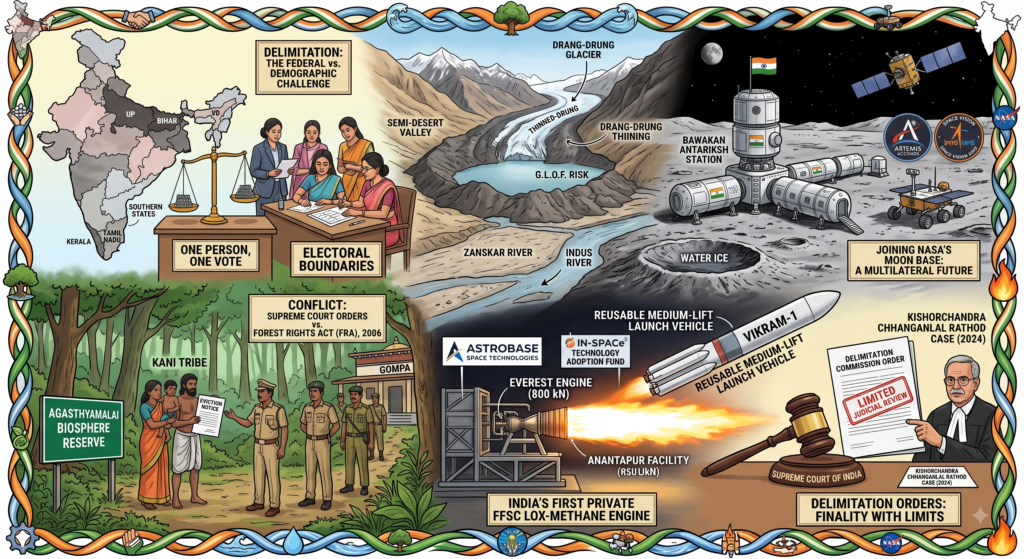
Delimitation in India
Syllabus Relevance: GS Paper 2 (Indian Constitution, Elections, Statutory Bodies, Federalism)
Keywords: Delimitation Commission, Census, Articles 81 & 82, Nari Shakti Vandan Adhiniyam (2023), North-South Divide, Gerrymandering.
Context
The delimitation of Lok Sabha constituencies is re-emerging as a pivotal political issue ahead of the 2029 General Elections. The upcoming 2027 digital Census is expected to trigger fresh delimitation under Articles 81 and 82. This has sparked debates over the potential shift of political power toward populous northern states, threatening the demographic and federal balance with southern states.
What is Delimitation?
Delimitation is the act of redrawing the boundaries of Lok Sabha and State Legislative Assembly constituencies to reflect changes in population.
- Core Objective: To uphold the democratic ideal of “One Person, One Vote, One Value” by ensuring equal voter representation across seats.
- Marginalized Representation: It identifies and allocates reserved constituencies for Scheduled Castes (SC) and Scheduled Tribes (ST).
- Constitutional Mandate:
- Article 82: Empowers Parliament to enact a Delimitation Act after every Census to readjust Lok Sabha seats.
- Article 170: Mandates similar readjustments for State Legislative Assemblies.
- Article 329(a): Protects delimitation laws from judicial scrutiny.
The Delimitation Commission
An independent, high-powered statutory body constituted under a parliamentary Delimitation Act. It has been set up four times (1952, 1963, 1973, and 2002).
- Composition: Three members—a serving or retired Supreme Court Judge (Chairperson), the Chief Election Commissioner (or nominee), and the respective State Election Commissioners.
- Judicial Review: Historically, orders have statutory finality. However, the Supreme Court in the Kishorchandra Chhanganlal Rathod case (2024) ruled that orders can face limited judicial review if manifestly arbitrary or violative of constitutional values.
- The Seat Freeze:
- 42nd Amendment (1976): Froze Lok Sabha seat allocations based on the 1971 Census so states practicing population control weren’t penalized.
- 84th Amendment (2001): Extended this freeze until the publication of the first Census post-2026. (The 2002 Commission redrew internal state boundaries based on the 2001 Census, but inter-state seat allocation remained fixed to 1971 data).
Key Challenges & Concerns
1. The Federal vs. Demographic Dilemma (North-South Divide)
Applying a strict population-based formula will penalize southern states (e.g., Kerala, Tamil Nadu) that successfully implemented national family planning policies. Conversely, northern states with historically higher growth rates (e.g., UP, Bihar) will gain a massive influx of seats. This threatens to reduce the South’s influence over national policies, resource allocation, and constitutional amendments.
2. Linkage to Women’s Reservation
The Nari Shakti Vandan Adhiniyam, 2023 (providing 33% reservation for women in Lok Sabha and Assemblies) is contingent on the next delimitation. If federal disputes delay delimitation, women’s reservation will inherently be delayed.
3. Census Delays and Political Mistrust
The decadal 2021 Census was indefinitely delayed by COVID-19. Subsequent attempts to use outdated 2011 data via the failed Constitution (131st Amendment) Bill, 2026 triggered severe opposition mistrust. While the 2027 digital census may be faster, the overall delimitation process is highly time-consuming and risks missing the 2029 election deadline.
4. Logistical Burden of a Larger Parliament
Currently, the Lok Sabha has 543 elected seats (Article 81 caps it at 550). The defeated 131st Amendment proposed a ceiling of 850 seats. Accommodating 800+ MPs would severely limit individual speaking time, complicate legislative debates, and create immense administrative hurdles.
5. Threat of Gerrymandering and Sub-Nationalism
Redrawing internal state boundaries leaves room for electoral manipulation, risking regional grievances and sub-nationalist protests. Tactics include:
- Cracking: Dispersing opposition voters across multiple districts to dilute their voting power.
- Packing: Concentrating opposition voters into a few districts to waste their excess votes and minimize their overall seat count.
Proposed Reforms for a Consensus-Based Approach
To ensure fairness, experts suggest moving beyond purely mathematical population counts to a more nuanced framework:
- Pro-Rata Seat Augmentation (Blanket Increase): Increase the total Lok Sabha seats by a flat percentage (e.g., a 50% jump from 543 to ~815) while retaining the existing 1971 state-wise ratios. The latest Census would be used strictly for intra-state boundary redrawing to fix urban-rural disparities.
- Weighted Representation Formula: Similar to Finance Commission metrics, representation could rely on a balanced matrix (requiring a constitutional amendment):
- Population (50%) – Upholds “One Person, One Vote.”
- Demographic Performance / TFR (25%) – Rewards successful family planning.
- Economic/Development Index (15%) – Factors in HDI, GST contributions, and fiscal discipline.
- Geographic Area (10%) – Protects large, low-density states.
- Decoupling Women’s Reservation: Pass a constitutional amendment to implement the 33% quota within the existing 543-seat matrix, preventing this vital reform from being held hostage by federal delimitation disputes.
- Bicameral Rebalancing (Empowering Rajya Sabha): Adopt the US or Australian Senate model, giving all states equal representation in the Upper House regardless of population, and strengthen its veto power over financial legislation to check demographic majoritarianism.
- Enhancing Institutional Transparency:
- Voting Rights for Associate Members: Give the 5 MPs and 5 MLAs assisting the Delimitation Commission binding voting rights to prevent packing and cracking.
- Inter-State Council Consultations: The Union must utilize Article 263 to debate the methodology with Chief Ministers before finalizing terms.
- Algorithmic Mapping: Mandate open-source Geographic Information System (GIS) algorithms to draw objective, contiguous boundaries, backed by public hearings and civil society audits.
Prelims
Q. How many Delimitation Commissions have been constituted by the Government of India till December 2023? (2024)
(a) One
(b) Two
(c) Three
(d) Four
Ans (d)
Q. With reference to the Delimitation Commission consider the following statements:
- The orders of the Delimitation Commission cannot be challenged in a Court of Law.
- When the orders of the Delimitation Commission are laid before the Lok Sabha or State Legislative Assembly, they cannot effect any modification in the orders.
Which of the statements given above is/are correct?
(a) 1 only
(b) 2 only
(c) Both 1 and 2
(d) Neither 1 nor 2
Ans: (c)
Mains
Q. “Demographic Dividend in India will remain only theoretical unless our manpower becomes more educated, aware, skilled and creative.” What measures have been taken by the government to enhance the capacity of our population to be more productive and employable? (2016)
Q. “While we flaunt India’s demographic dividend, we ignore the dropping rates of employability.” What are we missing while doing so? Where will the jobs that India desperately needs come from? Explain.? (2014)
Thinning-Induced Deceleration of Zanskar Glaciers
Syllabus Relevance: GS Paper 1 (Physical Geography, Geographical Features), GS Paper 3 (Environmental Pollution & Degradation)
Context
A recent study published in The Cryosphere analyzed 12 glaciers in the Zanskar Basin between 1992 and 2023. The findings reveal severe thinning and a deceleration in glacier movement due to climate change, posing long-term threats to water availability in the Upper Indus basin.
Key Findings of the Study
- Decelerating Velocity: Over the last three decades, glacier movement in the Zanskar region has slowed by an average of 2.4 meters/year per decade.
- Accelerated Thinning: The rate of surface ice thinning more than doubled, jumping from 0.22 meters/year (2000–2005) to 0.57 meters/year (2015–2020).
- The Underlying Mechanism: Global warming triggers mass loss, causing the ice to thin. Thinner ice generates less driving stress, reducing the glacier’s ability to flow and push ice from high altitudes down to lower elevations.
- Non-Uniform Response: Glacier behavior varies individually based on specific factors like geometry, debris cover, and conditions at the glacier’s snout (terminus).
Impact on Regional Water Security
- “Peak Water” Phenomenon: While accelerated melting causes a temporary surge in river runoff (expected to peak around 2028), this will be followed by a drastic drop in meltwater once a significant portion of the ice mass is lost.
- Threat to the Upper Indus System: The Indus basin relies heavily on summer glacier meltwater. The persistent shrinking of these glaciers threatens agriculture, hydropower, and downstream ecosystems in the coming decades.
- Glacial Lake Outburst Floods (GLOFs): Retreating glaciers leave behind meltwater pools dammed by fragile rock and debris (moraines). The failure of these natural dams can cause catastrophic downstream flooding, similar to the 2023 South Lhonak disaster in Sikkim.
Geographical & Cultural Profile: Zanskar Valley
Located in the Union Territory of Ladakh, the Zanskar Valley is a high-altitude semi-desert situated in the rain shadow of the Great Himalayan Range.
Key Geographical Features:
- Penzi La Pass (4,400m): The broad, lake-dotted gateway connecting Zanskar to the Suru Valley and Kargil. Heavy snowfall blocks this pass, isolating the valley for about eight months a year.
- Chadar Trek: During winter, the frozen Zanskar River serves as the historic—and perilous—pedestrian route in and out of the valley.
- Drang-Drung Glacier: Visible from Penzi La, it is a crucial freshwater source and one of Ladakh’s largest glaciers outside the Karakoram range.
- River System: The Doda (Stod) River originates from the Drang-Drung Glacier, flowing to Padum where it meets the Lungnak River to form the Zanskar River. The Zanskar flows through a deep gorge before joining the Indus at Nimmu.
Cultural Significance:
Often described as a “Microcosm of Tibet,” Zanskar’s isolation has preserved ancient Ladakhi and Tibetan traditions, including rare social systems like polyandry. Padum serves as the administrative and tourist hub.
The Monastic Circuit of Zanskar:
Monasteries (Gompas) function as religious, educational, and historical centers.
| Monastery | Key Features & Historical Significance |
| Sani Gonpa | Built on level ground near Padum; features the Kanishka Stupa, linking it to the 2nd-century Kushan ruler. |
| Karsha Gompa | The largest monastic complex in Zanskar; a 14th-century white-washed structure housing valuable Thangkas. |
| Phugtal Gompa | An 11th-century cave monastery built directly into a cliffside in the Lungnak valley. |
| Stongde | Founded by the Tibetan Yogi Marpa (known as Marpa Ling); perched on a hillock overlooking the valley. |
| Burdan | Built on a vertical rock above the river in the 17th century; a key seat of the Drogpa order. |
| Zangkul | Famous as the 10th-century meditation retreat of the revered Indian Yogi, Naropa. |
Way Forward: Strengthening Cryosphere Resilience
- Enhanced Monitoring: Deploy high-altitude meteorological stations and ground-based tools to measure ice thickness and subglacial hydrology, supplementing satellite data.
- Black Carbon Mitigation: Reduce soot deposition on glaciers by regulating brick kilns, upgrading diesel transport, and promoting clean cooking fuels in Himalayan communities.
- Integrated Basin Management: Shift from observing individual glaciers to managing the entire river basin, linking meltwater, groundwater, agriculture, and hydropower demands.
- Disaster Risk Reduction (DRR): Map GLOF-prone lakes, install Early Warning Systems (EWS), and undertake structural mitigations like the controlled siphoning of expanding lakes.
- Climate Adaptation: Scale up local innovations like Ice Stupas (artificial glaciers that store winter water for spring use) and promote climate-resilient agriculture among mountain communities.
Mains
Q1. Briefly mention the alignment of major mountain ranges of the world and explain their impact on local weather conditions, with examples. (2021)
Q2. How will the melting of Himalayan glaciers have a far-reaching impact on the water resources of India? (2020)
Eviction Drive in Agasthyamalai Biosphere Reserve & FRA 2006
Syllabus Relevance: GS Paper 2 (Indian Constitution, Statutory Bodies), GS Paper 3 (Conservation, Environmental Degradation)
Keywords: Agasthyamalai Biosphere Reserve (ABR), Forest Rights Act (FRA) 2006, Central Empowered Committee (CEC), Gram Sabha, Forest Dwelling Scheduled Tribes (FDST).
Context
The Forest Department has issued eviction notices to thousands of households in the Agasthyamalai Biosphere Reserve (ABR), particularly in Tamil Nadu’s Theni district. The notices stem from a Supreme Court directive based on findings by the Central Empowered Committee (CEC). This has ignited a debate over whether the eviction process violates the legal protections granted to forest dwellers under the Forest Rights Act (FRA), 2006.
Background of the Eviction Orders
- The Supreme Court Directive (March 2025): The apex court instructed the CEC to survey the Agasthyamalai landscape to identify non-forestry activities violating the Forest Conservation Act (1980) and the Wild Life (Protection) Act (1972).
- Targeted Areas: Following the CEC’s report, the SC ordered the removal of commercial infrastructure, encroachers, and non-forestry activities from critical protected areas, explicitly naming the Kalakkad Mundanthurai Tiger Reserve and Srivilliputhur-Megamalai Tiger Reserve.
- State Action: Tamil Nadu was directed to execute a time-bound, division-wise eviction plan that includes ecological restoration and rehabilitation “wherever applicable.”
- The Core Conflict: The push by the judiciary and administration for strict conservation is clashing with the statutory rights of indigenous communities, leading to accusations that the legally mandated procedures of the FRA are being bypassed.
Key Concerns Raised Against the Evictions
- Bypassing Statutory Verification (Gram Sabhas): The FRA establishes a decentralized, transparent mechanism where Gram Sabhas and multi-departmental committees verify land claims. Authorities are reportedly ignoring this, classifying all occupants as illegal encroachers without confirming whose occupation falls outside the FRA’s purview.
- Violating the Eviction Bar: The FRA strictly prohibits the eviction of any eligible forest dweller until the official recognition and verification process is complete. Furthermore, wrongfully dispossessing an SC/ST individual from their land can invite charges under the SC/ST (Prevention of Atrocities) Act, 1989.
- Misinterpretation of Tenure Rules: Officials are allegedly imposing extra-legal conditions on Other Traditional Forest Dwellers (OTFDs), such as demanding proof of 75 years (three generations) of occupation for the exact plot of land claimed prior to 2005—a rigid restriction not present in the actual FRA text.
- Restricting Livelihoods: Authorities are halting FRA implementation by wrongly citing “commercial cultivation.” The FRA explicitly permits the sale of surplus minor forest produce and grazing as part of a community’s “bonafide livelihood needs.”
- Inaction by Nodal Agencies: Forest-rights advocates have strongly criticized the State’s tribal welfare departments for failing to intervene and protect the rights of the dwellers.
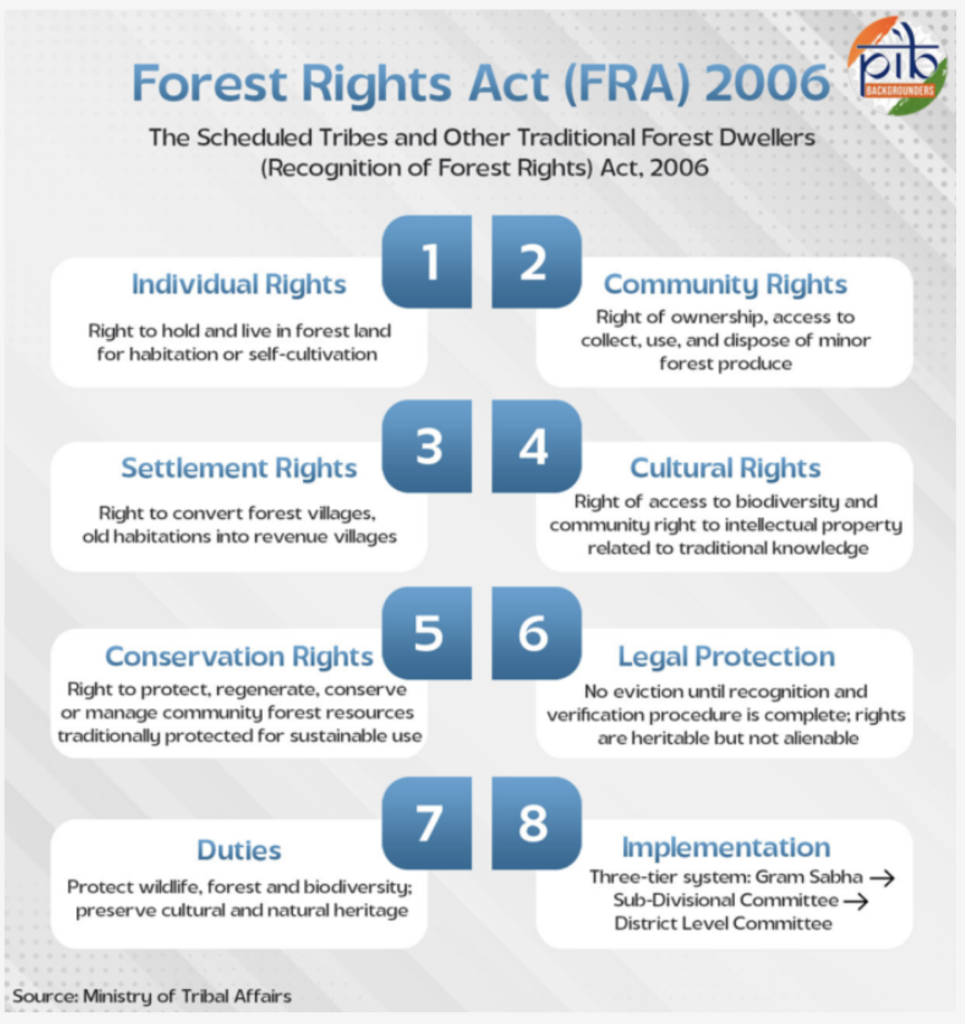
The Forest Rights Act (FRA), 2006
The FRA seeks to undo historical injustices by recognizing the rights of communities that have resided in forests for generations, balancing conservation with food and livelihood security.
Who is Eligible?
- Forest Dwelling Scheduled Tribes (FDST): Tribal communities primarily residing in and depending on the forest.
- Other Traditional Forest Dwellers (OTFD): Any member or community that has resided in and depended on forest land for bona fide livelihood needs for at least three generations (75 years) prior to December 13, 2005.
Decentralized Governance:
The Gram Sabha is the statutory authority responsible for initiating the process to determine the nature and extent of Individual Forest Rights (IFR) and Community Forest Rights (CFR).
Four Types of Rights Granted:
- Title Rights: Ownership of land currently being farmed by tribals or forest dwellers, capped at a maximum of 4 hectares. (Ownership applies only to land actually under cultivation; no new land is granted).
- Use Rights: Rights to graze animals, use pastoral routes, and extract Minor Forest Produce (MFP).
- Relief and Development Rights: The right to rehabilitation in cases of illegal eviction/forced displacement, and access to basic amenities (subject to forest protection norms).
- Forest Management Rights: The right to protect, regenerate, and manage any community forest resource traditionally conserved for sustainable use.
Key Facts: Agasthyamalai Biosphere Reserve (ABR)
- Geography: A 3,500 sq. km biosphere reserve located at the southern tip of the Western Ghats, straddling Tamil Nadu and Kerala.
- Global Recognition: Added to the UNESCO World Network of Biosphere Reserves in 2016.
- Protected Areas within ABR:
- Tamil Nadu: Kalakad-Mundanthurai Tiger Reserve, Srivilliputhur-Megamalai Tiger Reserve, Nellai Wildlife Sanctuary, and Kanyakumari Wildlife Sanctuary.
- Kerala: Periyar Tiger Reserve and Shendurney Wildlife Sanctuary.
- Demographics: Home to several indigenous communities and traditional forest dwellers, most notably the Kani tribe, whose culture and livelihood are deeply intertwined with the forest ecosystem.
Prelims
Q. At the national level, which ministry is the nodal agency to ensure effective implementation of the Scheduled Tribes and Other Traditional Forest Dwellers (Recognition of Forest Rights) Act, 2006?
(a) Ministry of Environment, Forest and Climate Change
(b) Ministry of Panchayati Raj
(c) Ministry of Rural Development
(d) Ministry of Tribal Affairs
Ans: (d)
Q. Under which Schedule of the Constitution of India can the transfer of tribal land to private parties for mining be declared null and void? (2019)
(a) Third Schedule
(b) Fifth Schedule
(c) Ninth Schedule
(d) Twelfth Schedule
Ans: (b)
Q. If a particular area is brought under the Fifth Schedule of the Constitution of India, which one of the following statements best reflects the consequence of it? (2022)
(a) This would prevent the transfer of land of tribal people to non-tribal people.
(b) This would create a local self-governing body in that area.
(c) This would convert that area into a Union Territory.
(d) The State having such areas would be declared a Special Category State.
Ans: (a)
Mains
Q. What are the two major legal initiatives by the State since Independence addressing discrimination against Scheduled Tribes (STs)? (2017)
NASA Invites ISRO to Join Moon Base Programme
Syllabus Relevance: GS Paper 2 (International Relations – Bilateral Agreements), GS Paper 3 (Science & Technology – Space Exploration)
Keywords: CSJWG, US-India TRUST Initiative, Moon Base Programme, Artemis Accords, NISAR, COPUOS, ISRO Space Vision 2047.
Context
During the 9th meeting of the India-US Civil Space Joint Working Group (CSJWG) held in August 2026 at ISRO headquarters in Bengaluru, NASA officially invited the Indian Space Research Organisation (ISRO) to join its historic Moon Base programme.This development marks a major milestone in the strategic space partnership between the two nations under the Artemis Accords.
Key Highlights of the CSJWG Meeting
- The TRUST Initiative:The discussions advanced civil and commercial space cooperation under the Transforming the Relationship Utilising Strategic Technology (TRUST) framework, aligning with the joint vision of both nations’ leadership.
- Open Scientific Data Sharing:Building on the Artemis Accords, both sides agreed to push forward negotiations on sharing open scientific data.
- NISAR and Future Tech:The delegations reviewed the successful launch of the NASA-ISRO Synthetic Aperture Radar (NISAR) mission (an advanced Earth observation satellite) and explored future joint ventures in human spaceflight technologies.
- Commitment to Space Sustainability:Both countries reaffirmed their commitment to the UN Committee on the Peaceful Uses of Outer Space (COPUOS) guidelines to ensure the long-term sustainability and safety of outer space activities.
What is the Moon Base Programme?
Announced by NASA in 2026, the Moon Base programme is an ambitious initiative to construct humanity’s first permanent lunar outpost.
- Strategic Location:It will be situated near the lunar South Pole.This area is highly valued because its elevated ridges receive near-continuous sunlight (ideal for solar power), while its permanently shadowed craters hold vast deposits of water ice.
- Long-term Goal:To serve as a sustainable surface habitat for astronauts to live, work, extract resources (In-Situ Resource Utilization or ISRU), and test survival technologies for future crewed missions to Mars.
Phased Rollout:
- Phase 1 (Through 2029):Focuses on gaining reliable surface access, conducting robotic reconnaissance, and demonstrating early technologies.
- Phase 2 (2029–2032):Involves deploying foundational surface infrastructure, including power networks, logistics, communications, and lunar terrain vehicles.
- Phase 3 (2032+):Begins the assembly of an expandable, permanently crewed outpost capable of supporting extended astronaut stays.
The Artemis Framework
- Artemis Program: NASA’s flagship initiative designed to return humans to the Moon for the first time since the 1972 Apollo missions, paving the way for eventual human exploration of Mars.
- Artemis Accords (2020): A non-binding, multilateral framework of principles led by the US State Department and NASA to guide the peaceful, safe, and sustainable exploration of space. India became a signatory in June 2023.
Implications for India’s Space Vision
- Alignment with Space Vision 2047: The collaboration perfectly complements ISRO’s roadmap, which aims for an Indian crewed Moon landing by 2040 and the creation of the Bharatiya Antariksh Station (first module targeted for 2028, full station by 2035).
- Elevating Global Standing: By participating in the Moon Base project, India transitions from conducting independent robotic missions (like the successful Chandrayaan-3) to playing a critical, foundational role in complex, multilateral human spaceflight.
- Technological Leap:Partnership in this program will accelerate India’s capabilities in deep-space habitation, commercial sector integration, and the harvesting of lunar resources (like extracting water ice for rocket propellant and oxygen).
Astrobase Unveils EVEREST Rocket Engine
Syllabus Relevance: GS Paper 3 (Science & Technology – Space Exploration, Indigenization of Technology)
Keywords: Astrobase Space Technologies, EVEREST Engine, Full-Flow Staged Combustion (FFSC), LOX-Methane, Reusable Launch Vehicle (RLV), IN-SPACe.
Context
Bengaluru-based space-tech startup Astrobase Space Technologies has unveiled EVEREST, India’s first privately built 800-kilonewton (kN) rocket engine. Coming on the heels of the Vikram-1 launch, this marks another major milestone in the rapid evolution of India’s private space sector, moving the country closer to indigenous, reusable, and high-frequency space launches.
About the EVEREST Engine
- Performance Metrics: The engine delivers a massive 800 kN of thrust with a specific impulse of approximately 340 seconds.
- Precision Control: It features a highly versatile throttle range of 50% to 110%, which is critical for precision maneuvering during launch and landing phases.
- Propellant: It relies on a combination of Liquid Oxygen (LOX) and Methane (Methalox). This blend ensures relatively clean combustion (minimal soot buildup), making engine refurbishment significantly easier and supporting repeated use.
Advanced Full-Flow Staged Combustion (FFSC) Technology
- The Mechanism: In an FFSC architecture, both the fuel and the oxidizer pass through two separate pre-burners before entering the main combustion chamber. The exhaust gases generated by these pre-burners drive the turbopumps and are completely fed into the main chamber.
- Efficiency: This cycle ensures zero wastage of propellant, resulting in exceptionally high efficiency, maximum thrust, and better thermal stability.
- Global Rarity: According to Astrobase, FFSC is one of the most complex propulsion architectures in the world. Its successful development makes India the fourth country (after the US, Russia, and China) and Astrobase only the fourth commercial company globally to achieve this feat.
Reusability and Development Roadmap
- Target Application: EVEREST is purpose-built for reusable medium-lift launch vehicles to improve turnaround times and launch economics. The company’s vehicle architecture aims to deliver about 3 tonnes to a 500-km Low Earth Orbit (LEO), featuring return-to-launch-site recovery.
- Timeline: Development began in 2024, and engine subsystems have already been tested. A full-scale engine hot-fire test at the company’s Anantapur facility in Andhra Pradesh is a major milestone scheduled for 2026.
- Flight Readiness: Astrobase plans to manufacture and test around 20 engines to ensure rigorous validation before its targeted first orbital flight in 2028.
Government Support & Strategic Significance
- IN-SPACe Backing: Astrobase is a recipient of IN-SPACe’s Technology Adoption Fund, a government initiative aimed at supporting the private sector in developing technically demanding and critical space infrastructure.
- Transforming India’s Space Economy: If successfully operationalized, the EVEREST engine will drastically strengthen India’s indigenous propulsion capabilities. By enabling high-cadence, reusable commercial spaceflight, India can secure a much larger footprint in the rapidly expanding global space economy.