1. India’s Private Capex Revival
India is experiencing a structural revival in its private sector capital expenditure (Capex), transitioning from a recovery driven by public investment to a broad-based private investment cycle.
Key Drivers of the Revival:
- Rising Capacity Utilization: The Confederation of Indian Industry (CII) reports that manufacturing capacity utilization hit 75.6% in Q3 FY26. Crossing the 75% threshold typically forces firms to expand production lines.
- Surging Investments: Listed companies are projected to spend Rs 12.6 lakh crore on capex in 2026. Combined capex by the Centre, States, and listed firms is estimated at Rs 32 lakh crore for FY26.
- The Government’s “Crowding-In” Effect: Heavy government spending on infrastructure (via PM Gati Shakti and the National Infrastructure Pipeline) has de-risked projects and lowered logistics costs, successfully attracting private capital. The FY25-26 budget earmarks Rs 11.21 lakh crore (3.1% of GDP) for public capex.
- Focus on Expansion: Borrowing is funding greenfield projects (new capacity) rather than just asset replacement. The Capex-to-Depreciation Ratio has doubled to 1.9–2.0x, and 168 firms are now investing over Rs 1,000 crore annually (up from 91 in 2012).
- Financial Health: The “twin balance-sheet problem” is largely resolved. Bank credit growth hit nearly 14% in H2 FY26, and the gross non-performing assets (GNPA) ratio dropped to a multi-decade low of 2.1% in FY26. Industrial credit growth surged to 19.2% YoY in June 2026.
- Policy Support: Production-Linked Incentive (PLI) schemes across 14 sectors are directly catalyzing investments, especially in new-age industries like green energy, EVs, and semiconductors.
Challenges to Sustainability:
- Global/Macro Risks: Geopolitical fragmentation, trade protectionism, and imported inflation (escalating raw material costs).
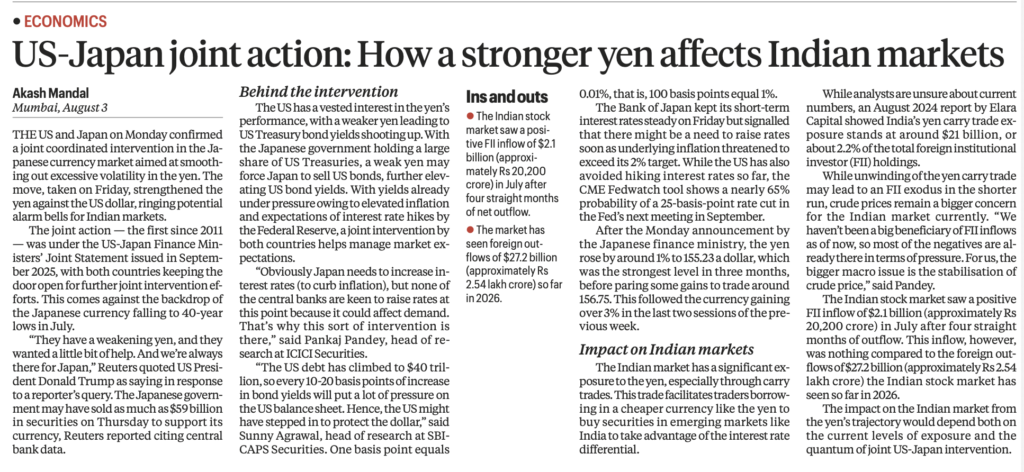
- Financial Constraints: Tight monetary conditions, high borrowing costs, a widening credit-deposit gap (82.6% in June 2026), and FPI outflows (net Rs 2.54 lakh crore pulled from equities by July 2026).
- Domestic Bottlenecks: Delays in regulatory/environmental clearances, sluggish rural demand, and climate-induced agricultural uncertainty.
Proposed Solutions: Fast-tracking approvals via the Project Monitoring Group (PMG), expanding ECLGS-like credit support to mid-sized manufacturers, broadening PLI schemes to space and defense, implementing the National Logistics Policy (aiming to cut logistics costs to 8% of GDP by 2030), and promoting InvITs/REITs.
2. Indian Rupee: From Overvaluation to Undervaluation
Reserve Bank of India (RBI) Governor Sanjay Malhotra stated that the Indian Rupee (INR) is currently “undervalued” despite depreciating nearly 5.8% against the USD in 2026. The RBI asserts this reflects global headwinds, not weak domestic fundamentals.
Understanding Currency Metrics:
- Nominal Effective Exchange Rate (NEER): A trade-weighted average measuring the rupee’s face value against 6-currency or 40-currency baskets (base year 2015–16 = 100). It ignores inflation.
- Real Effective Exchange Rate (REER): The inflation-adjusted version of NEER. A REER > 100 indicates overvaluation; < 100 indicates undervaluation. It is a critical metric for global trade competitiveness.
Why the Rupee is Undervalued:
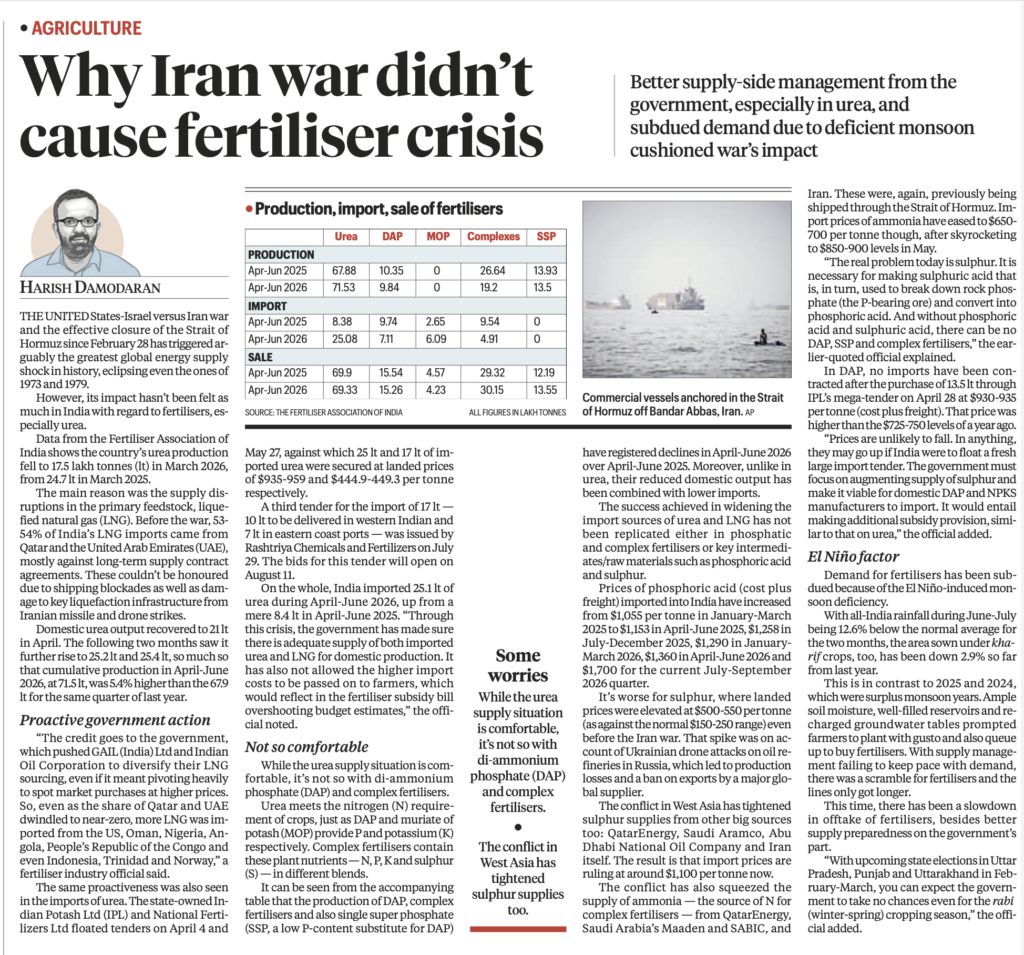
- Valuation Shift: The average exchange rate dropped from Rs 84.4/USD (Nov 2024) to Rs 95.5/USD (May 2026). Consequently, the NEER fell from 91.68 to 77.19, and the REER dropped from 108.03 to 89.08 (marginally recovering to 91.26 by June 2026).
- Economic Reality: India’s fundamentals remain strong (GDP growth >6%, 11+ months of forex reserves). The depreciation is driven by external pressures: high crude prices, a strong US dollar, and heavy FPI outflows.
Impacts of an Undervalued Rupee:
- Pros: Boosts export competitiveness, supports “Make in India” by making domestic manufacturing more viable, and can help narrow the trade deficit.
- Cons: Drives imported inflation (crude oil, electronics, fertilizers) and increases the burden of servicing External Commercial Borrowings (ECBs).
3. India’s Solar Growth Enters a New Era
India’s installed solar capacity has surged fiftyfold, from ~3 GW in 2014 to 162.15 GW as of June 30, 2026, making it the bedrock of the nation’s renewable infrastructure.
Growth Milestones & Capacity Details:
- Global Standing: India added 37 GW in 2025, passing the US to become the world’s second-largest solar growth market. FY 2025–26 saw a record 44.61 GW of solar capacity added (nearly double the previous year).
- Current Mix: Utility-scale projects account for 118.79 GW (e.g., Bhadla, Pavagada, Rewa), while grid-connected rooftop systems contribute 27.88 GW.
- Overall Renewables: Total non-fossil capacity reached 283.46 GW. Renewables met a record 51.5% of India’s electricity demand on July 29, 2025.
- Manufacturing: Domestic solar module manufacturing expanded from 2.3 GW (2014) to nearly 172 GW (March 2026), heavily supported by a Rs 24,000 crore Solar PLI scheme.
- Cost Efficiency: Competitive e-Reverse Auctions crashed tariffs from ~Rs 18/unit in 2010 to Rs 2.44/unit in 2017.
Key Policy Architecture:
- PM Surya Ghar Muft Bijli Yojana (2024): A Rs 75,021 crore scheme that solarized over 43 lakh households by June 2026, dropping electricity bills to zero for >7.7 lakh homes.
- PM-KUSUM (2019): Targets 34,800 MW of agricultural solar capacity by 2026–27 (Rs 34,422 crore funding). It has benefited 21.77 lakh farmers via 11.49 lakh off-grid pumps and 15.89 lakh feeder-level solarized pumps.
- Solar Parks Scheme: 54 parks sanctioned (39,188 MW capacity) as of Feb 2026. Gujarat leads with 12,150 MW.
- Pradhan Mantri Surya Sarovar Yojana (PM-SSY): A newly approved scheme targeting 5,000 MW of floating solar with co-located battery storage.
- Global Leadership: India co-founded the International Solar Alliance (ISA) with France and launched the Green Grids Initiative (One Sun One World One Grid) with the UK to interlink global renewable grids.
4. 150th Birth Anniversary of Pingali Venkayya
On August 2nd, the Prime Minister honored Pingali Venkayya (born Aug 2, 1876, in Andhra Pradesh) on his 150th birth anniversary for designing the Indian National Flag.
Historical Contributions:
- Flag Design: At the 1921 INC session in Vijayawada, Venkayya presented the Swaraj Flag (red and green with a spinning wheel) to Mahatma Gandhi. On Gandhi’s advice, a white band was added for peace. The INC adopted it in 1931. The Constituent Assembly modified it (replacing the charkha with the Ashoka Chakra) and officially adopted it on July 22, 1947.
- Military & Activism: Fought in the Second Boer War in South Africa (where he met Gandhi) and participated in the Vande Mataram and Home Rule movements.
- A Renowned Polymath: Known as “Japan Venkayya” (delivered a speech in Japanese in 1913), “Patti Venkayya” (Cambodia cotton research), and “Diamond Venkayya” (geology graduate, authored The Mother of Diamonds in 1955).
- Legacy: Honored with a 2009 postage stamp; AIR Vijayawada was renamed after him in 2015.
5. Shipki La Pass Trade Resumes
Cross-border trade between India and China via the Shipki La Pass resumed on August 1, 2026, after a 6-year pandemic-induced halt.
Geographical & Strategic Facts:
- Located at an altitude of over 4,000 meters in Himachal Pradesh’s Kinnaur district, on the border with the Tibet Autonomous Region.
- The Sutlej River (Langqen Zangbo in Tibet) enters India through this pass.
- It offers a strategic elevation advantage to Indian security forces.
- Trade Mechanics: A historic Silk Route trade point, it is unique among India-China border routes (unlike Lipulekh or Nathu La) because trade here is traditionally conducted via a barter system rather than currency. Traded goods include wool, livestock, spices, and timber.
6. Migration Crisis in Ceuta
In July 2026, nearly 60,000 migrants attempted to enter the Spanish autonomous city of Ceuta from Morocco.
Geographical Context:
- Ceuta is an 18.5 sq. km Spanish enclave on the North African coast, sharing a land border with Morocco and facing the Strait of Gibraltar.
- Along with Melilla and the Plazas de Soberanía, it forms the EU’s only land borders with Africa.
- Morocco claims sovereignty over the territory. Ceuta’s location makes it a critical maritime chokepoint and a volatile hotspot for irregular migration into Europe, straining Spain-Morocco diplomatic relations.
7. India’s 1st Comprehensive Catalogue of Lepidoptera
The Zoological Survey of India (ZSI) has finalized a 22-volume catalogue of Indian butterflies and moths after more than 12 years of research, with the final volume published in Zootaxa.
Biodiversity Highlights:
- India hosts 13,703 species of Lepidoptera (3,705 genera across 102 families), representing ~8.25% of the world’s known species.
- Geometridae is the largest family in India with 2,100 species.
- Ecologically, these insects serve as vital pollinators, herbivores, and a food source for insectivores, making this catalogue a critical baseline for biodiversity and climate-change monitoring.
8. Leptospirosis Burden in Kerala
Kerala is facing a high mortality and disease burden from Leptospirosis, particularly during monsoon seasons.
Medical & Epidemiological Facts:
- Pathology: A zoonotic disease caused by spiral-shaped Leptospira bacteria (spirochaetes).
- Transmission: Spread primarily through contact with the urine of carrier animals (rodents, cattle, dogs, pigs). The bacteria enter humans through skin cuts or mucous membranes via contaminated water or soil.
- Symptoms & Treatment: Ranges from mild flu to severe complications like Weil’s syndrome, pulmonary hemorrhage, and meningitis (jaundice indicates severe disease). Treated with antibiotics like doxycycline, penicillin G, or ceftriaxone.
- Prevention: Animal vaccination (though it may not stop renal carriage), rodent control, and wearing protective clothing in endemic areas.
IMPORTANT NEWS ARTICLES