UPSC Daily Current Affairs Comprehensive Analysis – 19th August 2026
1. Polity & Governance (GS Paper II): Implementation Roadmap for ‘One Nation, One Election’
Source: The Hindu / Press Information Bureau (PIB)
Context: The Law Commission of India and the High-Level Committee on Simultaneous Elections have jointly submitted the final operational roadmap for implementing ‘One Nation, One Election’ (ONOE) starting from the 2029 general electoral cycle.
Key Highlights of the Roadmap:
- Constitutional Amendments: The roadmap outlines a two-phase synchronization. This requires amending at least five critical constitutional provisions: Article 83 (duration of Houses of Parliament), Article 85 (dissolution of Lok Sabha), Article 172 (duration of State Legislatures), Article 174 (dissolution of State Legislatures), and Article 356 (President’s Rule).
- Ratification: Since these amendments alter the federal structure, ratification by at least 50% of the State Legislatures is mandatory under Article 368.
- Constructive Vote of No-Confidence: To prevent mid-term collapses from derailing the synchronized cycle, the committee has recommended a “Constructive Vote of No-Confidence,” akin to the German model. A government can only be ousted if the opposition simultaneously proposes a viable alternative leader.
- Common Electoral Roll: A unified electoral roll for Lok Sabha, State Assemblies, and Local Body elections (Panchayats/Municipalities) managed by the Election Commission of India (ECI) in consultation with State Election Commissions (SECs).
Significance:
- Governance Continuity: Reduces the paralyzing effect of the Model Code of Conduct (MCC), which currently stalls developmental activities multiple times a year.
- Economic Prudence: Drastically cuts down the recurring expenditure on deploying security forces, polling personnel, and election machinery.
- Voter Fatigue: Aims to increase voter turnout by preventing election fatigue.
Challenges & Way Forward:
The primary challenge remains the perceived threat to federalism, as national issues may overshadow regional electoral narratives. Additionally, the logistical requirement of procuring millions of additional EVMs and VVPATs poses a short-term fiscal burden. The way forward requires extensive all-party consensus building and public awareness campaigns to ensure the democratic ethos is not compromised in the pursuit of administrative efficiency.
2. Science & Technology (GS Paper III): ISRO’s Gaganyaan Mission Enters Final Crew Integration Phase
Source: PIB
Context: The Indian Space Research Organisation (ISRO) has officially commenced the final integration of the Orbital Module for the Gaganyaan mission, marking the penultimate step before India’s maiden human spaceflight scheduled for late 2026.
Key Technical Details:
- Orbital Module (OM): Comprises the Crew Module (CM) and the Service Module (SM). The CM is a pressurized, habitable enclosure with an Earth-like environment, while the SM contains the propulsion and power systems.
- Launch Vehicle: The mission will utilize the Human Rated LVM3 (HLVM3), which has undergone rigorous structural and acoustic testing.
- ECLSS System: The Environmental Control and Life Support System (ECLSS), developed indigenously, has passed human-rating certification. This system regulates cabin pressure, oxygen levels, and removes carbon dioxide and moisture.
- Vyommitra Integration: Data from the recent uncrewed flight featuring ‘Vyommitra’ (the half-humanoid robot) validated the microgravity parameters and radiation shielding efficacy.
Strategic Significance:
- Elite Club: Successful execution will make India the fourth nation (after the US, Russia, and China) to possess independent human spaceflight capability.
- Space Economy & Spin-offs: The mission drives immense growth in the domestic aerospace MSME sector. Spin-off technologies from ECLSS are already finding applications in deep-sea submarines (Samudrayaan) and hazardous industrial environments.
Way Forward:
ISRO must ensure absolute zero-defect execution, particularly focusing on the Crew Escape System (CES) and safe splashdown recovery operations in the Bay of Bengal, requiring seamless coordination with the Indian Navy.
3. Economy (GS Paper III): UPI 3.0 and Full CBDC (e-Rupee) Interoperability
Source: The Indian Express
Context: The Reserve Bank of India (RBI) and the National Payments Corporation of India (NPCI) have rolled out the “UPI 3.0” framework, featuring full, seamless interoperability with the retail Central Bank Digital Currency (e-Rupee).
Provisions and Mechanisms:
- Interoperability: Users can now scan any generic UPI QR code and choose to pay via their bank account (fiat money) or their CBDC wallet. The merchant will receive the payment in their preferred format without needing separate onboarding for the e-Rupee.
- Programmable Money: UPI 3.0 introduces deep programmable features for the e-Rupee. The government can issue subsidies (e.g., fertilizer subsidies, student book grants) that can only be spent at specific, verified merchant categories, drastically reducing leakages.
- Offline Transactions: Utilizing Near Field Communication (NFC) technology, the updated infrastructure allows consecutive offline digital payments in network-dark zones, reconciling once the device connects to the internet.
Significance:
- Financial Deepening: Further accelerates India’s transition to a less-cash economy while providing the sovereign backing of fiat currency, countering the influence of private, volatile cryptocurrencies.
- Cross-Border Remittances: The CBDC-UPI integration lays the groundwork for linking with payment systems of ASEAN and Gulf nations, slashing cross-border transaction costs and time.
Challenges:
Scaling up the underlying blockchain/distributed ledger infrastructure to handle the massive volume of daily Indian transactions without latency is a major technological hurdle. Furthermore, digital literacy and cybersecurity awareness must be scaled to prevent localized phishing and NFC-skimming attacks.
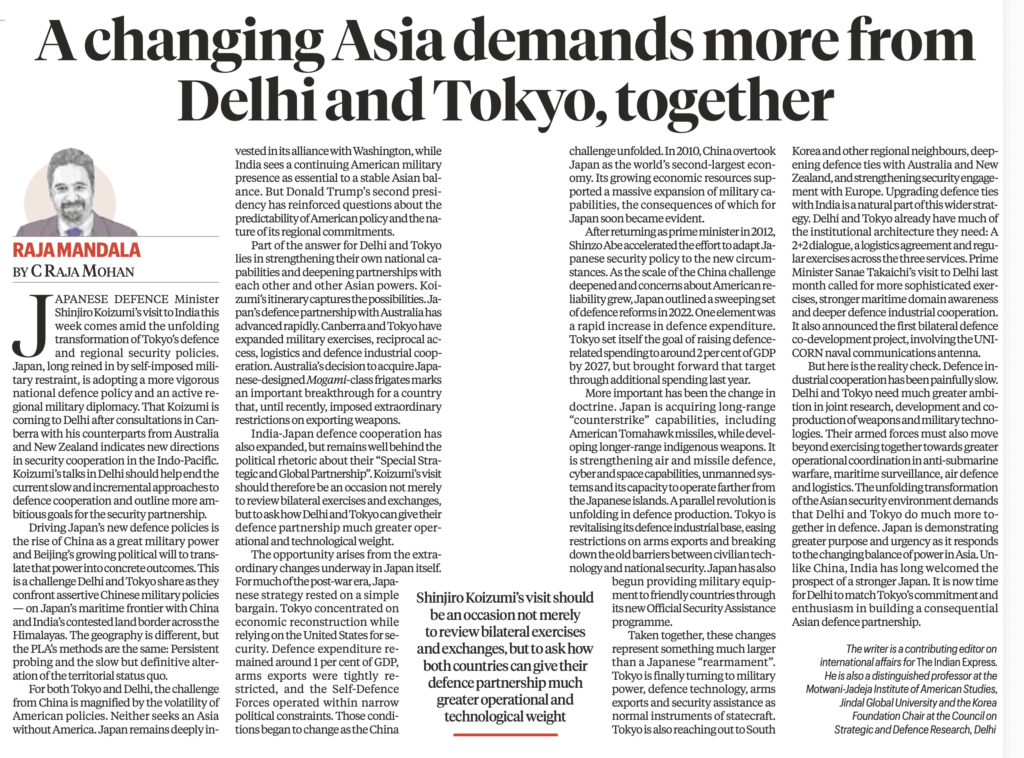
4. International Relations (GS Paper II): BIMSTEC Summit 2026 & The Maritime Security Framework
Source: The Hindu
Context: The 7th BIMSTEC (Bay of Bengal Initiative for Multi-Sectoral Technical and Economic Cooperation) Summit held in Bangkok concluded with the signing of the ‘BIMSTEC Comprehensive Maritime Security Framework’.
Key Outcomes of the Summit:
- Maritime Security Framework: Establishes a joint mechanism for combating piracy, illegal, unreported, and unregulated (IUU) fishing, and maritime terrorism in the Bay of Bengal. It includes provisions for real-time intelligence sharing.
- Connectivity Master Plan 2030: Fast-tracking the Kaladan Multi-Modal Transit Transport Project and the India-Myanmar-Thailand Trilateral Highway, extending proposals to link with Laos and Cambodia.
- Free Trade Agreement (FTA) Revival: Renewed political commitment to finalize the long-pending BIMSTEC FTA, prioritizing tariff rationalization in agriculture and pharmaceuticals.
Strategic Implications for India:
- Alternative to SAARC: With SAARC remaining defunct due to Pakistan’s obstructionism, BIMSTEC has become the primary vehicle for India’s “Neighbourhood First” and “Act East” policies.
- Countering China: Strengthening regional integration in the Bay of Bengal serves as a strategic counterbalance to China’s expanding footprint in the Indian Ocean Region (IOR) through its Belt and Road Initiative (BRI).
- North-East Development: Enhanced connectivity through Myanmar and Bangladesh provides landlocked Northeast Indian states access to the sea, boosting regional economic growth.
5. Environment & Ecology (GS Paper III): Launch of the National Carbon Credit Trading Scheme (CCTS)
Source: PIB
Context: The Ministry of Environment, Forest and Climate Change (MoEFCC) has formally launched the operational phase of the National Carbon Credit Trading Scheme (CCTS), transitioning from voluntary markets to a mandatory compliance market for highly polluting industries.
Key Features of the CCTS:
- Obligated Entities: Industries in sectors like steel, cement, petrochemicals, and aluminum are now given strict greenhouse gas (GHG) emission intensity targets.
- Trading Mechanism: Entities that surpass their emission reduction targets are issued Carbon Credit Certificates (CCCs), which can be sold on a dedicated platform (managed by the Grid Controller of India) to entities failing to meet their targets.
- Integration with Green Credits: The scheme runs parallel to the Green Credit Programme, which incentivizes broader environmental actions like water conservation, afforestation, and waste management.
Significance:
- Net Zero 2070: It establishes the domestic economic infrastructure necessary to achieve India’s COP26 Panchamrit commitment of reaching Net Zero by 2070.
- Shielding against CBAM: By establishing an internal carbon pricing mechanism, India aims to shield its exports from the European Union’s Carbon Border Adjustment Mechanism (CBAM), arguing that Indian products are already subject to domestic carbon taxation.
Challenges:
Ensuring rigorous, tamper-proof Measurement, Reporting, and Verification (MRV) processes is critical. Over-allocation of carbon credits could crash market prices, rendering the scheme ineffective, a flaw observed in the early days of the EU Emissions Trading System.
6. Internal Security & Technology (GS Paper III): The ‘Safe AI and Deepfake Regulation Act, 2026’
Source: The Indian Express
Context: Recognizing the severe threat posed by synthetic media, the Ministry of Electronics and Information Technology (MeitY) has tabled the ‘Safe AI and Deepfake Regulation Act’ in Parliament.
Major Provisions:
- Mandatory Watermarking: All AI-generated audio, video, and text must carry a cryptographically secure, invisible watermark and a clear visible disclaimer identifying it as synthetic content.
- Algorithmic Audits: Developers of large language models (LLMs) and generative AI platforms operating in India must undergo mandatory bi-annual audits by the newly established AI Safety Directorate to check for algorithmic bias and the potential to generate illicit content.
- Revision of Safe Harbor: Social media intermediaries will lose their ‘safe harbor’ immunity under Section 79 of the IT Act if they fail to remove reported deepfakes of individuals (especially non-consensual deepfake pornography or electoral misinformation) within 12 hours of receiving a grievance.
Significance:
Deepfakes pose severe risks to the integrity of democratic elections, stock markets, and individual privacy (particularly for women). This legal framework shifts the burden of accountability from the victims to the platforms and creators.
Way Forward:
Legislation alone is insufficient against decentralized, open-source AI models. India must champion a global regulatory framework (similar to the Bletchley Park consensus) and invest heavily in indigenous “AI-to-detect-AI” technologies to keep pace with malicious actors.
UPSC Prelims Specific Facts (19th August 2026)
- Project Udbhav 2.0: Recently in the news, it is an initiative by the Indian Army in collaboration with the United Service Institution of India (USI) to further integrate ancient Indian strategic thinking (from texts like Arthashastra and Thirukkural) into modern military pedagogy and warfare strategies.
- KAVACH 2.0: The upgraded, LTE-based indigenous Automatic Train Protection (ATP) system. Unlike its predecessor, 2.0 uses AI-driven predictive braking algorithms and is currently being deployed on the high-density Howrah-Delhi and Mumbai-Delhi corridors.
- Lake Chad Basin Crisis: Highlighted in recent UNHCR reports due to acute climate-induced migration. Located in the Sahel region of Africa, bordered by Chad, Nigeria, Niger, and Cameroon, it is shrinking rapidly due to climate change, sparking resource conflicts.
- Exercise Pitch Black 2026: A biennial multilateral air combat exercise hosted by the Royal Australian Air Force (RAAF). The Indian Air Force (IAF) is participating with its upgraded Su-30MKI and indigenous LCA Tejas Mk1A.
- Kandhamal Haldi (GI Tag Update): The famous turmeric from Odisha, known for its high curcumin content and healing properties, has recently seen the establishment of an exclusive export-processing zone to boost tribal incomes.
- T+0 Settlement Cycle: The Securities and Exchange Board of India (SEBI) has officially mandated the transition of all top 500 market-cap stocks to a T+0 (same day) trade settlement cycle, making Indian equity markets one of the fastest and most liquid globally.