The Makkah Joint Defence Agreement (MJDA): The Emergence of a Multipolar West Asian Security Architecture
The signing of the Makkah Joint Defence Agreement (MJDA) between Saudi Arabia, Türkiye, and Pakistan at the Al-Safa Palace represents a watershed moment in West Asian geopolitics. Often characterized as a new “Sunni security triangle,” this trilateral pact fundamentally alters the regional security architecture, signaling a decisive shift away from a unilateral reliance on the traditional American security umbrella toward strategic regional autonomy.
The Trilateral Framework and Collective Deterrence
At the core of the MJDA is a mutual-defense clause establishing that an armed attack against one signatory is considered an attack against all three. While this mirrors the collective defense principle of NATO’s Article 5, the operational mechanisms of the MJDA remain bespoke to the region. To operationalize this deterrence, the agreement institutionalizes joint military coordination, mandating regular, combined military exercises to ensure interoperability among the armed forces of Riyadh, Ankara, and Islamabad. Furthermore, it establishes formal, encrypted channels for real-time strategic intelligence sharing, threat assessments, and security data exchanges to proactively neutralize regional hostilities.
Geopolitical Drivers and Strategic Synergies
The formation of this alliance is driven by overlapping vulnerabilities and complementary strengths among the three nations, catalyzed by the perceived retreat of “Pax Americana” and the escalation of Iran-aligned proxy threats.
- Saudi Arabia (The Financial and Energy Hub): Riyadh is urgently seeking to secure its massive energy infrastructure and the ambitious economic diversification goals of Vision 2030. Vulnerabilities exposed by Houthi missile and drone strikes on Red Sea shipping lanes and domestic oil facilities have necessitated a robust deterrence mechanism independent of Washington. Saudi Arabia brings immense financial heft, energy resources, and purchasing power to the alliance.
- Türkiye (The Technological and Industrial Engine): Ankara views the expanding military footprint of Israel in Gaza and Syria as an immediate perimeter threat. By entering the Gulf security matrix, Türkiye gains geopolitical leverage and a lucrative market for its rapidly expanding, NATO-standard military-industrial complex (particularly aerospace and advanced drone technologies like the Bayraktar TB2).
- Pakistan (The Conventional and Nuclear Vanguard): Grappling with domestic economic crises, Islamabad leverages its massive military manpower and nuclear capabilities to retain strategic relevance in the Islamic world. The pact promises deep economic lifelines, energy security from Riyadh, and access to Turkish defense technology.
Strategic Ramifications for India
The consolidation of a Saudi-Turkish-Pakistani security axis introduces profound complexities for India’s strategic posture, spanning diplomatic, military, and economic domains.
- The Pakistan-Türkiye-China Nexus: Both Türkiye and Pakistan maintain robust strategic ties with Beijing. A formalized security relationship with Saudi Arabia indirectly strengthens a network of partnerships along India’s western flank, potentially emboldening Pakistan.
- Defense Market Competition: India’s aspirations to export indigenous defense platforms (such as the BrahMos and Akash missile systems) to the Gulf face direct competition from Türkiye’s aggressive entry into the West Asian defense market, heavily subsidized by Saudi capital.
- Diplomatic Leverage on Kashmir: Pakistan and Türkiye have historically weaponized the platform of the Organisation of Islamic Cooperation (OIC) to target India regarding Kashmir. Increased Saudi reliance on Pakistani military support may force Riyadh to recalibrate its historically balanced stance, granting Islamabad undue diplomatic leverage.
- Military Modernization and the Conflict Threshold: The influx of Saudi financing combined with Turkish technology threatens to accelerate Pakistan’s acquisition of advanced drones, electronic warfare systems, and fighter aircraft, eroding India’s conventional military asymmetry. Furthermore, the “attack on one is an attack on all” clause introduces a dangerous layer of ambiguity; it remains untested whether a localized India-Pakistan conflict could draw political or material intervention from Riyadh or Ankara, providing Pakistan with a perceived shield of extended deterrence.
India’s Strategic Counter-Calculus
To mitigate these emerging challenges, New Delhi must double down on its multipronged “Look West” strategy and accelerate indigenization.
- Deepening Minilateralism and Economic Corridors: India must fast-track the India-Middle East-Europe Economic Corridor (IMEC) and the I2U2 (India, Israel, UAE, US) framework. Intertwining the economies of the UAE and Saudi Arabia with India’s growth story serves as a powerful counterbalance to purely military alliances.
- Leveraging Iran and the Eastern Mediterranean: To bypass the Pakistan-Türkiye axis, India must fully operationalize the Chabahar Port and the International North-South Transport Corridor (INSTC). Simultaneously, strengthening defense and diplomatic ties with Eastern Mediterranean nations—Greece, Cyprus, and Armenia—creates a reciprocal pressure point against Turkish overreach.
- Technological Asymmetry (Atmanirbhar Bharat): India’s defense establishment must pivot aggressively toward next-generation warfare capabilities, heavily investing in AI, counter-drone swarms, hypersonic glide vehicles, and advanced electronic warfare to render Pakistan’s imported modernizations obsolete.
UPSC Civil Services Examination, Previous Year Questions (PYQs)
Q. Consider the following statements: (2023)
Statement-I: Israel has established diplomatic relations with some Arab States.
Statement-II: The ‘Arab Peace Initiative’ mediated by Saudi Arabia was signed by Israel and Arab League.
Which one of the following is correct in respect of the above statements?
(a) Both Statement-I and Statement-II are correct and Statement-II is the correct explanation for Statement-I
(b) Both Statement-I and Statement-II are correct and Statement-II is not the correct explanation for Statement-I
(c) Statement-I is correct but Statement-II is incorrect
(d) Statement-I is incorrect but Statement-II is correct
Ans- C
Mains
Q. “India’s relations with Israel have, of late, acquired a depth and diversity, which cannot be rolled back.” Discuss. (2018)
Q. The question of India’s Energy Security constitutes the most important part of India’s economic progress. Analyse India’s energy policy cooperation with West Asian countries. (2017)
Sino-Indian Border Dynamics: Cartographic Sovereignty in Arunachal Pradesh
In a direct counter-offensive to China’s persistent territorial revisionism, India has formally identified and recorded 27 locations in Arunachal Pradesh on the official Survey of India map. This administrative maneuver is a critical response to Beijing’s ongoing “cartographic aggression,” wherein China has repeatedly issued lists renaming places in the Indian state, referring to the territory as “Zangnan” (South Tibet).
The Anatomy of Cartographic Warfare
China’s strategy of renaming territories is designed to create alternative geographical narratives and fabricate historical claims, attempting to build a legal and psychological foundation for territorial expansion. By formally codifying its own native nomenclature for these high-altitude passes, logistical hubs, and cultural sites, India is legally and administratively reinforcing its unalienable sovereignty over the region, rejecting the legitimacy of China’s unilateral declarations.
Strategic and Historical Significance of the Identified Locations
The 27 locations formalized by New Delhi hold immense historical weight and dictate the military logistics of the Line of Actual Control (LAC).
- Flashpoints and Memorials: The inclusion of Long Ju (the site of a critical 1959 skirmish) and Thag La (where the 1962 Sino-Indian War commenced) serves as a historical anchor, cementing India’s long-standing presence. The recognition of memorials like Jaswant Garh and the Sher-e-Thapa Memorial immortalizes the sacrifices of the Indian armed forces in defending the frontier.
- High-Altitude Passes: Formally naming strategic bottlenecks such as Bisa, Dzo La, Riza La, Pukur La, and Thag La underscores India’s focus on high-altitude terrain dominance. Control over these passes is an absolute prerequisite for military mobility and artillery placement in the Himalayas.
- Logistical Hubs: The inclusion of Jairampur highlights the importance of deep-state logistics and border connectivity, linking the eastern extremities of Arunachal Pradesh with the Myanmar border.
The Geopolitical Imperative of Arunachal Pradesh
Arunachal Pradesh remains the most critical geographical buffer in the Northeast. As the upper catchment area for the Brahmaputra River system (fed by tributaries like the Subansiri, Kameng, and Lohit), sovereignty over this territory is intrinsically linked to the water and food security of the entire Brahmaputra Valley and downstream Bangladesh.
Furthermore, the state is home to Tawang, the birthplace of the 6th Dalai Lama. India’s steadfast control over Tawang provides New Delhi with vital leverage concerning Tibetan Buddhist geopolitics and the future succession of the Dalai Lama—a prospect that deeply unsettles Beijing. India’s border alignment remains firmly rooted in the 1914 Simla Convention and the McMahon Line, reinforcing an international legal boundary that stands against revisionist hegemony.
The e-Courts Mission Mode Project (Overview & Phase III)
- Current Phase: The project is currently in Phase III (2023–2027), backed by a ₹7,210 crore outlay.
- Primary Goal: Transitioning from a paper-based system to a completely digital, paperless, and smart judicial infrastructure.
- Scale of Adoption: As of mid-2026, over 4,500 courts have implemented e-filing, and 474 are equipped for entirely paperless functioning.
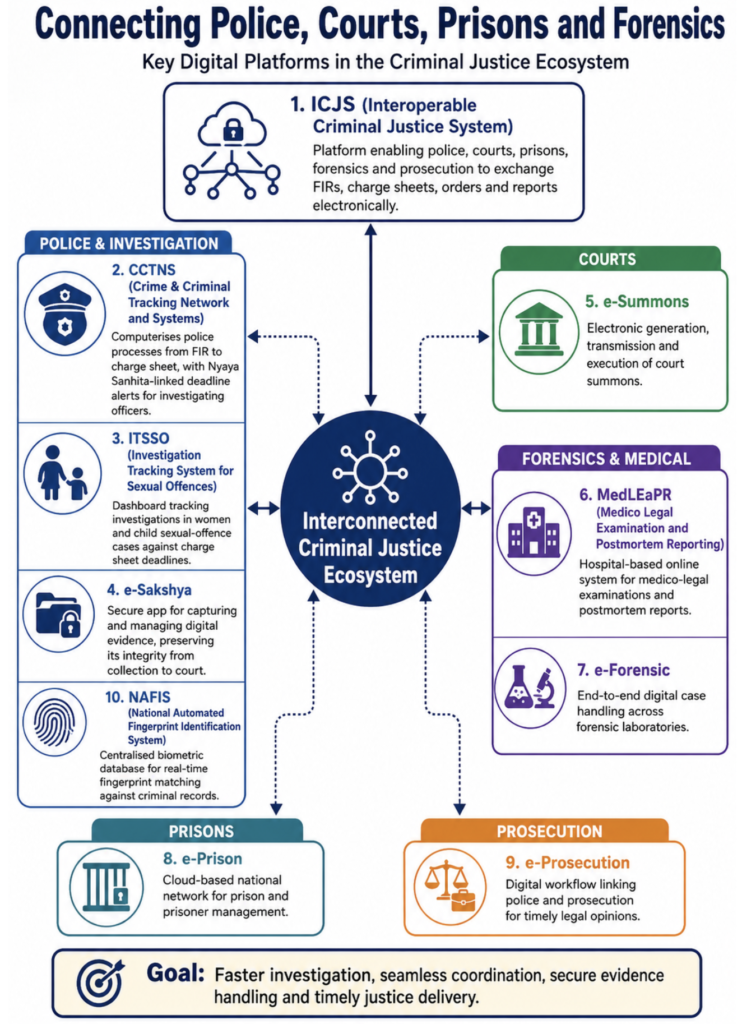
Key Technological Innovations & AI Tools
The integration of Artificial Intelligence (AI) and digital tracking is a major focus of Phase III (allocated ₹53.57 crore):
- Nyaya Shruti: Launched in 2024 under the Inter-operable Criminal Justice System (ICJS), this platform enables accused persons, witnesses, and experts to appear virtually, speeding up case resolutions.
- LegRAA (Legal Research and Analysis Assistant): An AI tool designed to assist judges with legal research and document analysis.
- ASR-SHRUTI & PANINI: Voice-to-text conversion (ASR-SHRUTI) and translation/dictation tools (PANINI) to streamline the drafting of judicial orders.
- eSCR Portal: Translates Supreme Court judgments into 18 Indian languages (over 83,000 translations completed by early 2025).
- AI Filing Scrutiny: Developed with IIT Madras, this tool automatically flags defects in e-filed petitions and extracts case metadata.
- Digital Courts 2.1: A single-window, paperless platform for judges to manage case information.
Citizen-Centric Portals & Infrastructure
- National Judicial Data Grid (NJDG): A public online dashboard providing real-time transparency on court orders, judgments, and pendency across the Supreme Court, High Courts, and District Courts.
- Virtual Courts & Hearings: Over 4.18 crore remote hearings have been conducted. 31 Virtual Courts specifically handle the online adjudication of traffic challans (processing over ₹1,135 crore in fines).
- NSTEP (National Service and Tracking of Electronic Processes): Allows bailiffs to serve summons and notices electronically using a centralized, GPS-enabled platform for transparent tracking.
- e-Sewa Kendras: Over 2,500 functional centers in court complexes assisting citizens with e-filing, digital signatures, downloading court apps, accessing virtual hearings, and facilitating eMulakat (virtual prison visits).
Impact and Milestones (As of June 2026)
- e-Filing: Over 1.25 crore cases filed electronically.
- e-Payments: Processed roughly ₹1,404 crore in court fees and ₹75 crore in fines online.
- Mobile Accessibility: The e-Courts Services App has reached over 3.84 crore downloads, allowing litigants and lawyers to seamlessly track case statuses and cause lists.
Prelims
Q. With reference to the Indian judiciary, consider the following statements: (2021)
1. Any retired judge of the Supreme Court of India can be called back to sit and act as a Supreme Court judge by the Chief Justice of India with the prior permission of the President of India.
2. A High Court in India has the power to review its own judgement as the Supreme Court does.
Which of the statements given above is/are correct?
(a) 1 only
(b) 2 only
(c) Both 1 and 2
(d) Neither I nor 2
Ans: (c)
Mains
Q. Discuss the desirability of greater representation to women in the higher judiciary to ensure diversity, equity and inclusiveness. (2021)
Q. Critically examine the Supreme Court’s judgement on ‘National Judicial Appointments Commission Act, 2014’ with reference to appointment of judges of higher judiciary in India. (2017)
The Big Picture: What is Epigenetics?
Epigenetics is the study of heritable changes in gene expression that occur without altering the underlying DNA sequence.
Think of your DNA sequence as the “hardware” or the text of an instruction manual. The epigenome is the “software” or the highlighter that determines which parts of the manual are actually read and executed by the cell. Even though all cells contain the same DNA, epigenetic differences are what allow a liver cell, a brain cell, and a muscle cell to perform entirely different functions.
Crucially, epigenetic markers can change in response to environmental factors like diet, stress, aging, physical activity, and toxins.
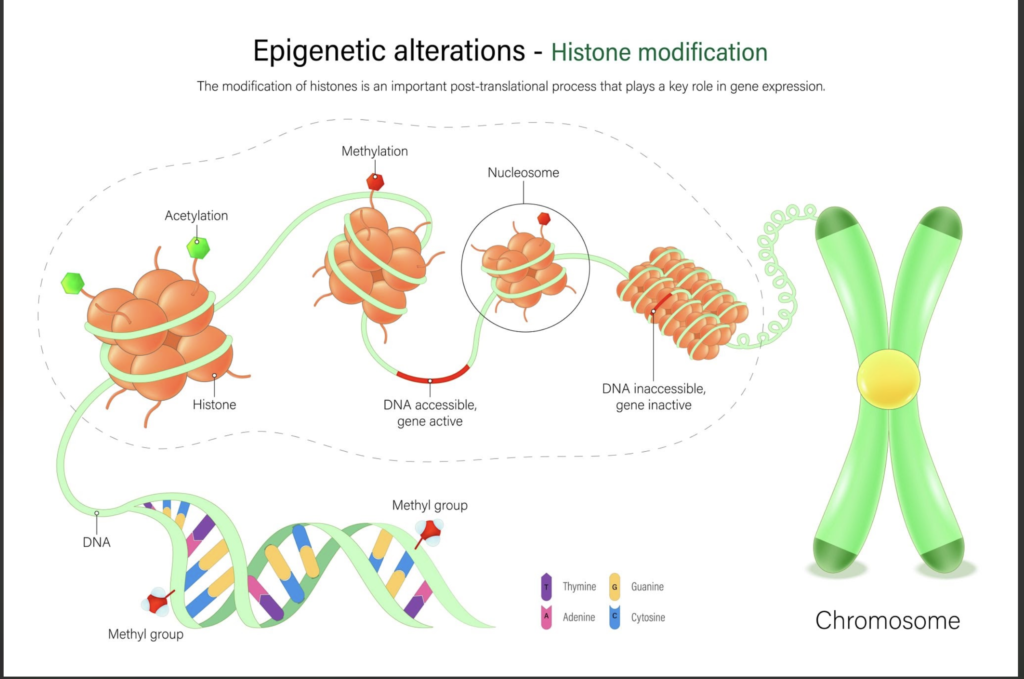
Core Epigenetic Mechanisms
- DNA Methylation: The most common mechanism. It involves adding a chemical tag (a methyl group) directly to the DNA. When this happens at gene promoters, it usually reduces or “turns off” gene transcription.
- Histone Modification: DNA is wrapped around protein spools called histones. Chemical modifications to these histones dictate how tightly the DNA is packed. Tightly packed DNA is silenced, while loosely packed DNA is active.
- Non-coding RNAs: Functional RNA molecules that do not translate into proteins. They can bind to coding RNAs to break them down, preventing protein production.
- Genomic Imprinting: An phenomenon where gene expression depends on whether the gene copy was inherited from the mother or the father. One copy is epigenetically silenced (usually via methylation) before fertilization.
- Paramutation: A rare process where the epigenetic state of one allele alters its homologous partner allele, and this newly altered state can persist across generations.
Key Findings from the Nature Genetics Study (Conducted in Mice)
This study challenges the conventional understanding that all heritable information is strictly tied to the DNA sequence (Mendelian inheritance).
- Non-Mendelian Inheritance Exists: Out of ~7,600 genomic locations with different DNA methylation patterns, about 7% showed non-Mendelian epigenetic inheritance (over 500 instances). This suggests epigenetic inheritance is much more widespread than previously thought.
- Sex-Specific Epigenetics: In over 300 areas of the mouse genome, methylation patterns depended on the animal’s sex (e.g., females showed significantly higher liver tissue methylation than males).
- Paramutation Discoveries: Researchers identified naturally occurring intergenerational paramutation at the Capn11 gene (involved in male fertility) and two highly likely cases involving intracisternal A particles (IAPs)—retroviral elements that resist normal DNA “resetting” during sperm/egg formation.
- New Genes: The study uncovered at least five new genes that display genomic imprinting.
Important Caveat: Because this study was conducted on mice, the extent to which these specific generational changes apply to humans is still under active research.
Why This Matters (Implications)
- Addressing “Missing Heritability”: It helps explain heritable traits and diseases that traditional Genome-Wide Association Studies (GWAS) cannot detect, as they only look for DNA sequence changes.
- Precision Medicine: Because epigenetic changes are dynamic and reversible, they could theoretically be targeted by epigenetic therapies to restore normal gene function.
- Complex Disease Pathology: Non-Mendelian inheritance offers a framework for understanding diseases that resist traditional genetic tracking, such as certain metabolic syndromes and cancers.
- Environmental Impact: It highlights how deeply parental health, nutrition, and environmental exposures could potentially impact future generations on a biological level.
Conventional vs. Epigenetic Inheritance
| Feature | Mendelian Inheritance | Epigenetic Inheritance |
| Basis of Inheritance | Transmission of DNA sequence variants (alleles). | Transmission of gene-regulating marks; DNA sequence remains unchanged. |
| Gene Expression | Dictated by the inherited DNA sequence. | Dictated by marks that switch existing genes on or off. |
| Stability | Highly stable across generations. | Dynamic, environmentally influenced, and reversible. |
| Reproductive Resetting | DNA sequence is permanently transmitted via sperm/eggs. | Most epigenetic marks are normally “erased” and reset during sperm/egg formation (though some escape this). |