The Strategic Pivot in India–Africa Relations
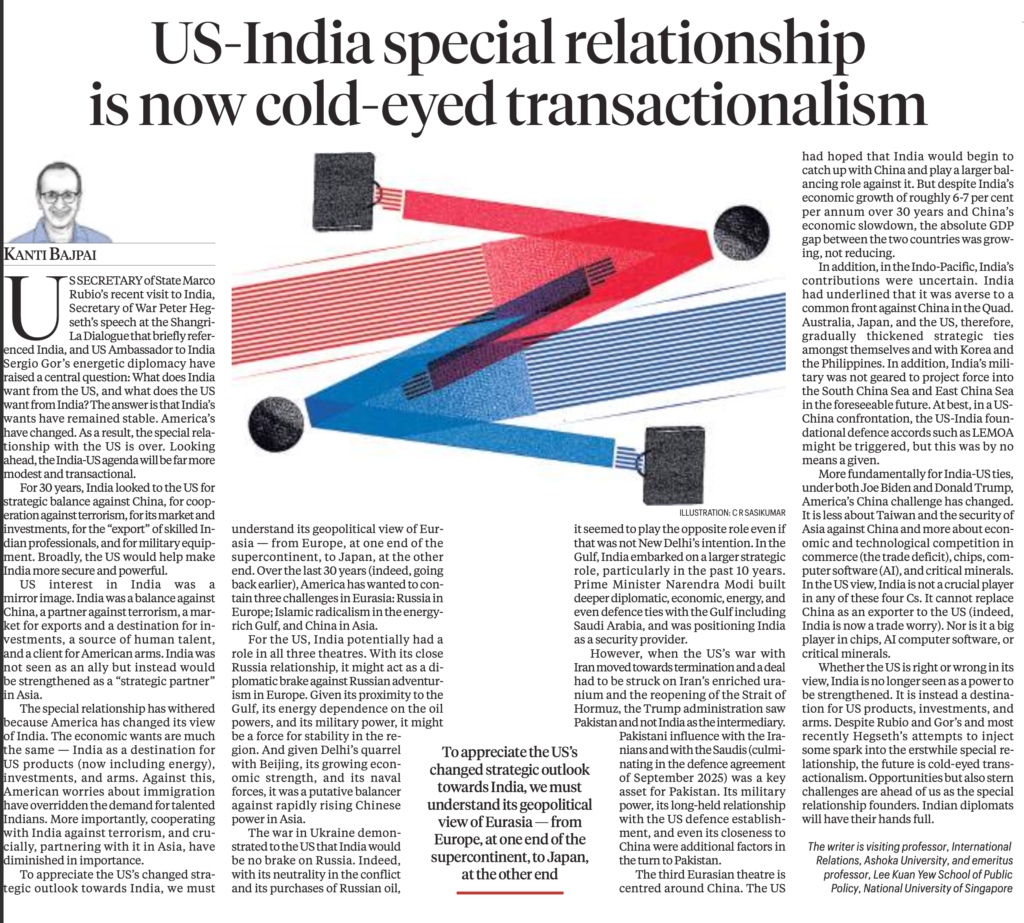
In June 2026, India and South Africa significantly upgraded their 31-year-old bilateral science and technology framework. Moving beyond traditional, research-oriented cooperation, the partnership has shifted toward industrial co-production.
Key areas of focus now include:
- Frontier Technologies: Artificial Intelligence (AI), Digital Public Infrastructure (DPI), Quantum Computing, and Genomics.
- Economic Strategy: A transition from credit-led development (Lines of Credit) to deep economic integration, focusing on supply-chain resilience and leveraging the African Continental Free Trade Area (AfCFTA).
- Security & Geopolitics: Strengthening the “Global South” voice in international forums, enhanced maritime security via the SAGAR doctrine, and providing a transparent, sustainable alternative to “debt-trap” diplomacy.
- Localized Engagement: Innovative “paradiplomacy,” exemplified by the Telangana–South Africa framework, which bridges India’s regional industrial strengths (pharma, IT, aerospace) directly with South African market needs.
Despite this progress, structural hurdles—such as bureaucratic delays in project execution, intense competition from state-backed foreign models, and regional political instability—remain significant challenges for New Delhi.
UPSC Prelims Practice Question
Q: With reference to India’s evolving engagement with Africa, consider the following statements:
- The recent India–South Africa S&T agreement marks a shift from purely academic research to industrial co-production.
- India is increasingly focusing on continent-wide Free Trade Agreements (FTAs) to replace regional bloc-level engagements in Africa.
- The “Kampala Principles” are associated with India’s approach to transparent and sustainable developmental partnership in Africa.
Which of the statements given above are correct?
A) 1 and 2 only
B) 2 and 3 only
C) 1 and 3 only
D) 1, 2, and 3
Correct Answer: C
(Explanation: Statement 2 is incorrect because India has shifted its strategy to prioritize regional blocs like SACU over continent-wide FTAs to enhance implementation efficiency.)
UPSC Mains Practice Question
Q: “The transition from credit-led assistance to industrial co-production marks a paradigm shift in India-Africa relations.” In light of this statement, examine the strategic significance of the recent India–South Africa technology partnership and suggest measures to overcome structural bottlenecks in India’s African outreach.
(Suggested Structure: 250 words)
- Introduction: Define the shift—from historical, aid-based ties to a modern, technology-driven, and commercially integrated partnership.
- Strategic Significance:
- Technology-first approach: Mentions of AI, DPI, and biotech.
- Geopolitical alignment: Strengthening the Global South and providing a “debt-free” alternative to existing models.
- Economic integration: Leveraging AfCFTA and the regionalization of trade.
- Structural Bottlenecks:
- Bureaucratic delays in Lines of Credit (LoC).
- Competitive asymmetry (vs. China’s state-backed model).
- Regional political volatility affecting long-term investment.
- Way Forward:
- Institutionalizing regular summits (IAFS-IV).
- Streamlining state-level “paradiplomacy” within the Union List framework.
- Exporting India’s “Digital Stack” to promote financial inclusion.
- Conclusion: Summarize how this pivot ensures shared prosperity and creates a stable, multipolar order.
Mains
Q. India-Africa digital partnership is achieving mutual respect, co-development and long-term institutional partnerships. Elaborate. (2025)
Q. ‘The long-sustained image of India as a leader of the oppressed and marginalised nations has disappeared on account of its new found role in the emerging global order.’ Elaborate. (2019)
India’s Climate Leadership & Market Mechanisms
India’s presentation at the WTO emphasizes a dual-track strategy: fulfilling international climate commitments while building robust domestic market mechanisms to incentivize a low-carbon transition.
Key Achievements (Surpassing 2030 NDC Targets)
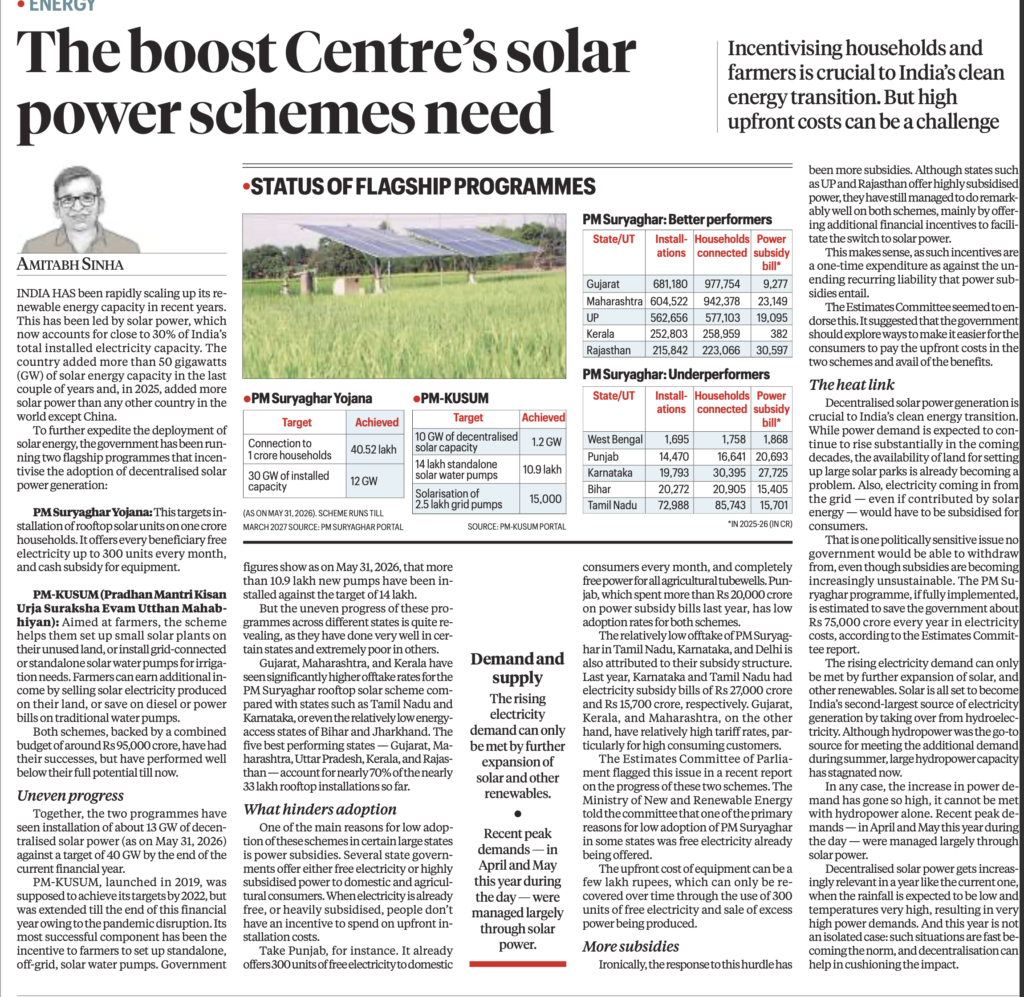
- Energy Mix: Non-fossil fuel-based capacity reached 53.21% by March 2026, exceeding the 50% target ahead of schedule.
- Emissions Intensity: Achieved a 37.38% reduction (2005–2022), surpassing the 33–35% target.
The Indian Carbon Market (ICM) Framework
Established under the Energy Conservation (Amendment) Act, 2022 (notified in 2023), the Carbon Credit Trading Scheme (CCTS) follows a ‘Cap and Trade’ model:
- Mechanism: Entities are assigned emission reduction targets. Those performing better generate Carbon Credit Certificates (CCCs)—where 1 CCC = 1 tonne of CO₂ equivalent.
- Institutional Framework:
- Administrator: Bureau of Energy Efficiency (BEE).
- Regulator: Central Electricity Regulatory Commission (CERC).
- Registry: Grid Controller of India Limited.
- Objective: To transition from voluntary efforts to a mandatory, transparent, and scalable market-based mechanism for emissions reduction.
UPSC Prelims Practice Question
Q: Consider the following statements regarding India’s Carbon Credit Trading Scheme (CCTS):
- It is a market-based mechanism that operates on a ‘Cap and Trade’ model.
- The Central Electricity Regulatory Commission (CERC) functions as the administrator of the scheme, responsible for setting emission targets.
- The Carbon Credit Certificates (CCCs) generated under this scheme are issued by the Grid Controller of India Limited.
Which of the statements given above are correct?
A) 1 and 2 only
B) 2 and 3 only
C) 1 and 3 only
D) 1, 2, and 3
Correct Answer: C
(Explanation: The Bureau of Energy Efficiency (BEE) acts as the administrator, not the CERC. The CERC regulates the trading platform, and the Grid Controller of India Limited serves as the registry.)
UPSC Mains Practice Question
Q: “Market-based mechanisms are essential for India to transition to a low-carbon economy while maintaining industrial competitiveness.” Discuss the significance of the Carbon Credit Trading Scheme (CCTS) in achieving India’s Nationally Determined Contributions (NDCs) and the challenges in its effective implementation.
(Suggested Structure: 250 words)
- Introduction: Contextualize the CCTS within India’s climate commitments and its goal of balancing “growth” with “green.”
- Significance of CCTS:
- Efficiency: Promotes cost-effective emission reductions via the ‘Cap and Trade’ model.
- Standardization: Creates a uniform price for carbon, encouraging private sector innovation.
- Global Alignment: Positions India as a responsible stakeholder in global climate finance and WTO-led environmental discussions.
- Challenges:
- Data Integrity: Difficulty in accurate Monitoring, Reporting, and Verification (MRV) across diverse industrial sectors.
- Market Maturity: Ensuring liquidity and preventing price volatility in early stages.
- Interoperability: Aligning domestic credits with international standards (e.g., Article 6 of the Paris Agreement).
- Way Forward: Strengthening institutional capacity, phased roll-out across sectors, and incentivizing technology transfer.
- Conclusion: Emphasize that CCTS, supported by the principles of CBDR-RC, is a critical step in India’s Net Zero journey.
India’s Flex-Fuel Strategy
Drawing inspiration from Brazil’s successful flex-fuel model, the Indian government has positioned E85 as a key tool for energy security, rural prosperity, and decarbonization.
- Rollout Plan: Initially available at 48 Public Sector OMC retail outlets, with aggressive expansion targets: 500 stations by end-2026 and 5,000 stations by end-2027.
- Targeted Use: Exclusively for Flex-Fuel Vehicles (FFVs) capable of handling ethanol blends from E20 to E100. It is not for conventional petrol vehicles.
- Economic Strategy: Priced approximately ₹20/litre lower than E20 to compensate for ethanol’s lower energy density and incentivize adoption.
- Long-term Goal: To raise aggregate ethanol blending levels to 26% by 2030-31.
UPSC Prelims Practice Question
Q: With reference to E85 fuel and India’s flex-fuel roadmap, consider the following statements:
- E85 fuel can be used in all BS-VI compliant vehicles to reduce carbon emissions.
- The Indian Carbon Market (ICM) and the E85 rollout are complementary pillars of India’s strategy to meet its 2030 Nationally Determined Contributions (NDCs).
- Flex-fuel vehicles are designed to operate on varying ethanol-petrol blends, ranging from E20 to E100.
Which of the statements given above are correct?
A) 1 and 2 only
B) 2 and 3 only
C) 1 and 3 only
D) 1, 2, and 3
Correct Answer: B
(Explanation: Statement 1 is incorrect because E85 is exclusively for specially designed Flex-Fuel Vehicles (FFVs), not for all BS-VI vehicles.)
UPSC Mains Practice Question
Q: “The transition to a flex-fuel ecosystem is not just a fuel policy, but a strategic imperative for India’s energy independence and rural economy.” In this context, discuss the benefits of E85 adoption and the structural challenges that must be addressed for its large-scale success.
(Suggested Structure: 250 words)
- Introduction: Briefly define E85 and its role in India’s broader biofuel roadmap and the “Atmanirbhar Bharat” vision.
- Strategic Benefits:
- Energy Security: Reducing dependence on imported crude oil and saving foreign exchange.
- Economic Impact: Creating a circular economy by providing farmers with a sustainable income stream from ethanol feedstocks.
- Environmental Impact: Highlighting the ~61% reduction in lifecycle greenhouse gas emissions and near-zero particulate matter (PM).
- Technological: Utilizing higher RON (Octane) values for better engine performance.
- Challenges to Implementation:
- Supply-side constraints: The potential impact of large-scale sugarcane/grain production on water resources and food security.
- Consumer Adoption: The “energy density” issue (lower mileage of ethanol) and the limited number of currently available FFV models.
- Infrastructure: The need for rapid scaling of storage and dispensing networks across diverse geographical corridors.
- Way Forward: Emphasize the need for favourable taxation (GST on FFVs), robust consumer awareness, and the development of second-generation (2G) ethanol to minimize the land-use conflict.
- Conclusion: Summarize how a balanced “Energy Trilemma” (availability, affordability, sustainability) approach can make this transition a success.
Jan Samarth Portal completes 4 years
The Jan Samarth Portal recently marked its 4th anniversary on June 6, 2026. Launched by the Prime Minister in 2022, it has established itself as India’s primary unified digital gateway for accessing credit-linked government schemes.
Key Milestones (As of June 2026)
- Operational Scale: The portal now hosts 16 credit-linked schemes spanning 8 core sectors, including agriculture, business activity, education, and housing.
- Performance Metrics: By June 1, 2026, the platform had processed approximately 54.10 lakh loan applications.
- Financial Impact: These applications involved credit requests exceeding ₹3 lakh crore, with financial institutions having digitally approved nearly 49.55 lakh applications amounting to over ₹2.76 lakh crore.
- Institutional Reach: There are currently 269 lending institutions integrated into the platform, comprising Public Sector Banks, private banks, NBFCs, regional rural banks, and small finance banks.
Core Objectives & Features
The portal was conceptualized to bridge the gap between borrowers and lenders by simplifying the loan application process through technology. Key features include:
- Single-Window Access: Instead of navigating multiple ministry websites, users can check eligibility and apply for various schemes in one place.
- Intelligent Eligibility Matching: The system uses a rule-based engine to match an applicant’s profile with the most suitable government scheme.
- End-to-End Integration: The platform pulls data from various government sources (Aadhaar, PAN, GST, Udyam, etc.) to auto-verify information and reduce manual documentation.
- Accessibility: To ensure inclusivity, the portal is available in 8 languages (English, Hindi, Bengali, Marathi, Gujarati, Telugu, Tamil, and Kannada) and features an “Assisted Mode” where Bank Business Correspondents (BCs) can facilitate applications for those with lower digital literacy.
- Digital Approval: The platform facilitates automated digital in-principle sanctions, with applications routed directly to the chosen bank branch.
By integrating into India’s Digital Public Infrastructure (DPI) ecosystem—alongside platforms like the Account Aggregator framework and the Universal Lending Interface (ULI)—Jan Samarth continues to play a vital role in formalizing credit access for MSMEs, entrepreneurs, students, and farmers across Tier-2 and Tier-3 towns.
7th Regional Meteorological Centre (RMC) in Jammu
On June 5, 2026, Union Minister Dr. Jitendra Singh inaugurated India’s 7th Regional Meteorological Centre (RMC) in Jammu.
Key Highlights of the New RMC
- Operational Scope: The Jammu facility will serve as the hub for Jammu & Kashmir, Ladakh, and Himachal Pradesh.
- Specialized Services: It is designed to provide mountain-specific weather services, which are critical for a region characterized by diverse terrain—from plains to high-altitude mountains. Key services include:
- District-level forecasts.
- Mountain weather and tourist-specific advisories.
- Early warnings for flash floods, cloudbursts, avalanches, heavy snowfall, thunderstorms, and landslides.
- Strategic Importance: The centre aims to bolster disaster management and early-warning systems, benefiting local farmers, transport operators, security forces, and pilgrims undertaking the Amarnath and Vaishno Devi yatras.
- Infrastructure Expansion: The launch is part of a broader strengthening of meteorological infrastructure in the region. Since 2014, the number of Doppler Weather Radars in J&K and Ladakh has increased from zero to four (Jammu, Srinagar, Leh, and Banihal Top), with five more proposed under Mission Mausam.
- Future Network: With this inauguration, the India Meteorological Department (IMD) has expanded its regional network. Furthermore, the Union Minister announced that an 8th RMC will soon be established in Lucknow to cater specifically to Uttar Pradesh and Uttarakhand.
Prior to this development, the IMD operated through six Regional Meteorological Centres located in New Delhi, Mumbai, Chennai, Nagpur, Kolkata, and Guwahati.
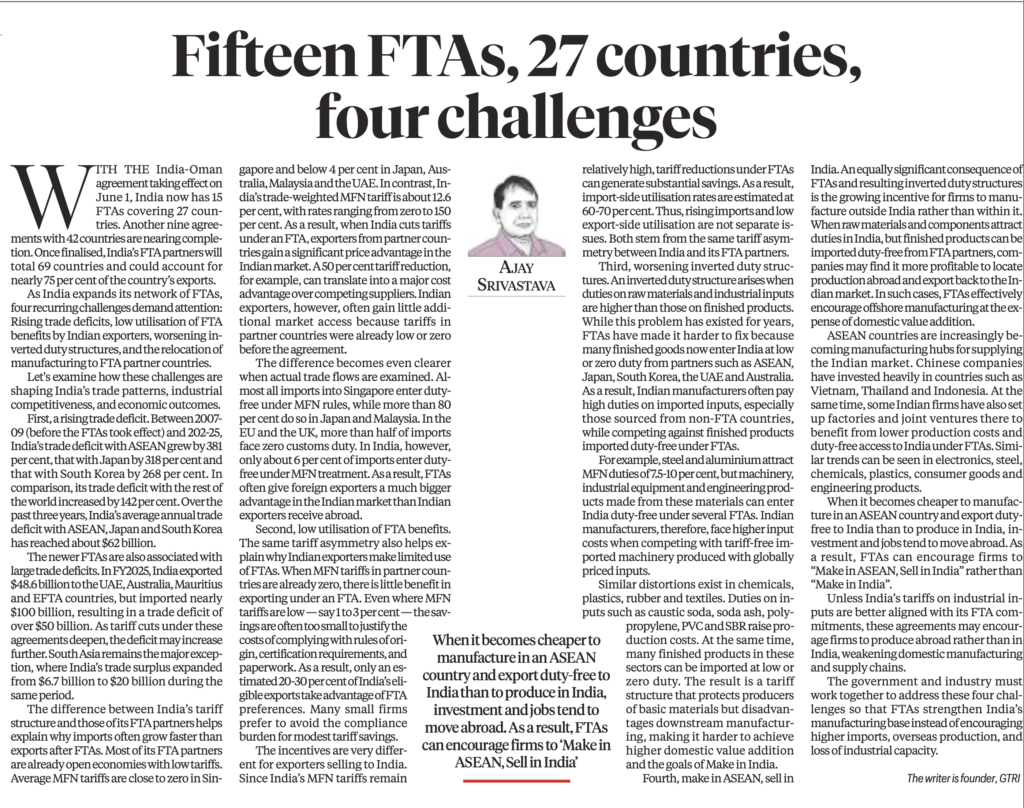
US Proposes 12.5% Tariff on India Over Forced Labour Issue
The United States Trade Representative (USTR) recently announced a proposal to impose additional tariffs on imports from 60 economies following an investigation under Section 301 of the US Trade Act of 1974. This action stems from findings that these nations have not adequately prohibited or enforced regulations against the importation of goods produced using “forced labour.”
Key Details of the Proposal
- Tariff Tiers: The USTR has proposed two tiers of additional duties:
- 12.5% Tariff: Applies to 54 economies, including India, China, Japan, Brazil, South Korea, and Switzerland, deemed to have failed to impose and effectively enforce a prohibition on forced-labour-linked imports.
- 10% Tariff: Applies to 6 economies—Canada, Ecuador, the European Union, Indonesia, Mexico, and Pakistan—which were found to have some existing prohibitions but inadequate enforcement mechanisms.
- Context: The investigation, self-initiated on March 11–12, 2026, is seen by trade experts as a strategic effort by the U.S. administration to establish a durable legal basis for tariffs following the Supreme Court’s earlier rejection of broader emergency tariffs.
- Status: The measures are currently proposals and have not been finalized. The USTR has invited stakeholders to submit written comments until July 6, 2026, with public hearings scheduled for July 7, 2026.
Impact on India
- Bilateral Negotiations: The proposal comes amid ongoing negotiations for an interim India-US bilateral trade agreement (BTA). Indian officials, including Union Minister Piyush Goyal, have stated that India remains engaged with the U.S. on these proceedings, emphasizing that such issues should be resolved through bilateral dialogue rather than unilateral trade actions.
- Strategic Response: Trade experts, such as those from the Global Trade Research Initiative (GTRI), have suggested that India should challenge the legal basis of the investigation, arguing that it exceeds the traditional scope of Section 301 and unfairly generalizes forced labour concerns across entire economies rather than targeting specific products or regions.
- Exemptions: The proposal includes numerous product-specific exemptions—such as for certain pharmaceuticals, chemicals, and agricultural goods—and excludes products already subject to existing U.S. sectoral tariffs (e.g., steel, aluminum, and autos).
The development is being closely monitored, as it could influence the final terms of the India-US trade deal and affect labour-intensive export sectors like textiles, leather, and carpets if the tariffs are implemented after the current temporary measures expire on July 24, 2026.
Editorials