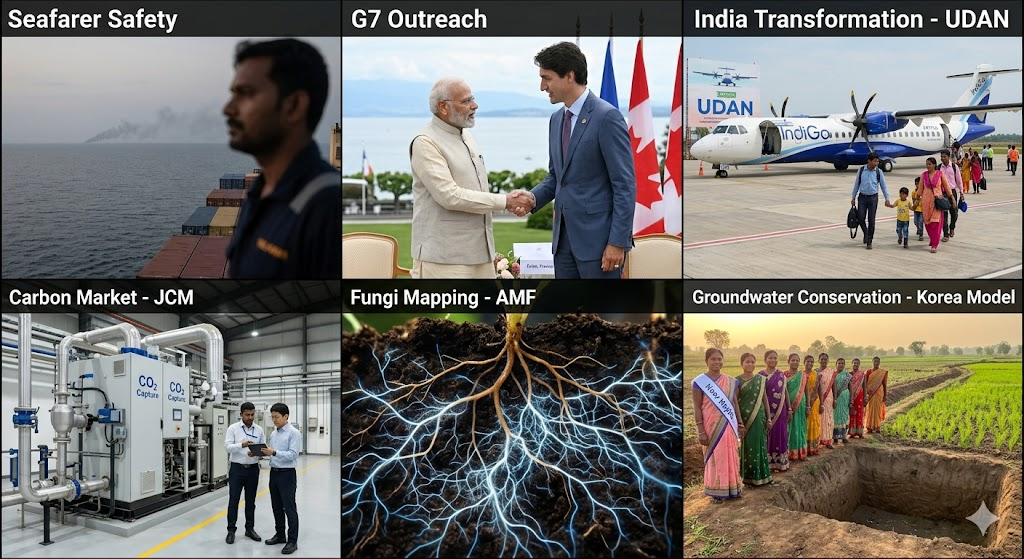
Context: The death of three Indian seafarers aboard MT Settebello following a US military strike in the Gulf of Oman has highlighted global maritime security threats.
Core Issues Affecting Seafarer Safety
Asymmetric Maritime Warfare: Transition from traditional piracy to military-grade precision munitions, drone strikes, and loitering munitions by sovereign militaries and non-state actors (e.g., Houthis).
Geopolitical Crossfire: Civilian merchant ships carrying highly combustible cargo are targeted to enforce geopolitical blockades (e.g., US naval blockade on Iranian ports).
Sanctions-Related Vulnerabilities: Vessels accused of violating international sanctions lose Protection and Indemnity (P&I) insurance cover and port access, increasing operational risks.
Lack of Hard Enforcement: International frameworks like UNCLOS (freedom of navigation) and the Maritime Labour Convention (MLC) lack enforcement mechanisms against missile/drone strikes.
Sanctioned Vessels: Definition & Mechanics
Definition: Ships blacklisted or restricted under economic, trade, or security laws globally by the UN Security Council (UNSC) or unilaterally by regional blocs (US, UK, EU).
Triggers: Ownership by blacklisted entities, links to transnational terrorism, or transporting prohibited cargo (weapons, illicit oil). It includes deceptive practices like disabling Automatic Identification Systems (AIS) and ship-to-ship transfers.
India’s Stance: Unilateral sanctions apply only within the imposing nation’s jurisdiction. A vessel blacklisted unilaterally by the US is not automatically illegal under Indian law, as India exclusively recognizes UN-mandated global sanctions.
Strategic Significance for India
Demographic Footprint: India has over 300,000 trained seafarers (2025), accounting for ~12% of the global seafaring workforce (ranked 3rd globally). India aims for a 20% global share by 2030 under Maritime India Vision 2030.
Flags of Convenience (FoC): Most Indian seafarers work on foreign-registered ships (Panama, Liberia, Palau), which complicates legal jurisdiction and direct state intervention when attacked.
Economic Security: Over 90% of India’s trade by volume and 70% by value moves through maritime routes. Threats spike War Risk Surcharges on maritime insurance, inflating energy import costs.
Legal and Institutional Frameworks
Global: * UNCLOS, 1982: Guarantees freedom of navigation and transit passage.
MLC, 2006 (ILO): “Seafarers’ Bill of Rights” mandating decent working conditions and repatriation rights.
STCW, 1978: Establishes global minimum qualification standards for seafaring personnel.
SOLAS, 1974 (IMO): Sets safety standards for merchant ship construction and operation.
SAR, 1979: Coordinates international maritime search and rescue.
Indian:
Merchant Shipping Act, 1958: Governs Indian-registered vessels and employment conditions.
Directorate General of Shipping (DGS): Apex regulatory authority under the Ministry of Ports, Shipping and Waterways.
Information Fusion Centre – Indian Ocean Region (IFC-IOR): Located in Gurugram; acts as the nerve center for real-time Maritime Domain Awareness (MDA).
India at the 52nd G7 Summit (2026)
Context: India attended the 52nd G7 Summit Outreach Session in Évian, France under the theme “Forging New Partnerships and Rebuilding International Solidarity.”
India’s Core Messages
Addressing Global Trust Deficit: Highlighted that global crises stem from a shortage of mutual trust rather than a shortage of resources.
Reforming the Development Paradigm: Called for an evolution from the traditional donor-recipient model to equal partnerships.
Global South Advocacy: Emphasized that developing nations seek equitable participation in global governance, not just financial assistance.
Major Bilateral Outcomes
India–Canada:
Target to conclude the Comprehensive Economic Partnership Agreement (CEPA) by the end of 2026 to double two-way trade by 2030.
Launched negotiations for a General Security of Information Agreement (GSOIA) for defence/intelligence sharing.
Established “Raisina Americas”, a new track-1.5 geopolitical platform.
Advanced the Security Energy Partnership via a CAD $2.6 billion commercial agreement between Cameco and India’s Department of Atomic Energy for uranium supply (2027–2035).
India backed Canada’s bid to become a Dialogue Partner of the Indian Ocean Rim Association (IORA).
India–United Kingdom: Reviewed the India-UK Vision 2035 framework and reaffirmed commitment to the early implementation of the Comprehensive Economic and Trade Agreement (CETA).
India–UAE: Called for free and unimpeded navigation through the Strait of Hormuz. India formally invited the UAE to the 18th BRICS Summit to be hosted by India later in 2026.
Key Facts About the G7
Evolution: Formed in 1975 (as G6) following the 1973 oil crisis. Canada joined in 1976. Russia joined in 1998 (G8) but was expelled in 2014 after the annexation of Crimea.
Status: Informal bloc with no permanent secretariat, treaty, or formal headquarters. The presidency rotates annually.
Economic Weight: Represents ~10% of the global population but accounts for ~43% of global nominal GDP.
A Decade of Inclusive Transformation (Poverty Alleviation)
Trend: Multidimensional poverty in India declined from 29.17% (2013–14) to 11.28% (2022–23), moving nearly 25 crore people out of poverty.
Universal Access to Basic Needs
Water & Sanitation: * Jal Jeevan Mission: Rural tap water coverage expanded from 3.23 crore homes (2019) to 15.84 crore by May 2026 (82% coverage).
Swachh Bharat Abhiyan: Achieved 100% initial rural sanitation coverage by 2019 (12.11 crore toilets); over 5 lakh villages are now certified ODF Plus (Model).
Energy & Housing:
Pradhan Mantri Ujjwala Yojana: Delivered over 10.57 crore free LPG connections to BPL households.
SAUBHAGYA: 100% village electrification achieved by 2025; average daily rural supply rose from 12.5 hours (2014) to 22.6 hours (2025).
PMAY: Completed 98.10 lakh houses under PMAY-Urban and 3.03 crore houses under PMAY-Gramin, primarily registered in women’s names.
Connectivity:PM Gram Sadak Yojana connected 99.6% of eligible habitations with all-weather roads.
Public Health, Food Security & Education
Ayushman Bharat: Issued 43.93 crore health cards providing ₹5 lakh annual health cover per family. The Ayushman Bharat Digital Mission linked 97.81 crore health records via 88.33 crore unique ABHA accounts.
Maternal Health: Maternal Mortality Ratio (MMR) declined from 130 per 100,000 live births (2014–16) to 88 (2021–23).
PMGKAY: Digitized foodgrain distribution for over 81 crore beneficiaries, automating 99.8% of Fair Price Shops for transparent delivery.
Education Indicators: Female primary school dropout rates fell from 4.6% (2013-14) to 0.3% (2024-25). Female secondary school enrollment rose to 80.2% under Beti Bachao Beti Padhao.
Economic Empowerment & Employment
DAY-NRLM: Self-Help Group (SHG) membership grew from 2.37 crore to 10 crore women by May 2026. The “Lakhpati Didi” initiative turned 3.07 crore rural women into entrepreneurs.
Financial Inclusion:PM Jan Dhan Yojana reached 58.16 crore beneficiaries. PM MUDRA Yojana disbursed 66% of its loans to women entrepreneurs.
Labor Formalization:eShram portal registered 31.64 crore unorganized workers. MGNREGA generated over 3,036 crore person-days of work since 2014.
Digital Infrastructure:BharatNet linked 2.19 lakh Gram Panchayats with high-speed broadband; UPI routinely processes over 2,100 crore monthly transactions.
Tribal Development Interventions
PM-JANMAN Mission: Directly services 75 Particularly Vulnerable Tribal Groups (PVTGs) with housing, water, and mobile medical units.
Eklavya Model Residential Schools (EMRS): Operational schools expanded from 129 to 499, enrolling 1.54 lakh ST students.
Van Dhan Vikas Kendras: 1,146 centers sanctioned to commercialize minor forest produce for tribal entrepreneurship.
Brain-Eating Amoeba Surge in Kerala
Context: Kerala reported a sharp rise in Amoebic Meningoencephalitis cases in early 2026.
[Infection Pathway: Contaminated Water]
                     │
                     ▼
         [Enters through the Nose]
                     │
                     ▼
      [Travels via Olfactory Nerve]
                     │
                     ▼
       [Fatal Brain Inflammation]
Key Scientific and Epidemiological Facts
Pathogens: Includes Primary Amoebic Meningoencephalitis (PAM) caused by Naegleria fowleri (brain-eating amoeba) and Granulomatous Amoebic Encephalitis (GAE) caused by Acanthamoeba.
Epidemiological Shift: GAE caused by Acanthamoeba (found in water, soil, and dust) has now become the dominant type over PAM in the recent outbreak.
Environmental Drivers: Proliferation is fueled by warm tropical climates, poor water quality, and high coliform bacterial contamination. Acanthamoeba feeds on bacteria like E. coli. High population densities with septic/toilet pits close to open wells exacerbate open water pollution.
Transmission & Symptoms: Occurs strictly when contaminated water enters through the nose (e.g., during swimming). It is not transmitted person-to-person or by drinking water. Symptoms include fever, headache, nausea, progressing rapidly to seizures, hallucinations, coma, and death.
Policy Response: Kerala became the first Indian state to establish a specialized clinical treatment protocol and SOP for managing Amoebic Meningoencephalitis to mitigate its high mortality rate.
Integrated Infrastructure Development
1. Mobility & Connectivity Ecosystem
Railways:
Budgetary support rose from ₹32,000 crore (2014–15) to ₹2.78 lakh crore (FY 2026–27).
Network electrification achieved 99.6% completion (69,873 km) by 2026.
Operationalized 162 Vande Bharat services and 60 Amrit Bharat trains.
Modernizing 1,338 stations under the Amrit Bharat Station Scheme.
Deployed the Kavach Automatic Train Protection System across 3,103 km, helping reduce accidents from 135 (2014–15) to 16 (2025–26).
Setup 139 operational cargo terminals under PM GatiShakti.
Roads and Highways:
Total network expanded to 63.73 lakh km (2nd largest globally). National Highways increased from 91,287 km (2014) to 1,46,572 km (March 2026).
High-capacity roads ($\ge$ 4 lanes) grew from 18,371 km to 45,516 km; 3,644 km of access-controlled expressways are operational.
Bharatmala Pariyojana: Completed 22,590 km of highway infrastructure.
Civil Aviation:
Operational airports increased from 74 (2014) to 165 (2026).
Deployed Digi Yatra (contactless travel) and GAGAN (Satellite-Based Augmentation System).
Metro & Urban Transit:
India holds the 3rd largest metro network globally, expanding from 248 km (2014) to 1,155 km (2026) across 26 cities.
Key projects include Kolkata’s underwater metro tunnel (2024), Kochi’s Water Metro Project, and the Namo Bharat Rapid Rail (Delhi–Meerut RRTS).
Ports & Inland Waterways:
Maritime transport handles 95% of trade by volume and 70% by value. Major port capacity grew from 873 MMTPA (2014) to 1,726 MMTPA (2026). Vessel turnaround times dropped from 94 to 48.8 hours.
National Waterways increased from 5 to 111 (20,187 km). Cargo movement rose from 29 MMT to 218 MMT.
Operationalized India’s first hydrogen fuel cell vessel in Varanasi (2025).
2. Industrial & Logistics Planning
Industrial Smart Infrastructure: Mapped 4,220 industrial parks (6.98 lakh hectares) via the GIS-based India Industrial Land Bank (IILB). Developed 272 plug-and-play parks, with 100 more planned under the BHAVYA scheme (2026). Approved 20 Industrial Smart Cities across 7 major corridors.
PM GatiShakti National Master Plan (2021): Integrates infrastructure planning across 58 Ministries utilizing over 3,202 GIS data layers.
National Logistics Policy (2022): Advanced India’s World Bank Logistics Performance Index ranking from 54 to 38 (Target: Top 25 by 2030).
Logistics Tech Integration: Unified Logistics Interface Platform (ULIP) for data integration; Logistics Data Bank for EXIM container tracking; FASTag for electronic toll collection.
PRAGATI Platform (2015): Monitored 382 major infrastructure projects and resolved 2,958 systemic bottleneck issues.
3. Water, Energy & Housing Security
Water Resources: Reorganized under the unified Ministry of Jal Shakti (2019). Extended the Jal Jeevan Mission to 2028 to achieve complete universal tap water coverage (currently at 15.86 crore households, 81.94%). Implementing the Ken–Betwa Link Project (India’s first river interlinking project). Deployed real-time forecasting via the FloodWatch India App and structured governance via the Dam Safety Act, 2021.
Urban/Rural Housing:SWAMIH Fund (₹15,531 crore corpus) completed 63,000 stalled housing units. AMRUT & AMRUT 2.0 delivered 2.53 crore urban tap connections across urban zones.
Power & Clean Energy:
Installed power capacity reached 532.74 GW by March 2026 (up from 248 GW in 2014).
Reached COP21 target of 40% non-fossil fuel electricity capacity nearly a decade early. India ranks 3rd in clean energy capacity and 4th in wind energy globally.
Power deficits dropped from 4.2% (2014) to 0.03% (2026).
National LPG coverage reached 107.2% in 2026 (from 55.9% in 2014) supported by biometric de-duplication.
Co-launched the Global Biofuels Alliance (2026) alongside the International Solar Alliance (ISA).
India-Japan Joint Crediting Mechanism (JCM)
Context: The Ministry of Environment, Forest and Climate Change (MoEFCC) adopted the Rules of Implementation for the Joint Crediting Mechanism (JCM) with Japan.
Key Conceptual Framework
Article 6.2 Alignment: Operates under Article 6.2 of the Paris Agreement, which allows bilateral cooperation via Internally Transferred Mitigation Outcomes (ITMOs).
Mechanism: Carbon credits generated from verified greenhouse gas reduction and carbon removal projects in India will be shared between both nations to meet their respective Nationally Determined Contributions (NDCs).
Environmental Integrity: Rules mandate rigid third-party validation and verification (V&V) tied to synchronized national registries to strictly avoid the double counting of emissions reductions.
Economic Benefit: Secures international climate finance and viability gap funding for deep-decarbonization technologies in heavy industries, renewable energy, and energy efficiency sectors, advancing India’s Net Zero 2070 target.
Global Mapping of Arbuscular Mycorrhizal Fungi (AMF)
Context: A breakthrough study published in Science used machine learning and 16,000 soil cores to globally map underground arbuscular mycorrhizal (AM) fungi networks for the first time.
Scientific Characteristics of AM Fungi
Taxonomy & Symbiosis: Belongs to the phylum Glomeromycota. They form symbiotic associations with the roots of 70–90% of all land plant species.
Evolutionary Context: Known as “living fossils” and “ancient asexuals.” They have co-existed since the earliest land plants without any observed sexual reproduction stage.
Structural Blueprint: Fine, branching underground threads (hyphae) spanning an estimated 110 quadrillion kilometers globally. They function as bidirectional conduits transferring carbon from plants to soil, and vital nutrients (phosphorus, nitrogen) from soil to plants.
Carbon Sink: AM networks store ~300 million tonnes of carbon globally and sequester approximately 4 billion tonnes of $CO_2$-equivalent annually.
Biofertilizers: Enhance plant water absorption, boost crop yield, optimize soil nutrient cycling, and provide dynamic plant pathogen resistance.
Geographical Hotspots: 40% of global AM networks are concentrated within grasslands, notably South Sudan, the Tibetan Plateau, and India’s Banni grasslands (Gujarat).
Conservation Threat: Industrialized agricultural cropland ecosystems show a 50% decrease in fungal density compared to undisturbed wild ecosystems. Rapid grassland conversion highlights the need to integrate soil microbiome mapping into global conservation policies.
Chhattisgarh’s “Korea 5% Model”
Context: Korea district in Chhattisgarh scaled an innovative community-led groundwater conservation framework to fight severe seasonal water scarcity.
Core Mechanics of the Model
The 5% Rule: Encourages local farmers to voluntarily dedicate exactly 5% of their private agricultural holdings for the construction of specialized soak pits, accelerating rainwater percolation, in-situ soil moisture retention, and rapid local water table recharge.
Scale of Deployment: Expanded from 2,000 to 30,000 soak pits within a single year through community-led action (Jal Sanchay Jan Bhagidari).
The 30–40 Model: A parallel, structural watershed intervention where 30 ft $\times$ 40 ft contour trenches are excavated across degraded, barren common lands to trap surface water runoff.
Institutional Execution: Funded via MGNREGS—locally operationalized as the Viksit Bharat–Guarantee for Rozgar and Ajeevika Mission (Gramin).
Social Innovation: Managed by local women leadership networks called “Neer Nayikas” for household water conservation awareness, and youth groups called “Jal Doots” for micro-watershed mapping and community desilting drives.
Tangible Ecological Impact: Central Ground Water Board (CGWB) tracking verified that regional post-monsoon groundwater levels improved from 6.6 meters Below Ground Level (BGL) in 2024 to 3.89 meters BGL in 2025. This stabilized the local implementation of the Jal Jeevan Mission, which had stalled due to dry source aquifers.